• Thursday 24 August - Friday 25 August 2023

Membrane Transport 2023: Recent Research into Ion Channels, Transporters and Epithelial Physiology

Click here to view other past events
  • Date

    Thu 24 - Fri 25 Aug 2023

  • Location

    University of St Andrews, UK

This meeting will explore the latest research in epithelial transport physiology and the role of ion channels and transporters in health and disease, as well as showcasing various emerging techniques in the field of membrane transport. Alongside the invited lectures, there will be the opportunity for early career researchers to present their work as an oral or poster communication to an international audience and ample time to catch up with colleagues and establish new connections. 

Membrane Transport 2023 is supported by Nanion, Mund Scientific Instruments, Fisher Scientific, Sarstedt and Harvard Biosciences

Dr Morag Mansley

University of St Andrews, UK

Professor Mike Althaus

Bonn-Rhein-Sieg University of Applied Sciences, Germany

Dr Stephen Keely

Royal College of Surgeons in Ireland, Dublin, Ireland
09:30 SA01 The role of TRPV4 in electrolyte and fluid secretion by choroid plexus epithelia: Implications for hydrocephalus

Professor Bonnie Blazer-Yost, Indiana University, Purdue University of Indianapolis, USA 

10:15 SA02 Nutraceutical targeting of Farnesoid X Receptor for regulation of CFTR expression in the colonic epithelium

Dr Jessica Smyth, Royal College of Surgeons in Ireland

10:30 C01 Succinate enhances mucociliary clearance in the murine tracheal epithelium by triggering acetylcholine release from chemosensory cells

Dr Alexander Perniss, Harvard Medical School, US

11:15 SA03 Aldosterone‐independent ENaC activity: A paradigm shift for renal salt homeostasis

Professor Christoph Korbmacher, Friedrich-Alexander-University Erlangen-Nuremberg, Germany

12:00 C02 Purinergic P2Y2 receptors are coupled to calcium-dependent mucus and fluid secretion in the human colonic stem cell niche

Dr Victoria Jones, University of East Anglia, UK

12:15 C03 Multiplatform analysis of kidney tubule-specific mechanisms during low dietary potassium intake

Dr Adrienne Assmus, Aarhus University, Denmark

13:30 SA04 Structural insights into the trimeric assembly of epithelial sodium channels

Dr Isabelle Baconguis, Oregon Health and Science University, US

14:15 C04 Conserved hydrophobic interactions play a critical role in inhibiting the epithelial sodium channel (ENaC) by α- and γ-inhibitory peptides

Dr Florian Sure, University of Erlangen-Nuremberg, Germany

14:30 C05 N-linked glycosylation contributes to the absence of protease-sensitivity in epithelial sodium channels containing the δ-subunit

Rene Lawong, Bonn-Rhein-Sieg University of Applied Sciences, Germany

15:15 SA05 CFTR structure and function: Insight from chimeric channels

Professor David Sheppard, University of Bristol, UK

16:00 SA06 Structural insights into the dynamics of bacterial mechanosensitive channels

Benjamin Lane, University of Leeds, UK

16:15 C06 Structural insight to human urea transporter function and implications for medicines

Dr Gamma Chi, University of Oxford, UK

09:30 SA07 Ion channel engineering

Dr Stephanie Heusser, University of Copenhagen, Denmark

10:00 SA08 Using scRNAseq datasets to explore glucose transporters in airway epithelia

Professor Deborah Baines, St George’s University of London, UK

11:00 SA09 Metabolic communication in SGLT2 inhibition

Dr Markus Rinschen, Aarhus University, Denmark and University Hospital Hamburg Eppendorf, Germany

11:30 SA10 Cryptic calcium signals for intestinal membrane transport: Utility of ex vivo 3D culture systems

Dr Mark Williams, University of East Anglia, UK

12:00 SA11 Identification of novel TMEM175 modulators using high throughput automated patch clamp and solid supported membrane- (SSM-) based electrophysiology platforms

Dr Alison Obergrussberger, Nanion Technologies GmbH, Munich, Germany

13:30 SA12 The role of a newly identified Ca2+-permeable channel in cardiac dysfunction

Dr Samantha Pitt, University of St Andrews, UK

14:15 SA13 Circadian regulation and dysregulation of the thiazide-sensitive sodium chloride co-transporter (NCC)

Dr Jessica Ivy, University of Edinburgh, UK

14:30 C07 Flotillins, nicotinic acetylcholine receptors, endothelial NO synthase, and the P2X7 receptor interact to control interleukin-1b release

Dr Katrin Richter, University of Giessen, Germany

15:15 SA14 Mechanisms of disturbed fluid and bicarbonate transport in the intestine in Cystic Fibrosis and Inflammatory Bowel Disease, and potential treatment options

Professor Ursula Seidler, Medizinische Hochschule Hannover, Germany

16:00 SA15 Impaired renal bicarbonate excretion in Cystic Fibrosis: Its physiology and clinical implications

Dr Peder Berg, Aarhus University, Denmark

16:15 C08 The effect of microgravity and galactic cosmic radiation on renal structure and function

Dr Keith Siew, University College London, UK

Registration

Registration is now closed

We are pleased to offer reduced early bird rates for Undergraduate & Master’s Members and Postgraduate Members, thanks to the generous support of the School of Medicine, University of St Andrews, UK. 

Before registering please read our event terms and conditions.

Registration rates

    Membership category Early registration rate until 06 July 2023  Standard registration rate 
until 10 August 2023 
Undergraduate & Master’s Member £35.00 £80.00
Postgraduate Member £65.00 £110.00
Full Member (concessionary)*    £100.00 £145.00
Full Member £150.00 £195.00
Fellow Member £150.00 £195.00
Honorary Member £150.00 £195.00
Retired Member £100.00 £145.00
Non-Member £250.00 £300.00
ECR Non-Member* £150.00 £200.00
Society Dinner £45.00  £45.00 

*Please email events@physoc.org for the appropriate discount code.

Please note, Full Member (concessionary) refers to those who have Full Membership at the reduced rate.

The Society Dinner is now full. If you wish to be added to the waiting list, please email events@physoc.org 

Member registration

In order to register as a member, you first need to log in with username and password. The system will default to the correct fee for your membership category. 

Should you have any queries, please email events@physoc.org

Non-member registration

In order to register as a non-member you need to create a guest account. The non-member fee is the membership fee plus member registration rate. By joining as a member, you will benefit from reduced registration and other key member benefits including:

  • Free online access to The Society’s three world-class journals
  • Free or discounted registration for Society events
  • Eligibility for Society’s grant schemes

To find out more about membership with The Society, please click here or email membership@physoc.org

Applying for a visa

Do you need a visa to be able to participate in the meeting?

To check whether you need a visa to be able to attend, please click here

For more detailed information, application forms and guidance notes, please visit the official UK visa website.

It is recommended that you apply for your visa well in advance (at least 12 weeks before the meeting) as applications for UK visas in certain countries can take longer than expected. Attendees are requested that they book early enough and apply for a visa with sufficient time prior to the conference.

The conference organisers cannot be held responsible if delegates do not receive their visas in time, and the cancellation policy will automatically apply. Every effort will be made to support genuine applications.The conference organisers are happy to provide you with documentation to support your application which will be sent as a PDF attachment. If you require a hard copy to be sent to you, please include your mailing (postal) address. The Physiological Society will only send via regular post.

Documentation to support visa applications will only be provided to those attendees who have registered to attend. 

Please complete the webform below, and attach confirmation of your registration, and submitted abstract (if appropriate).

Supporting documentation will be distributed within 10 working days – it is the responsibility of the attendee to allow sufficient time for processing.

Please note that The Society are not involved with and cannot influence consular decisions.

Click here for the visa supporting documents form


Abstract submission

Abstract submission is now closed.

View the abstracts

Presentation guidelines

Oral Communications 

Oral communications are strictly limited to 10 minutes duration (and five for discussion). 

In addition, please note the following rules pertaining to oral communications: 

  • No Oral Communications shall be read either from written script, slides or PowerPoint transmissions 
  • An Oral Communication shall not occupy more than 10 minutes 

To comply with these rules, and to ensure that Communications are presented in a concise and comprehensible manner, the Scientific Programme Committee advises that: 

  • Not more than six slides or PowerPoint transmissions should normally be shown, NOT including title slide and acknowledgements. 
  • Any PowerPoint animations should be ‘basic’ 
  • Graphs should not normally contain more than three curves 
  • Tables should not normally contain more than 30 values 

All Oral Communications should be rehearsed for time, sense and audibility 

Poster Communications 

Poster dimensions for our meetings are as follows: 

  • Standard A0 (841mm x 1189 mm)
  • Portrait orientation (i.e. height longer than width) 

For full information on oral communication and poster guidelines, please click here. 

Key information

Key dates

Registration opens 03 April 2023
Abstract submission opens 03 April 2023
Abstract submission closes 30 April 2023
Abstract decisions issued 25 May 2023
Conference Attendance Award deadline 31 May 2023
Early bird registration deadline 06 July 2023
Registration deadline 10 August 2023
Meeting dates 24 – 25 August 2023

Venue

The meeting will take place in the School of Medicine, Medical Sciences Building at the University of St Andrews, UK.

School of Medicine
Medical and Biological Sciences
North Haugh
St Andrews
KY16 9TF 

Accommodation

Agnes Blackadder Hall accommodation is now sold out

Travel

The School of Medicine is around a 13 minute walk from the centre of St Andrews.  

There are a number of options for travelling to St Andrews including by air, train and bus.

By air (and onwards travel) 

St Andrews is connected to a number of international airports in Scotland: 

Edinburgh Airport 

  • Take the St Andrews Shuttle which is bookable in advance and is a taxi service ideal for groups 
  • Take a shuttle bus to Halbeath Park and Ride and transfer to the Stagecoach X24 or X59 bus to St Andrews (~2 hours) 
  • Take the tram or Airlink bus service to either Edinburgh Waverly or Haymarket station and transfer to a train to Dundee, Aberdeen or Dyce via Leuchars 

 Aberdeen Airport 

  • Take the bus to Dyce railway station and transfer to a train via Leuchars 

 Dundee Airport 

  • Take the bus to Dundee bus station and then the Stagecoach in Fife 99 service to St Andrews 

By train 

The nearest station to St Andrews is Leuchars. From Edinburgh, you will need to take a train towards Dundee or Aberdeen.  

The Edinburgh to Aberdeen line links with the LNER line from London Kings Cross to Edinburgh, which provides a direct route between London and Leuchars. The LNER line also stops at York, Darlington and Newcastle.  

The Caledonian Sleeper service also runs between London Euston and Leuchars overnight.  

Use National Rail to plan your journey. 

From Leuchars, you can take a bus (99 services) or a taxi into St Andrews. 

By taxi 

St Andrews Taxis can be booked in advance and provide cost-effective travel from airports or train stations. You book online or contact them directly here.  

By bus 

St Andrews is well connected across Scotland by bus, including: 

  • From Edinburgh – Stagecoach X58, X59 and X60 
  • From Dundee – Stagecoach 99 services 
  • From Glasgow – Stagecoach X24, X26 and X27 

Use Stagecoach to plan your journey. 

For other UK or Europe destinations, there are options with Megabus and National Express

For further details about travelling to St Andrews, please visit the university website.

Support to Attend

The grant below supports attendance at our events.

Grants for Carers

We care because you do. We are aware that many of our Members have caring responsibilities or need care. We have funds allocated to help you with care costs to facilitate your attendance at meetings.

Find out more

Conference Attendance Award

Up to £375 for the support of member engagement at our own meetings. The deadline for this meeting is 31 May 2023.

Find out more

Digital Media Kit

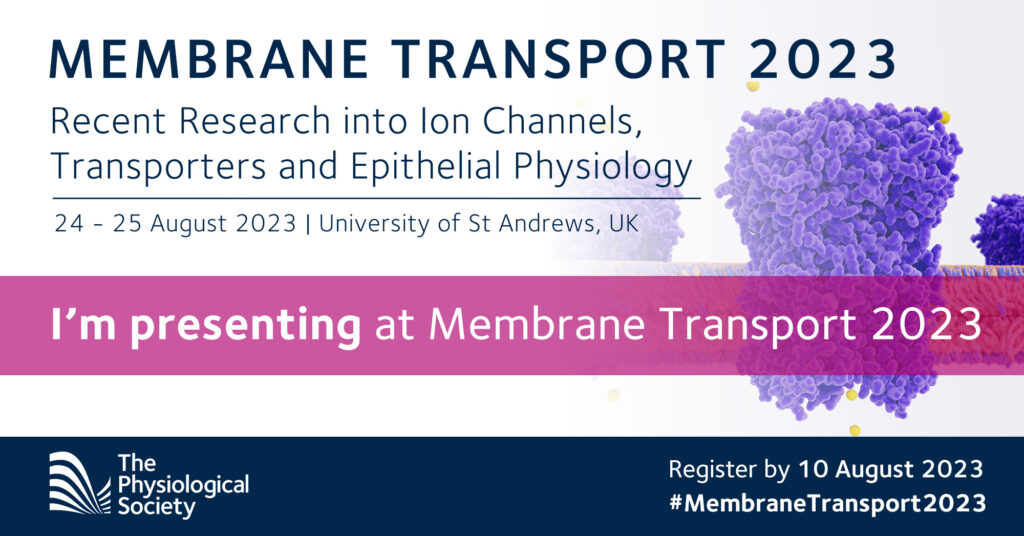
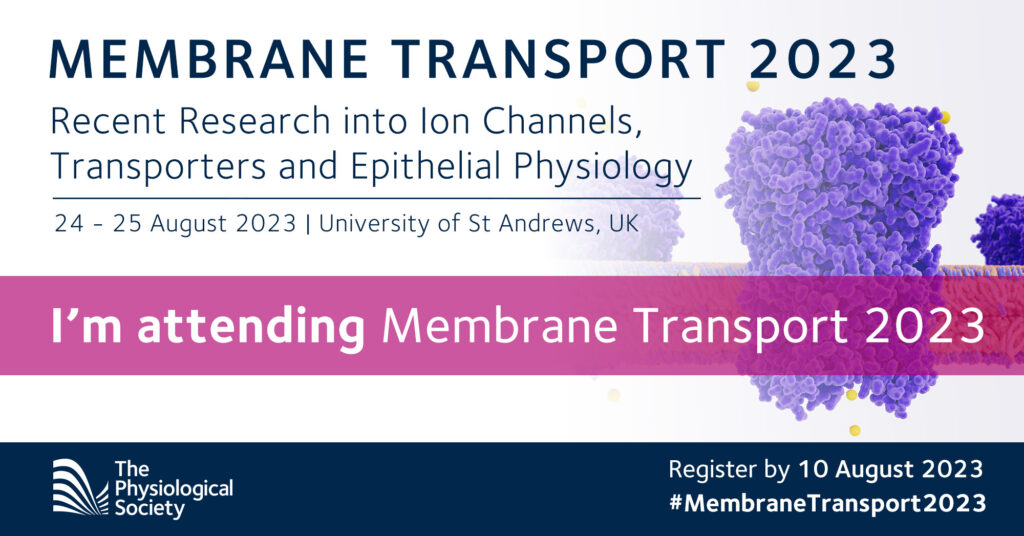
Help us promote Membrane Transport 2023 by sharing the event with your networks or on social media.

Social media

We have created social media graphics for you to share across social media, you can also find some draft social media posts in the digital pack below which you can adapt.

You can download the images below by right clicking on the image and selecting save image as.

Download digital pack

Telling colleagues and students

If you think that this conference would appeal to any colleagues or students, we would appreciate it if you forwarded the details to them.

Download Membrane Transport 2023 poster

Email

We have created an email banner for you to add to your emails to help either promote your talk or your attendance at the conference.

You can save the images below by right clicking on the banner and selecting save image as.


To update the hyperlink on your banner, please follow these instructions on Outlook.

Go to:

  1. File > Options > Mail > Signatures
  2. Hover over the graphic, select it and then click the hyperlink option (a globe icon near ‘Business Card’). You can then add the relevant URL in the address bar: physoc.org/membranetransport
  3. Click ‘OK’ and the changes will be saved. Please test the change by creating a new email and clicking on the banner.

Site search

Filter

Content Type