What do students and educators need to face the challenges of the changing landscape of higher education? We'll explore this at our two-day meeting, 'Physiology Education in a Changing Landscape' taking place on 1 - 2 April 2027 at the University of Sussex, UK. Find out more about the meeting.
  • Tuesday 14 April - Wednesday 15 April 2026

Fit for the Future: Physiology Education and Teaching in the UK

Click here to view other past events
  • Date

    Tue 14 - Wed 15 Apr 2026

  • Location

    Newcastle University, UK

This year’s meeting will provide the opportunity for educators to describe how they are incorporating and promoting physiology in broader biomedical and clinical programmes, how they engage students with physiological content, and how they are addressing the challenge of restricted finances, growing class size, and changes to academic careers.  These will be addressed in four related themes: 

Students as co-creators 

Student participation in programme design can improve engagement and enthusiasm, strengthen the student-teacher relationship, and improve understanding of the learning process from both sides.   

Bringing research culture to the undergraduate experience 

Exposure to research stimulates an inquisitive and critical approach to learning, reinforces classroom material, and teaches key graduate skills while building-in real-life experience. However, as degree-level research expands beyond the ‘wet-lab’ experience, how is the new research culture being used in physiological teaching?   

Innovations and hot topics in curriculum design 

Three years on from ChatGPT and mass accessibility to LLM, we will consider the impact on teaching and assessment. What methods have been tried and how successful are they?  What is next on the horizon? 

Education focused academics 

Larger class sizes and student numbers often mean increasing proportions of teaching in academic contracts, with a growing number dedicated to education and education support.  What does the education focused academic career look like and how is it supported across the UK?   

Joining Instructions

Be part of the Physiological Society’s legacy

In 2026, the Society celebrates its 150th anniversary: a landmark moment to celebrate physiologists past and present, the discoveries that have shaped our understanding of the body, and the community driving physiology forward.

This meeting is one of the many exciting activities in our biggest programme of events to date celebrating this important milestone.

All abstracts presented throughout the year will be published in a special 150th Anniversary Abstract Booklet, which will become part of our historical archive capturing a snapshot of physiological research in 2026.


Dr Alison Howard

Newcastle University, UK

Dr Christina Elliott

Newcastle University, UK

Dr Harley Robertson-Cocks

Newcastle University, UK

Dr Michele Sweeney

Newcastle University, UK

This meeting is supported by ADInstruments, AIBODY, Aelius Biotech and McGraw Hill.

  • AD Instruments 40th anniversary logo

Registration

Registration is now closed.

To celebrate our 150th anniversary in 2026, we have introduced a new, more inclusive membership model, including the launch of a new free category, Associate Member, to welcome qualified individuals and strengthen the future of the Society. This is alongside reduced global membership fees to make joining and staying involved more accessible for all.

Membership category  Early registration rate until 03 March 2026  Standard registration rate until 24 March 2026
Undergraduate & Master’s member £50.00 £100.00
Postgraduate member £50.00 £100.00
Full member (concessionary) * £50.00 £100.00
Full member £100.00 £150.00
Fellow member £100.00 £150.00
Honorary Fellow £100.00 £150.00
Retired member £50.00 £100.00
Associate member £150.00 £200.00
Non-member £200.00 £250.00
ECR Non-member *  £100.00 £150.00

*please email events@physoc.org for the discount code

Please note, Full Member (concessionary) refers to those who have Full Membership at the reduced rate.

Before registering, please read our event terms and conditions. 

Member registration

In order to register as a member, you first need to log in with username and password. The system will default to the correct fee for your membership category.

Should you have any queries, please email events@physoc.org

Non-member registration

In order to register as a non-member you need to create a guest account.

Non-member rates include a complimentary one-year Society membership. Non-member attendees will be contacted after the event to confirm their membership activation.

By joining as a member, you will benefit from reduced registration and other key member benefits including:

  • Free online access to The Society’s three world-class journals
  • Free or discounted registration for Society events
  • Eligibility for Society’s grant schemes

To find out more about membership with The Society, please click here or email membership@physoc.org

Applying for a visa

Do you need a visa to be able to participate in the meeting?

To check whether you need a visa to be able to attend, please click here

For more detailed information, application forms and guidance notes, please visit the official UK visa website.

It is recommended that you apply for your visa well in advance (at least 12 weeks before the meeting) as applications for UK visas in certain countries can take longer than expected. Attendees are requested that they book early enough and apply for a visa with sufficient time prior to the conference.

The conference organisers cannot be held responsible if delegates do not receive their visas in time, and the cancellation policy will automatically apply. Every effort will be made to support genuine applications. The conference organisers are happy to provide you with documentation to support your application which will be sent as a PDF attachment. If you require a hard copy to be sent to you, please include your mailing (postal) address. The Physiological Society will only send via regular post.

Documentation to support visa applications will only be provided to those attendees who have registered to attend.

Please complete the webform below, and attach confirmation of your registration, and submitted abstract (if appropriate).

Supporting documentation will be distributed within 10 working days – it is the responsibility of the attendee to allow sufficient time for processing.

Please note that The Society are not involved with and cannot influence consular decisions.

Click here for the visa supporting documents form

Abstracts


View the abstracts

Please view our presentation guidelines in preparation for the meeting and make sure to register for the conference to join the discussions, network with peers, and expand your knowledge with the latest advancements in the field.


Poster communications

Poster communications can be displayed for both days of the meeting. Please ensure your posters are affixed by 11:15 on Tuesday, 14 April and are accompanied between the applicable formal presentation time detailed below.

The poster session will take place on Tuesday 14 April from 18:00 – 20:00. Odd communication numbers are scheduled to present from 18:00 – 19:00.

Even communication numbers are scheduled to present from 19:00 – 20:00.

Workshops


The following workshops will feature as part of the programme. Delegates will have the choice of one of the two workshops held on each day, on a first come, first served basis.

Tuesday 14 April

Team-based solutions to local and global health challenges… and to challenges in student education?

Dr Alexandra Holmes, University of Leeds, UK

Due to an ever-growing range of careers available to our graduates, there is an increasing need for effective transferable skills education, and although there are more toolsets and initiatives, implementing these to create a coherent experience for students and staff can be challenging. We will give an overview of these strategies, before mapping the skills students learn in their programmes. We will discuss the pathway of skills education in the School of Biomedical Sciences at the University of Leeds, which uses project-based learning. This will lead into a discussion of how team project-based learning can be used in participants’ disciplines.

Being inclusive, not just saying inclusive 

Dr Damian Parry and Dr Christina Elliot, Newcastle University, UK

Finding a way we can make our teaching accessible to everyone in the room makes it better for all. But how?
Inclusive teaching means designing learning from the outset so that all students can participate, feel valued and succeed, not retrofitting adjustments after someone struggles.
Using Universal Design for Learning as a framework, participants work through real physiology teaching contexts including lectures, practicals, seminars and online sessions, identifying barriers and building practical solutions together.

In this workshop we will share our common experiences (successes and mistakes) and hopefully walk out of the room with new ways to achieve those elusive goals of inclusive and accessible teaching.


Wednesday 15 April

GenAI in physiology education: Benefits versus challenges

Professor Louise Robson, University of Sheffield and Dr Catriona Cunningham, University of Aberdeen, UK

In this workshop we will explore the challenges and benefits of GenAI in teaching, supporting students and assessment practices. We will discuss how physiologists feel about using GenAI in both teaching and their own daily work activities and consider the staff perspective on teaching students to use GenAI in a professional and ethical way. There will be round table discussions where participants can share best practice and ideas, and see specific examples of what others are doing. The workshop will finish with a reflection on what the future holds for GenAI in physiology education. 

Beyond mere engagement: Activating physiology students as sustainability champions

Dr Sean Roe and Dr Mary McGahon, Queen’s University Belfast, UK

In this 75 minute workshop, Drs McGahon and Roe will explore ways in which attendees can adapt their teaching in meaningful ways to encourage their students to embrace the challenges presented to us by the United Nations Sustainable Development Goals. 

The workshop will first set the scene, contextualising the educator’s role in sustainability promotion. Then attendees will be challenged to create teaching resources that will make sustainability a meaningful (and just as importantly) practically doable component of their teaching.


Key Information

Key Dates

Registration opens 06 October 2025
Abstract submission opens 27 October 2025
Abstract submission closes 09 January 2026
Early review deadline 17 December 2025
Early bird registration deadline 03 March 2026
Conference Attendance Award deadline 28 February 2026
Registration deadline 24 March 2026
Meeting dates 14 – 15 April 2026

Venue

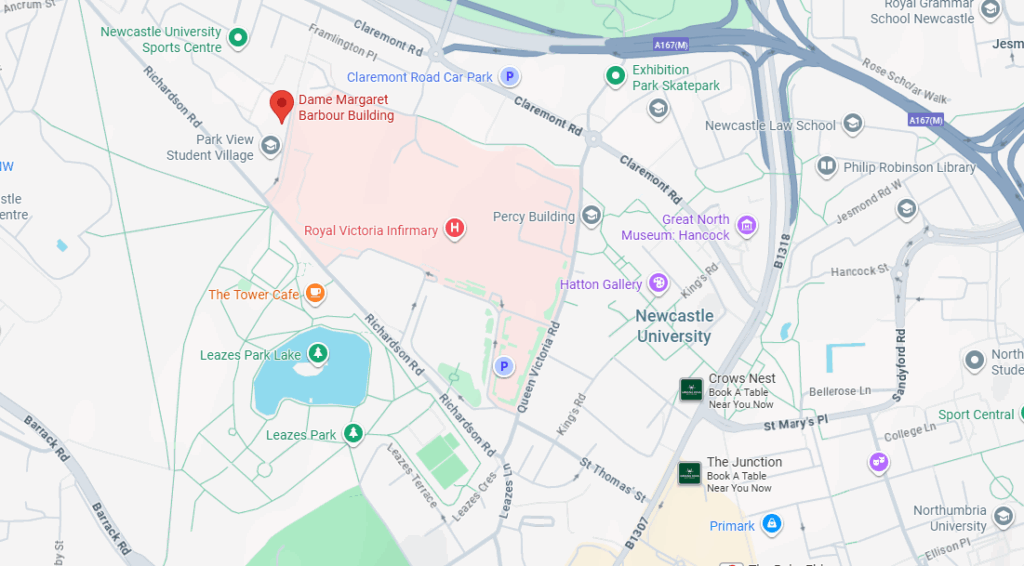
The meeting will take place in the Dame Margaret Barbour Building, Newcastle University, UK.

Dame Margaret Barbour Building
Wallace Street
Richardson Road
Newcastle Upon-Tyne
NE2 4DR

Travel

By train 

Newcastle Central Station is the main station in Newcastle and is a 25 minute walk from the venue. 
Book your tickets on the National Rail Enquiries website. 
Walking directions can be found here. 

There is a taxi rank outside the station. 

By plane

Newcastle International Airport is approximately a 15 minute taxi ride from the venue. 

The Metro also runs between the airport and the city centre. 

Accommodation

We do not have a specific conference hotel so attendees are able to choose accommodation which meets their needs and budgets. The following hotels are within walking distance of the venue:  

Sandman Signature Newcastle  

Maldron Hotel Newcastle  

Hotel Gotham Newcastle  

Travelodge Newcastle Central 


Support to Attend

The grants below support attendance at our events.

Grants for Carers

We care because you do. We are aware that many of our members have caring responsibilities or need care. We have funds allocated to help you with care costs to facilitate your attendance at meetings.

Find out more

Conference Attendance Award

Up to £375 for the support of member engagement at our own meetings. The deadline for this meeting is 28 February 2026.

Find out more

Partner With Us

Partnering with us provides you with the ideal platform to highlight your brand, products and services to our members and the broader physiology community of researchers and educators.   

In addition, attending our conferences also gives you an invaluable opportunity to network with influential scientists from around the UK, Europe and further afield.   

All external funding is used to support the scientific community by keeping event registration fees at an affordable level and to achieve the charitable aims of The Society.    

Partner Packages

Opportunities range from a standard tabletop exhibition space, to more comprehensive sponsorship packages, including advertising, session sponsorship and speaking slots at the meeting.    

To discuss your requirements in more detail and build a package that suits you, contact us today at events@physoc.org. 

Site search

Filter

Content Type