

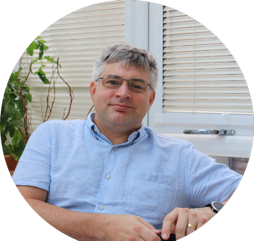
Dr Gordon Cooper
University of Sheffield
Gordon started his career in Leeds working in the laboratory of Dr Malcolm Hunter. Following a three-year spell at Yale working in Professor Walter Boron’s group, Gordon returned to work in Manchester with Craig Smith. In 2000 he moved to Sheffield, first as a Post doc in Stan White’s lab, before taking up a lectureship post in 2002. He was promoted to senior lecturer in 2014 and is currently the programme lead for Biomedical Science in the School of Bioscience. His research work was linked to epithelial and renal physiology with particular focus on the transport of gases and small solutes across membranes. In 2012 he was awarded a David Jordan Teaching Grant to develop the use of multimedia teaching resources in physiology teaching labs. In 2019 he shifted onto a teaching and scholarship focused pathway and in 2020 led a successful CATE bid which acknowledged how employability has been successfully embedded into Biomedical Science curriculum. Gordon became a member of the Society in 1996 and was elected to a Fellow in 2016. In 2016 he also obtained Senior Fellow status of the Higher Education Academy. More recently he has been pivotal in starting the Northern Biosciences Teaching Network, aiming to bring teaching focused staff together to showcase and discuss their work. His current research has two focuses. In collaboration with Liam Bagley at Manchester Metropolitan University he is developing a model for cross-institutional Capstone projects and together with academics from Sheffield School of Law he is exploring the use of alternative formats to deliver student feedback.
We spoke to Gordon as part of our voices of physiology series.
As an undergraduate student, the enthusiasm and passion of the staff for physiology and their research areas provided the inspiration to build towards a career in academia, performing novel research and hopefully inspiring future generations.
Even before becoming a full member, the Physiological Society has played an important part in my development as a scientist and teacher throughout my career. The Epithelial and Renal field in the UK was a close knit community when I started my PhD, and Society meetings provided a friendly environment to present and make lasting connections. As I moved away from lab-based research to focus on education, being a member of the Society was an asset. The award of a David Jordan Teaching Grant in 2012 provided a launching point to ease the transition from research to education.
During the last 30 years, the Society has provided a key reference point, with publications and Physiology News providing a link between the ‘ancient’ and ‘modern’ sides of the discipline. Importantly, despite its long history the Society is not a stuffy old fashioned institution, but is proactive at building and introducing changes. The prominent integration and expansion of the Education and Teaching theme within the Society has aided my development. I feel part of a vibrant group of excellent teachers, who recognise the importance of good pedagogical practice, willing to share their ideas and experiences.
Over the course of my career initially as a lab-based researcher I was particularly proud of the work I performed while in Walter Boron’s lab demonstrating that the membrane protein Aquaporin 1 is permeable to the gas carbon dioxide a finding which challenged the dogma regarding the movement of gases across biological membranes. More recently, focusing on education I have found efforts to build a regional bioscience teaching network to be a rewarding enterprise.
The last 40 years has seen major advancements in the technology, with advanced microscopy techniques, complex electrophysiology recording and cellular and molecular physiology coming together to provide a much deeper understanding of the mechanisms underpinning key physiological processes. We are obtaining a greater understanding of the minutiae, a trend that will continue. However, it will be crucial as we move into the next period of the Society’s history, that we don’t lose sight of the bigger picture and continually relate back to understand the form and function of the whole organism.
Although within my institution there has been a decline in physiology-based research, it remains the most popular subject for students on the biomedical related programmes. As we look to the future of the discipline and the Society it is reassuring we continue to enthuse the next generation of researchers and teachers who will build on our understanding and move the discipline forward.
If asked for advice by someone starting out on a longer term career in physiology, I would recommend taking the chance to experience different labs and environments to gain a broad picture of working in physiology and related disciplines. Having the chance to work in the Department of Cellular and Molecular Physiology at Yale was invaluable. Interacting on a daily basis with world leaders and emeritus professors gave a unique opportunity to widen my views and horizons, setting the scene for my future.