

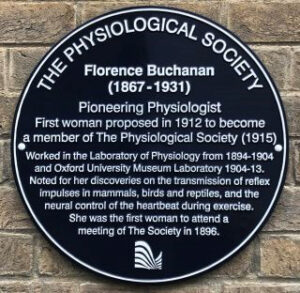
Florence Buchanan occupies a significant place in the history of physiology as both the first woman known to attend a Physiological Society meeting (in 1896) and the first woman elected as a member. Florence studied zoology at University College London, graduating in 1890 after publishing two research papers as an undergraduate.
Muscle and heart physiology research
Her early research focused on marine worms and crustaceans, including the discovery of several new species. In 1894 she moved to Oxford to work with John Burdon Sanderson in the Laboratory of Physiology. There she studied the electrical responses of muscle and began attending Physiological Society meetings. When Burdon Sanderson retired, she established her own laboratory at the Oxford University Museum of Natural History.
Florence’s later work explored heart rate variability, hibernation, exercise physiology, electrocardiography, and the transmission of reflex impulses. She contributed data to August Krogh’s studies on exercise, although she did not receive credit as an author.
The start of a new era
Despite her scientific contributions, women were not formally welcomed into the Physiological Society. Florence attended meetings for 16 years before John Scott Haldane proposed her for membership in 1912. She received strong support from leading scientists, including William Osler and Charles Sherrington, but her nomination was blocked before reaching a ballot. Haldane then proposed a formal change to the rules, leading to a postal vote in June 1914.
The vote resulted in clear support for admitting women on equal terms: 94 votes in favour, 36 for Associate Membership, and 31 for no change. On 3 July 1915, Florence became the first woman elected to the Physiological Society, heading a group of six pioneering women.
She received a DSc from UCL in 1902 and an American research prize in 1910. Florence died in 1931 and is buried in Wolvercote Cemetery beside Burdon Sanderson. Today, her legacy is marked by a Physiological Society blue plaque at Oxford’s Department of Physiology, Anatomy and Genetics.
Historical inequities
Brian Clark from Ohio University discusses the life and scientific contributions of Florence Buchanan. Watch the EPicks video for a summary of his review published in Experimental Physiology.
References
Ashcroft F (2022). Florence Buchanan: A true pioneer https://doi.org/10.36866/pn.127.46
Women in physiology. Available at: https://www.physoc.org/about-us/history-archives/historicalhighlights/women-in-physiology/ (Accessed January 2026)