
By Dr Francesca Arrigoni
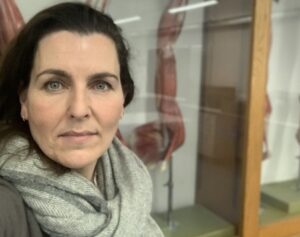
Dr Francesca Arrigoni is an Associate Professor in pharmacology and physiology. Her career spans molecular physiology, immunology, and translational pharmacology, with a strong focus on sex differences in health and disease. Francesca’s research examines the biological and social determinants of hypertension, the cardiovascular impacts of menopause, and the role of inflammation and cytokine signalling in chronic disease. She has also worked extensively on sex‑specific cardiovascular risk, integrating laboratory approaches with clinical and public‑health perspectives.
Alongside her scientific work, Francesca has a growing interdisciplinary practice; in 2025 she was awarded an MA in Illustration, strengthening her research at the intersection of biomedical science, visual communication, and public engagement. This dual expertise informs collaborations with archives, museums, and arts organisations to create innovative forms of scientific storytelling.
Francesca is a Senior Fellow of the Higher Education Academy (SFHEA) and the Staff and Educational Development Association (SFSEDA), recognised for her leadership in innovative curriculum design and research‑led teaching.
Dr Francesca Arrigoni was a 2023 Education and Teaching Award recipient. We followed up with Francesca to find out more about her project and the outcomes.
Promoting transdisciplinary creative thinking skills to improve accessibility of physiology and STEM teaching
My aim with this project was to demonstrate the impact of embedding a transdisciplinary approach to teaching physiology within a preparatory year of the pharmacy curriculum, and in doing so, generate evidence of its influence on students’ creative and critical thinking. In this approach, art and physiology were treated as equally integral components, with the deliberate engagement in both offering students new perspectives and a deeper understanding of the subject matter at hand. It also allowed me to begin exploring the importance of art to science.
How did receiving the Education and Teaching Award support you in this work?
The grant enabled the acquisition of essential equipment for the students and invested in necessary hardware to support my digital research infrastructure, facilitating a robust environment for my research activities. This included the production of videos for the students and the podcasts. The nice thing is that this equipment is still used and a vast majority of my own research uses it, going forwards.
What were the outcomes/impact of your project?
The project generated clear observational and empirical outcomes. Students showed sustained engagement throughout, producing artworks and reflective notebooks, later exhibited in the Kingston University Townhouse, in partnership with the Hunterian Museum (Transforming Lives, Easter 2024). As their drawing skills developed, they deepened their understanding of the anatomical and physiological structures they depicted and began to interrogate the provenance of the materials used. This made learning more active and memorable, strengthening comprehension through close observation and building transferable skills; critical thinking, communication, adaptability and creativity, through the integration of creative practice with disciplinary content.
Interviews and observation showed that this transdisciplinary approach reduced barriers between students, and between students and staff, creating a more inclusive environment. The most significant outcome was the marked improvement in progression rates from the Preparatory Year into the MPharm programme, alongside examination performance. These findings demonstrated that embedding creative, cross‑disciplinary practice enhanced learning and supported student success at programme scale.
In parallel, for the exhibition, as part of the exploration of art and science as interconnected mechanisms for understanding, I created a series of five short podcasts entitled ‘What’s Art Got to Do with It?‘ that have now reached over 6 thousand listens globally over 50 countries. These conversations investigate how artistic and scientific practice has shaped the careers, thinking and perspectives of both successful artists and scientists.
Has this influenced the scope and trajectory of your research?
The work with the Hunterian Museum continues to evolve, and each year the workshops are refined to reflect the changing needs and experiences of the student cohort. Iterative improvements, shaped by observation and feedback have allowed the sessions to remain engaging, relevant, and pedagogically robust. This ongoing development ensures that students encounter both historical material and contemporary scientific context in ways that deepen understanding and sustain curiosity.
Personally though, as a result of this project, I undertook an MA in Illustration to understand the impact of art itself on science and scientific thinking, which led me to examine the history of science communication, and particularly the role of scientific illustration. This line of inquiry resulted in the award of the Physiological Society’s Paton Prize for research, exploring the impact of the illustrations in Hooke’s Micrographia on a seventeenth century culture that was often sceptical, and at times openly hostile, towards emerging scientific practices.
What did you learn from undertaking this project?
The rabbit hole that this project has led me down has helped consolidate my thinking around the value of integrating art within science education, reinforcing the principles now captured in the acronym ‘STEAM’, [Science, Technology, Engineering, Art and Maths]. The research has deepened my understanding of the philosophy of science and of natural philosophy as conceived by at the inception of the Royal Society in the 1660s. Their approach at that time emphasised collaborative observation of the natural world, the things hiding in plain sight, and through the Micrographia, encouraged participation from those without mathematical training or specialised equipment. Hooke’s influence declined in the eighteenth century as more mathematically driven, Newtonian modes of inquiry came to dominate, and his empirical, collaborative methodology was marginalised. Yet the principles at the heart of Hooke’s practice, shared observation, inclusivity, and the value of looking closely are now re-emerging within contemporary STEAM approaches. In many ways, his method is experiencing a quiet renaissance.
The evidence from my work aligns closely with three major European STEAM initiatives, STEAM Inc, RoadSTEAMer and SENSE, recently completed that each show how creativity and scientific inquiry are mutually reinforcing rather than competing domains.
Altogether, the evidence across countries and contexts, in addition to my own work demonstrate that there is a steady movement to embed these principles within mainstream science education.
It shows a consistent pattern: shared observation, collaborative exploration and careful attention to detail deepen understanding and build confidence. These approaches lower barriers, widen participation and deliver measurable gains in progression and attainment. Creative practice connects disciplines in ways traditional methods often overlook, strengthening critical thinking and adaptability.
Taken together, the findings present a coherent case that STEAM enhances learning, fosters curiosity and develops the broader skills needed for future scientific practice.
Do you have any advice or recommendations for potential future applicants?
Choose a project you are genuinely passionate about. You never know where it will lead. In science education, if ideas have legs, when you run with them, the work is stronger, more sustainable, and far more enjoyable.
Focus on a clear problem, a rigorous method and evidence that shows measurable impact. Strong applications demonstrate how an intervention improves understanding, skills or progression, supported by data and well observed practice.
Keep the scientific context in view. Situate your work within current discussions in pedagogy, disciplinary development or sector needs; reviewers value projects that speak to wider challenges in learning and teaching.
Finally, be concise and reflective. Show what you learned, what you refined and why it matters.
f.arrigoni@kingston.ac.uk, franscienceart