

Professor Louise Burke awarded the Joan Mott Prize Lecture Celebrating Women Physiologists
Sports nutrition research can address the specific demands of elite athletes seeking to break world records and win gold medals, while also benefiting recreational athletes and improving community health. “Navigating the path from molecules to medals is challenging, requiring an array of research skill sets and knowledge,” attests Professor Louise Burke (Australian Catholic University, Australia), whose career includes aiding the Australian Olympic teams as the team sports dietitian for six Summer Olympic Games from 1996-2012, and 2021.
Louise presented her Prize Lecture today on sports nutrition research, exploring its benefits for elite performance to the community, at our nutritional physiology meeting, ‘Dietary Manipulations for Health and in the Prevention and Management of Disease 2026’ at Manchester Metropolitan University (MMU), UK.
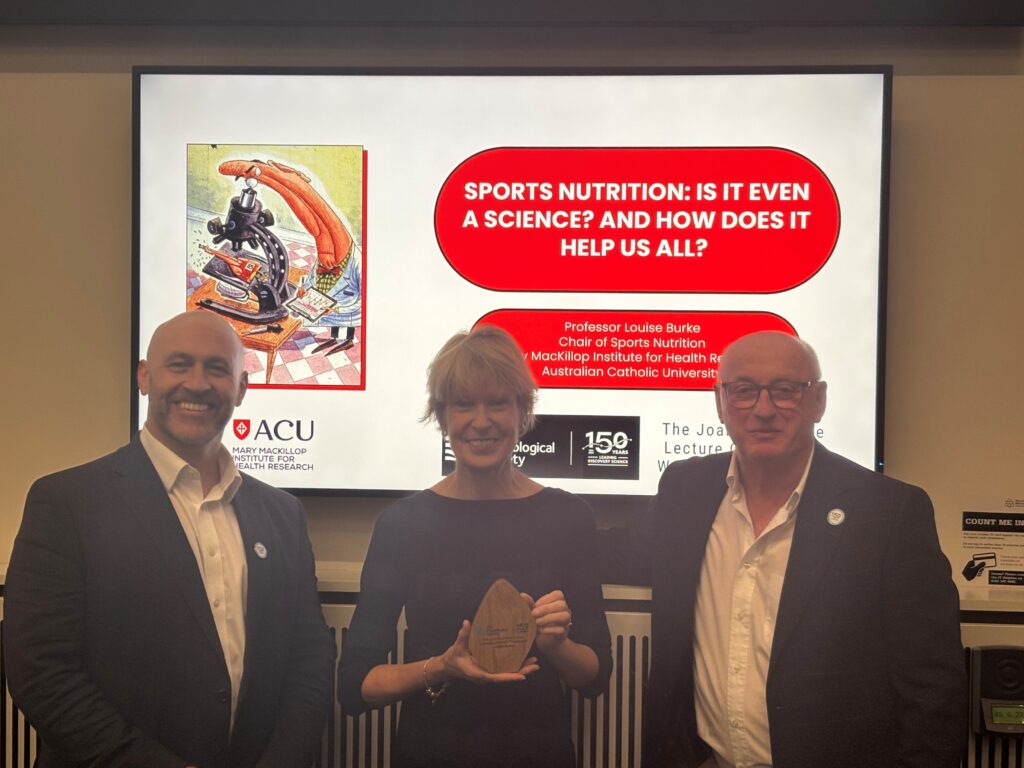
Louise is the 2026 recipient of the Society’s Joan Mott Prize Lecture Celebrating Women Physiologists, the annual lecture that celebrates women in physiology whose work has demonstrated impact. She was introduced to the stage by Professor Craig Sale (MMU), Editor-in-Chief of the Society’s The Journal of Nutritional Physiology.
Louise’s Prize Lecture ‘Sports Nutrition: Is it even a science? And how does it help us all?’ explained and defended the science underpinning sports nutrition. She wanted to address the criticisms levelled at sports science by the British Medical Journal (BMJ) during the London 2012 Olympic Games. Much of the critique focused on sports nutrition themes and products. One feature article published in the BMJ, listed a range of flaws in the conduct and interpretation of the underpinning research related to sports drinks, while other articles applied to sports science research more largely. The main criticisms included small sample sizes, poor surrogate measures of performance, poor standardisation of moderating factors and the bias of industry funding. The BMJ‘s central message was that sports science was of poor quality and lacked generalisability.
“Having spent forty years undertaking sports performance research, I feel able to respond with the insight that was missing in this critique,” says Louise. She explained that poor quality publications have contributed to a lack of respect and understanding of sports nutrition, as has sadly been the case for other areas of science.
Louise outlined the unique issues of the investigation and implementation of sports nutrition science. Discussing extreme energy and fuel demands, optimisation of training adaptations, performance supplements, special models of working with elite athletes, and the neglect of key populations including female athletes.
The Society’s President, Professor Mike Tipton, thanked Louise and presented her with the Joan Mott Prize Lecture award.
Coming soon ‘Nutrition strategies and athletic triumphs’ – we interviewed Professor Louise Burke for Physiology News magazine Spring Edition. The article celebrates Louise’s 45 years educating and counselling elite athletes on nutrition, and will publish this April.