

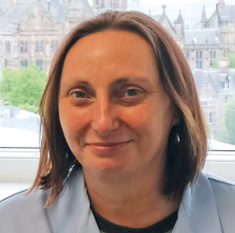
By Marie Bowers
Marie Bowers is Technician in Charge of the Physiology Teaching Lab at the University of Glasgow. She started academic life with a BSc in Biochemistry before working in commercial and academic research on a range of physiological and pharmacological models, which provided exposure to research skills and enthusiastic scientists with hard won expertise. These experiences now inform her student-facing role in the physiology teaching lab and in developing and delivering outreach and public engagement projects.
We spoke to Marie as part of our 150 voices of physiology series, about her career, her hopes for the future of physiology and her work with the Society.
For the majority of my working life, I have been the only Romany in the lab, or at the conference, or at the outreach event. However, that can and should change to include members from our diverse communities of Romany and Travellers in physiology research and teaching. We have been here far longer than the Physiological Society has been in existence, ever since Henry VIII misidentified us as “Egyptians.” Fortunately, things have improved a little, and with the support and encouragement from members of the Society and the wider community of physiologists, we will continue to welcome everyone and strengthen science through our diversity, whether that be socio-economic, job, family, place of work or other protected characteristics.
“Squiggly” career paths, sorry Dr Liam Bagley (Manchester Metropolitan University), I’ve stolen that phrase from you, are common and to be honest the Society has supported the squiggliest part of mine. My Society membership has persuaded me that even I can attempt to affect social change.
This journey began in 2021 with the award of an Outreach Grant from the Society, which seeded my project “Science Travels”: using physiology as a bridge to improved access to STEMM for Gypsy, Traveller, Roma, Showman and Boater (GTRSB) Communities. Thanks to Professor Charlotte Haigh (University of Leeds) and Dr Lucy Green (University of Southampton) who sat on the panel with Eleanor Newton. The project aims to engage GTRSB communities in physiology and STEMM more widely and educate our undergraduates and institutions about the communities and the health, education and societal inequalities they face.
Dr Iain Rowe (now retired) helped me secure that first funding. I mention him because, for me, he is an example of what the Society is: people willing to identify opportunities, to share information and to support the efforts of colleagues even when their ideas sound a little ‘out there’. Professor Craig Daly (University of Glasgow) provided musical accompaniment for talks I have delivered, to help me overcome my nerves and to bust the myth that Romany people are all great singers. Never has ‘The drugs don’t work’ by the Verve been so very badly sung. But the song gave the presentation an ‘in’ with a lay audience in a pub with the Glasgow Skeptics, where I used its lines as slide headers. ‘All this talk of getting old’ titled the population pyramid slide: Gypsy, Roma and Traveller people do not tend to reach old age as often as the majority population in Scotland, England, Wales or Northern Ireland. The song allowed me to broach those health outcomes in a non-threatening way. Iain and Craig’s support offered something a wavering voice needs: a safe space to test an idea aloud (and off key), without penalty for imperfection. This approach was further road tested at the BIG STEM Communicators Network event at the Royal Institution in 2024 with positive feedback and open discussion.
My project has travelled further than I ever thought it could. The Society welcomed “Science Travels” to Westminster (2022) to celebrate the launch of its report on the economic contribution of physiology teaching – a document that locates the discipline’s public value in the courses I support at the bench. We took our biosensors, kindly gifted by ADInstruments, to take the pulse of parliament with the support of University of Glasgow staff, Dr Katherine Price and Dr Louise McCallum from Life Sciences and Nursing. In addition, the project was exhibited at Holyrood, as part of the Society’s Scotland at the Heart of Meeting Global Challenges event, after which “Science Travels” was discussed by name in the Scottish Parliament’s debate on International Women and Girls in Science Day 2023. When Professor Christopher Torrens (Royal College of Surgeons in Ireland) and Professor Derek Scott (University of Aberdeen) invited me to speak at the Society’s Annual Conference in 2023 in Harrogate, at a symposium on diversifying physiology teaching, my voice carried. One invitation led to others: the inaugural equality, diversity and inclusion conference of the Royal College of Surgeons in Ireland, and further afield too. In an unexpected turn of events, I now find myself identifying as a Romany woman, a teaching technician and a Doctoral candidate at the University of Aberdeen.
As I’ve said, the Physiological Society is a community, and one which I feel comfortable in and this isn’t because of the patronage of a few sympathetic members. The Society’s Tom Addison and Caitlin Hawkins and Professor Raheela Khan (University of Nottingham) have all provided me with opportunities to speak, grow and develop; opportunities I don’t believe I would have been offered elsewhere. All of which have widened my network, broadened my outlook and challenged my ideas and understanding.
So, what about the future of physiology and the next 150 years of the Society itself? I can only answer through the lens of inclusion: it is what I’ve felt as a member and that’s something that I have not always felt elsewhere. There is work to be done; decolonisation of research and teaching, co-creation of research with underrepresented groups, and true recognition of the diversity of the physiology workforce. The Physiological Society provides the space and the motivation to attempt this work. The Society helped me find my voice; my hope now is that it helps others to find theirs.