

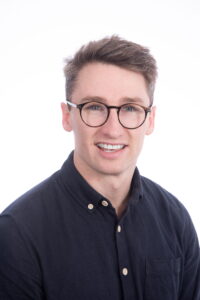
By Dr Harry Smith
Dr Harry Smith graduated from the University of Bath with an MSci in Sports and Exercise Science with a professional placement in 2018. He stayed on to undertake a PhD under the supervision of Professor James Betts between 2018-2022 investigating Nutrient Timing, Metabolism, and Health in Humans focusing on how daily rhythms in the skeletal muscle transcriptome respond to differing daily feeding patterns. Following this he worked with Professor Sarah Berry in a joint industry and academic role at ZOE Ltd and Kings College London working in the field of personalised nutrition. Now as a Postdoctoral Research Fellow his current work explores the crosstalk between adipose tissue inflammation and the regulation of skeletal muscle mass during ageing.
Harry was a 2026 Poster Winner at our Dietary Manipulations for Health and in the Prevention and Management of Disease conference. We spoke to Harry as part of our 150 voices series.
How did you first get involved with The Physiological Society?
My first Physiological Society event was the Biomedical Basis of Elite Performance meeting in Nottingham in 2016, when I was an undergraduate student. It was an opportunity to hear from established researchers and practitioners discussing how physiological principles can be applied in the context of elite performance. The meeting gave me an early appreciation of the breadth of physiology research and the value of bringing together people from different areas of the discipline.
What impact has being part of the Society had on your career?
Being part of the Physiological Society has helped me build connections with researchers working across a range of physiological disciplines and career stages. The Society’s meetings have provided opportunities to learn about new methodologies, discuss ideas, and gain feedback on my own research. As an early career researcher, these opportunities have been particularly valuable in broadening my perspective and helping me develop professionally.
Tell us about the meeting you won your poster presentation at?
I was fortunate to receive the poster presentation award at the Dietary Manipulations for Health and in the Prevention and Management of Disease 2026 meeting, held at Manchester Metropolitan University.
The meeting brought together researchers interested in the interactions between diet, health, and physiology. Across the two days there was a wide range of presentations covering both fundamental and applied research, highlighting how physiological approaches can help us better understand the role of nutrition in health and disease. It was an enjoyable meeting to attend and provided a good opportunity to discuss ideas with researchers working in related areas.
What was a highlight of the meeting that you’d like to reflect on?
In addition to the brilliant programme of scientific presentations, a particular highlight for me was the panel discussion focused on career development and support for early career researchers. Hearing established researchers reflect on their own career journeys, the challenges they had faced, and how we might best support ECRs moving forward was insightful as an ECR myself. It is really reassuring that this is something that the society is so clearly keen to support and reinforced the value of meetings like this in bringing together researchers at different career stages to share experiences and advice.
Where do you hope to see the field, and the Society, 50 years from now?
It is difficult to predict exactly where the field will be in 50 years given the pace of scientific and technological change, especially if we look at the last 10-15 years. However, I hope physiology continues to play a central role in understanding health and disease by integrating advances from different areas of science.
For the Physiological Society, I hope it continues to provide high-quality scientific meetings, bringing together researchers from diverse disciplines, and supporting the development of physiologists throughout their careers.
What makes you most hopeful about the next chapter for physiology?
What excites me most is the pace at which new tools and technologies are expanding the questions we can address. Developments in omics approaches are providing increasingly detailed insights into human biology, while advances in wearable technologies and continuous monitoring, such as continuous glucose monitoring, are allowing researchers to increasingly study physiology outside of the lab.
I think these advances (and whatever else is yet to come) hold great potential to improve our understanding of how people respond to diet, exercise, and other lifestyle factors through the lens of physiology. I’m looking forward to seeing how these approaches continue to shape the field in the years ahead.