

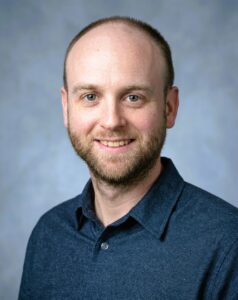
By Dr Simon Cork
Dr Simon Cork is Associate Professor of Physiology and Medical Education at Anglia Ruskin University School of Medicine. His scientific expertise is in the neurobiology of appetite regulation and the impacts of GLP-1 based weight loss medication. He is a leading science communicator on weight loss medications and has written for major national and international media outlets, including the BBC and CNN. He is also a national leader in admission to medical school, championing widening access. He is co-chair of the Medical Schools Council Selection Alliance Executive Board and a trustee and board member of the UCAT consortium.
Simon Cork is the 2026 winner of The Widening Participation in Physiology Prize. We spoke to Simon as part of our 150 Voices of Physiology series.
What first inspired you to go into physiology or your area of research?
I am somewhat of an accidental scientist. Careers advice at my school was not necessarily forthcoming (I recall we were once tasked with completing a questionnaire on some computer software that suggested I should become an ice cream seller), but I was always interested in human biology. I grew up watching the programmes of Robert Winston on the BBC, which piqued my interest in how the body worked, so I knew that’s something that I wanted to be involved in when I grew up.
I studied Biomedical Science at Durham, with no real plan on what I was going to do afterwards and was lucky to secure a funded PhD position with Prof Susan Pyner, who I did my final year dissertation project with. I was immediately drawn to physiology because it takes a whole organism view of biology – to be able to tinker with something in the brain and see the effects elsewhere was fascinating.
I had spent a lot of my PhD reading papers that used patch clamp electrophysiology, and it was something I really wanted to learn. A postdoctoral position came up in Prof Stefan Trapp’s lab at UCL to use patch clamp electrophysiology to study GLP-1 neurons in the brain, and I’m grateful to Stefan for taking a punt on me and giving me the opportunity to join his group.
Since then GLP-1 is having its moment in the spotlight, thanks to the introduction of GLP-1 based weight loss drugs. I got involved with the Science Media Centre while working as a research fellow at Imperial (thanks to working with the Policy Committee at the Physiological Society who signposted them to me), so I managed to learn the ropes of communicating with the media early on before GLP-1’s really took off. That has meant that since the licencing of GLP-1 receptor agonists for weight loss, I’ve been able to do a lot of media work around weight loss drugs, including TV, radio, newspapers and public events, such as the Cheltenham Science Festival, which is immensely fun.
How did you first get involved with the Physiological Society?
Joining the Physiological Society was one of the first things I did when I started my PhD. It has been instrumental in funding my attendance at various conferences and providing an opportunity to network with likeminded academics and share best practice.
I also had the opportunity to sit on the Policy Committee, which provided fantastic insights into how science and government intersect, and I am now using that understanding of how government functions to further my work in widening access.
Please tell us more about your 2026 prize lecture, The Widening Participation in Physiology Prize
My career has latterly moved more into teaching. I moved to the new medical school at Anglia Ruskin University in 2020 to lead on physiology teaching, and quickly also took on the role of Medicine Admissions Lead.
Medicine has a long-standing issue on widening access. Around 75% of medical entrants are from the highest socioeconomic backgrounds, and only around 7% of medical students received free school meals (compared to around 26% of school aged pupils).
A big part of my role in admissions is to lead our institutional commitment to widening access to the medical profession. As someone who was the first in my family to go to university, I know first hand the impact that that had on my career and life trajectory, so I am really keen to open that opportunity up to as many people as possible.
Not only do I think there’s societal and individual benefit in promoting fair access to medicine, but there is plenty of evidence that diversifying the medical profession leads to better patient outcomes.
I am lucky that Anglia Ruskin University is proud to go against the grain when it comes to admissions policies, and the university has given me a lot of freedom to develop innovative policies that are now being replicated by others in the sector.
These initiatives include being the first medical school to recruit T level students, offer guaranteed interviews to candidates who receive free school meals or have experienced care (leading to 30% of our medical student intake being free-school meal eligible against a national average of 7%) and developing a Medicine with Gateway Year programme, which recruits students from underrepresented backgrounds with lower grades onto a supported pre-medicine year and leading on our award winning summer school.
I am now co-chair of the Medical Schools Council Selection Alliance, bringing together admissions leads from all medical schools across the UK, with an aim to drive forward the successes we have had on widening access to medicine at a national level.
What makes you most hopeful about the next chapter for physiology?
There was a real concern 10-20 years ago that physiology would become obsolete in a world of advancing molecular biology techniques. I think there are many instances (GLP-1 based weight loss drugs being a good example), where science is remembering the importance of viewing organisms on the systems level, rather than just focussing on individual cells or molecules. The fact we still have physiology taught as a core discipline in medical schools and that physiology is still recognised in the Nobel Prizes demonstrates the importance we still hold for this important topic.