Erectile dysfunction (ED) is characterised by impaired relaxation of corpus cavernosum smooth muscle (CCSM), leading to reduced penile blood filling and failure to achieve or maintain erection. Although phosphodiesterase-5 inhibitors improve erectile function by enhancing nitric oxide (NO)-mediated signalling, many patients, particularly those with diabetes or vascular disease, exhibit a poor therapeutic response. Voltage-gated potassium (Kv7) channels regulate membrane potential and smooth muscle excitability and may represent an alternative therapeutic target. This study investigated the role of Kv7 channels in regulating neurogenic contractile and relaxation responses in mouse CCSM.
Corpus cavernosum strips were isolated from adult male C57BL/6 mice and mounted in organ baths for isometric tension recordings. Electrical field stimulation (EFS; 0.5–8 Hz, 30 s, 0.3 ms pulse width) was used to evoke neurogenic responses. Contractile responses were examined in the presence of the nitric oxide synthase inhibitor Nω-nitro-L-arginine (L-NNA), while relaxation responses were assessed following pre-contraction with phenylephrine and guanethidine. Kv7 channels were activated using ML213 (5 μM) and inhibited using linopirdine (10 μM) or XE991 (10 μM). The contribution of large-conductance Ca²⁺-activated potassium (BK) channels was investigated using Penitrem A (300 nM). Data were analysed using two-way ANOVA followed by Šídák’s multiple comparisons test. All animal procedures were approved by the Dundalk Institute of Technology Animal Use and Care Committee and conducted in accordance with EU Directive 2010/63/EU.
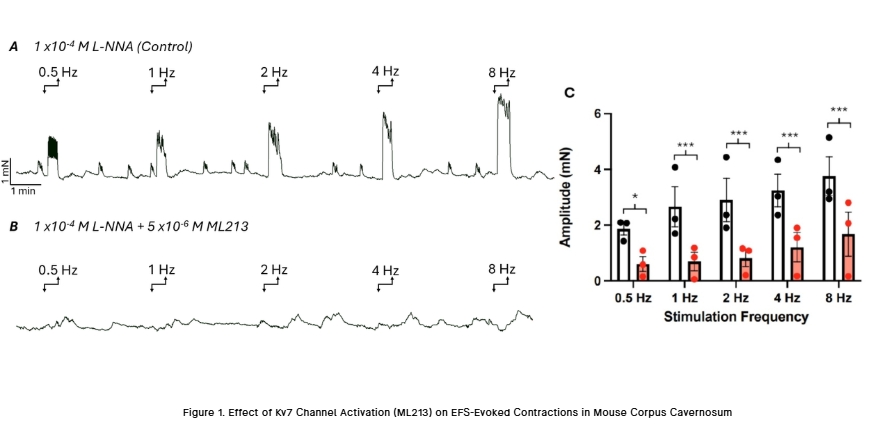
EFS evoked frequency-dependent contractions that increased with stimulation frequency. Activation of Kv7 channels with ML213 significantly reduced contraction amplitude in preparations (n=3) at 0.5 Hz (P = 0.0141), 1 Hz (P = 0.0008), 2 Hz (P = 0.0005), 4 Hz (P = 0.0006), and 8 Hz (P = 0.0006), with a corresponding reduction in contractile area across all frequencies. Inhibition of Kv7 channels with linopirdine significantly increased relaxation amplitude at 1 Hz (P = 0.0038), 2 Hz (P = 0.0008), 4 Hz (P = 0.0009), and 8 Hz (P = 0.0048; n = 3), although relaxation area was not significantly altered. Sequential inhibition of BK channels with Penitrem A following Kv7 blockade (n = 2) produced no further enhancement of relaxation responses, indicating a minimal contribution of BK channels under these experimental conditions.
These findings demonstrate that Kv7 channels play a key role in regulating neurogenic contractile activity in mouse CCSM by limiting membrane excitability and phasic contraction. The increased relaxation observed following Kv7 inhibition is likely secondary to enhanced pre-stimulation contractile tone rather than direct modulation of nitrergic signalling. In contrast, BK channels appear to contribute minimally to EFS-evoked relaxation under these conditions. Pharmacological modulation of Kv7 channels may therefore represent a promising therapeutic strategy for ED, particularly in patients with impaired NO-dependent relaxation. Taking all together, these findings raise the possibility that NO-dependent neurogenic relaxations may be largely independent of Kv7-mediated membrane potential regulation, suggesting that membrane potential primarily regulates contractile rather than nitrergic relaxation mechanisms.