By Society Member Aliya Maqsood
Dr. Aliya Maqsood is a molecular physiologist, educator, and Registered Scientist who recently completed her PhD in Molecular Physiology. She is the author of The Genie in Me, a children’s science book introducing genes and inheritance through storytelling. Her public engagement work connects physiology with everyday life, including through Seasons of Change, a citizen science project funded by the Royal Society of Biology. She is also the founder of OGPhysiologist, a platform bringing physiology research, education, and community engagement together to nurture curiosity and encourage wider participation in science.
Physiology begins with a child asking “why”
“Why do I look like Baba?”
My five-year-old son was asking about a resemblance he could see. As his mother, I wanted to answer him in a way he could understand. As a molecular physiologist, I could see how much science lay behind his question. The challenge was finding a way to share it without losing the curiosity that had prompted him to ask.
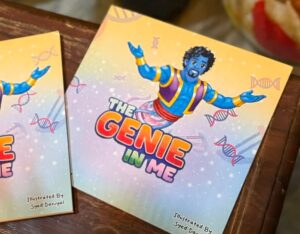
That question became the starting point for The Genie in Me, my children’s book about genes, inheritance and what makes each of us unique. It also made me reflect on a responsibility that comes with being a scientist: how do we make our knowledge accessible to the people whose questions deserve our attention?
The body gives everyone a starting point
Children have questions about their bodies long before they know the word physiology. Why does my heart beat faster when I run? Why do I feel sleepy? How does my body know that I am hungry?
These questions bring us directly to the science of how living organisms work. They also offer something valuable for outreach: a starting point that belongs to the person asking. A child does not need a laboratory or specialist vocabulary to notice something, wonder about it and seek an explanation.
My son’s question began with genetics, but it opened a route towards physiology. Inherited information contributes to how our bodies develop and function. Following that connection can take us from family resemblance to cells, proteins and the processes that keep us alive. There is room to explore the influence of our environment and experiences too. We do not need to explain all of this at once. We need to offer an answer that makes sense now and leaves space for the next question.
Our responsibility is to keep the conversation growing
As physiologists, we spend years learning to investigate complex questions. Sharing that knowledge with a child asks something different of us. We have to listen carefully, choose our language thoughtfully and notice when our explanation has become harder to follow than the original question.
I believe this is an important part of our responsibility to the wider community. People should have opportunities to explore the science of their own bodies, and to meet scientists who welcome their questions. For children, those encounters can also make a possible future more imaginable. The pupil asking question after question today may one day become a scientist, an educator or a physiologist. We cannot know where their interests will lead, but we can help create the conditions in which those interests have room to grow. That means allowing time for unexpected questions, encouraging children to suggest explanations and being willing to say, “I don’t know; how could we find out?” It means showing them that curiosity has a place in science, even before they have the language to express it precisely.
What Year 6 reminded me!
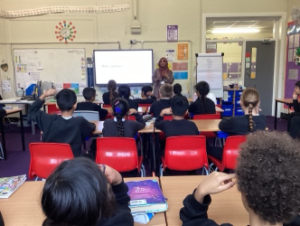
During recent The Genie in Me sessions with Year 6 pupils at Battle Primary Academy in Reading, we combined reading with discussion, activity sheets and a closing quiz.
I arrived with activities prepared. The children arrived with questions.
There were so many contributions that we completed only two activities in each session. Their enthusiasm reminded me that participation can take a different shape from the one we plan. Giving their questions time was part of the learning.
The pupils enjoyed the activities and quiz, and the goodie bags brought extra excitement. What stayed with me, though, was their willingness to keep asking. The school team’s support helped create a space where that curiosity could be expressed freely.
Opening the conversation to the wider community
Schools are one place to begin, but physiology outreach can reach further through families, libraries and community groups. A question explored in a classroom can travel home and become a conversation with a parent, sibling or grandparent.
We can invite people to contribute their observations, help shape the questions we explore and participate in projects about everyday experiences such as sleep, activity and changing seasons.
This gives communities an active role in scientific enquiry and gives us, as scientists, opportunities to learn from them. Storytelling is one way I hope to support that connection. It gives me a familiar setting in which to introduce an unfamiliar idea, then listen to what children make of it.
As we celebrate Physiology Week 2026, I want us to make more room for these conversations. Exceptional scientists and educators need opportunities to develop their curiosity. Some of those opportunities may begin with a school visit, an encouraging response or an adult who takes a question seriously.
My son asked, “Why do I look like Baba?”
I am glad we made time for the answer, and for everything he might ask next.