
Obesity an independent risk factor for the development of atherosclerosis is associated with abnormalities of insulin action and endothelial function. This study sought to explore the mechanisms underlying endothelial dysfunction in mice rendered obese using a high fat diet. Male C57BL/6 mice and iNOS knockout (iNOS KO) mice on a C57BL/6 background (n=8 per group) were fed an obesogenic diet (35% fat/carbohydrate) from weaning until 8 weeks. Body weight, epididymal fat pad mass, glucocompetence, systolic blood pressure (SBP) and vasomotor responses in aortic rings ex vivo were assessed after 4 and 8 weeks of feeding. Glucose regulation was evaluated by a glucose tolerance test (1mg/kg i.p.) and an insulin tolerance test (0.75 units/kg i.p.). Systolic blood pressure was measured by tail cuff method. Vascular responses were studied by suspending thoracic aortic rings (4 per animal) in a temperature controlled organ bath. Dose-response curves were plotted for vasoconstriction to phenylephrine before and 30 min after exposure to L-NMMA (a non-specific NOS inhibitor). Similar dose-responses curves to acetylcholine (Ach 1nM-10μM) were performed before and after exposure to catalase (1250 units/ml), an enzyme that dismutes H202. Mice were humanely killed with pentobarbital administered subcutaneously prior to vascular ring experiments. The study was done in accordance with current UK legislation on animal experimentation. Both wild-type (WT) and iNOS KO mice developed comparable degrees of obesity and hypertension. Glucocompetence was however significantly better in the iNOS KO mice than WT mice suggesting that iNOS may play a role in impaired insulin signalling during obesity. Vascular responses to insulin (0.1 units/ml) an effect mediated by NO release was lost in WT mice at 8 weeks but preserved in iNOS KO mice. Basal NO production in mouse aortic rings was significantly lower in iNOS KO mice than WT mice. Endothelial dysfunction was unmasked by catalase in both groups. These results suggest that iNOS may play a key role in impaired insulin actions in both skeletal muscle and the vascular wall in obesity. Despite been protected against impaired insulin action, mice with a knockout for iNOS had blunted acetylcholine responses compensated for by production of H202 in diet-indeced obesity.
King's College London (2005) J Physiol 565P, PC135
Communications: Mice with a knockout for inducible nitric oxide synthase are protected against metabolic but not vascular dysfunction in diet induced obesity
Noronha, Brian T; Zhang, Min ; Wheatcroft, Stephen B; Shah, Ajay M; Kearney, Mark T;
1. Dept of Cardiology, Kings College London, London, United Kingdom.
View other abstracts by:
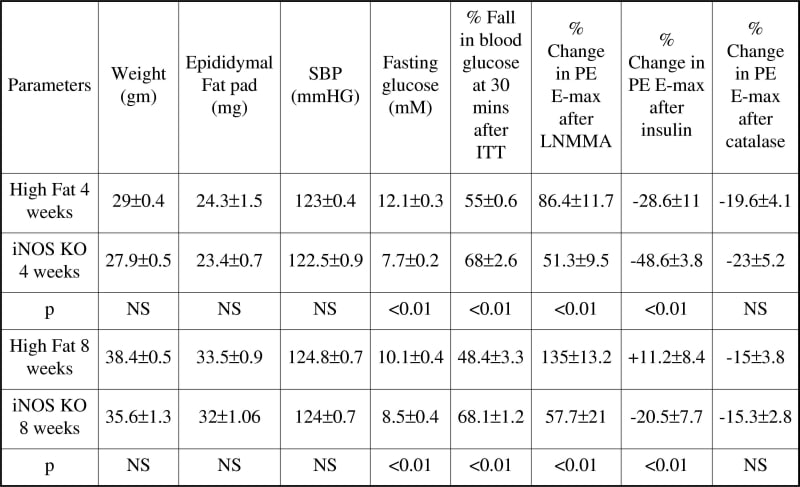
Table Results (mean± SEM)NS not significant unpaired Student's t test.
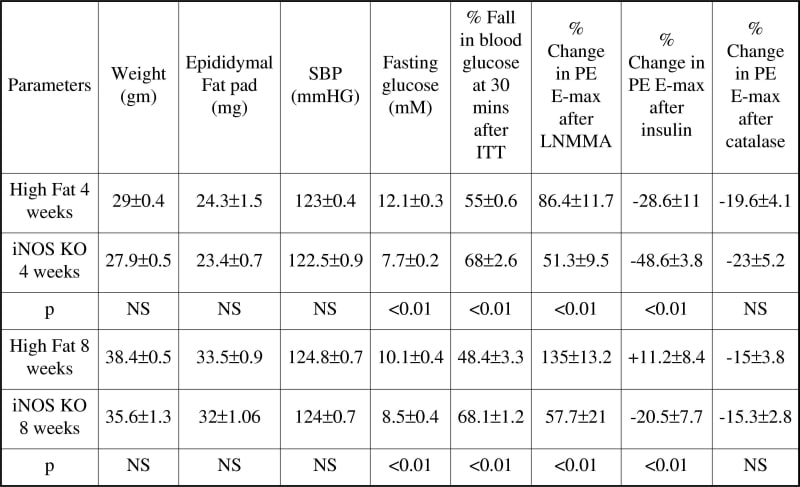
Table Results (mean± SEM)NS not significant unpaired Student's t test.
Where applicable, experiments conform with Society ethical requirements.