
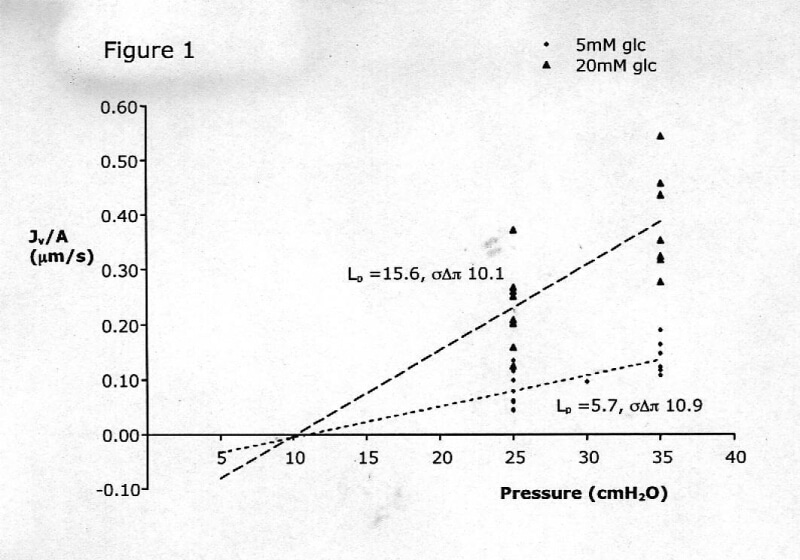
The endothelium is thought to be the primary target of poor glycaemic control in diabetes. We previously reported that treatment with high glucose Ringer causes increased microvascular permeability in mesenteric microvessels of R.temporaria in vivo. (Mean fold change ± sem, 1.49 ± 0.15, n=7). This was not due to an osmotic effect (0.84 ± 0.11, n=5 for mannitol Ringer). Here we show that whilst high glucose Ringer causes an increase in hydraulic conductivity (Lp), it has no effect on either reflection coefficient or microvessel compliance. R.temporaria were anaesthetised by submersion in MS222 (1mg.ml-1) and anaesthesia maintained by constant superfusion of the mesentery with Ringer containing MS222 (0.2mg.ml-1). Hydraulic conductivity (Lp) and oncotic reflection coefficient (σ) were measured during perfusion and superfusion with normal or high glucose Ringer in 20-25μm diameter mesenteric microvessels using the Landis-Michel technique (Michel, 1974). Briefly, each vessel was cannulated with a bevelled glass micropipette connected to a manometer and perfused with 3% BSA in ringer (5mM D-glucose) containing rat red cells as flow markers, and subsequently perfused and superfused with 20mM D-glucose Ringer. A glass rod downstream from the cannulation site was used to occlude the vessel at a set pressure. After approx. 5 seconds the perfusion pressure was either increased or decreased by 10cmH2O within the same block. The regression line taken from a plot of the filtration rate against pressure, allowed Lp and σΔπ (and thus σ) to be calculated. Vessel compliance, the change in radius per unit change in pressure, was also determined by measuring the distance moved by a red blood cell towards the cannulation site (to calculate the change in radius) during a reduction in pressure from 35 to 25 cmH20 (Bates, 1998). In 9 vessels measured, baseline reflection coefficient was not significantly different (0.9 ± 0.09 (mean ± sem)), compared with high glucose Ringer (0.87 ± 0.06. Wilcoxon matched pairs test p=0.73, n=9), whereas the Lp increased from 7.3 ± 1.77 to 11.0 ± 2.48×10⁻⁷cm.s-1.cmH2O-1 in the same vessels, p=0.02 (Figure1). Mean ± sem compliance after treatment with high glucose Ringer (15.4 ± 0.89 nm.cmH2O-1) was also not significantly different from baseline (13.8 ± 1.81 nm.cmH2O-1, n=7, a mean fold change of 1.15 ± 0.11, Wilcoxon matched pairs test p=0.29, n=7). These results demonstrate that hyperglycaemia increases hydraulic conductivity but not reflection coefficient or vessel compliance.
King's College London (2005) J Physiol 565P, PC145
Communications: High glucose Ringer increases microvascular hydraulic conductivity but has no effect on oncotic reflection coefficient or vessel compliance in frog mesenteric microvessels in vivo.
Perrin, Rachel Morvah; Bates, Dave ; Harper, Steve ;
1. Microvascular Research Laboratories, Dept Physiology, University Bristol, Bristol, United Kingdom.
View other abstracts by:
Where applicable, experiments conform with Society ethical requirements.