
In 1884 William James suggested that pain sensations are at least partly due to autonomic reactions changing local blood flow and blood pressure (James, 1884). For treatment of chronic neuropathic pain, we implanted deep brain-stimulating electrodes into the periaqueductal grey (PAG). Thirteen male and 3 female patients (mean age 52 years)were entered into this study. In awake, non-sedated patients, we continuously measured finger arterial pressure and ECG during periods of PAG stimulation ‘on’ or ‘off’. Stimulation parameters during ‘on’ sessions were those that provided optimal analgesia. Patients provided a visual analogue score (VAS) of their pain during each session using a scale of 0 to 100 (0 = no pain, 100 = worst pain imaginable). To compare long-term analgesia, on-year McGill’s pain questionnaire (MPQ) scores were also compared to blood pressure changes. The MPQ score consists of a list of words that describe the pain, that are selected by the patient. We used the scoring system devised by Melzack (Melzack 1975). Linear regression analysis of improvement in VAS and blood pressure showed a significant correlation between reduction in pain score and reduction in blood pressure (r2 =0.62, p=0.0105, n=16), reduction in dP/dt (r2= 0.62, p<0.008, n=16) but only a weak correlation with reduction in pulse pressure (r2=0.48, n=16). These results are summarized in Fig. 1. Autoregressive power spectral analysis of systolic blood pressure variability (Fig. 2) revealed that in the group with decreased blood pressure, there was a significant reduction (p<0.001, n=7) in the logarithm of the low frequency component (0.023-0.4Hz). The converse was true for increases in blood pressure (p<0.001, n=4). Long-term MPQ scores showed similar results. Electrodes that reduced blood pressure were ventral to those that increased it and there was a significant better analgesia in patients with ventral electrodes (p=0.036, Wilcoxon, n=16). The analgesic effect of stimulation of human PAG is associated with changes in blood pressure. The underlying mechanism appears to be an alteration in sympathetic activity, as indicated by power spectral analysis of the blood pressure variability and the change in dP/dt which is related to contractility of the myocardium (Brinton et al. 1997).
University College London 2006 (2006) Proc Physiol Soc 3, C88
Research Symposium: Stimulating the human midbrain to reveal the link between pain and blood pressure
Alexander Laurence Green1, Shouyan Wang2, Sarah L.F. Owen2, John Frederick Stein2, David J Paterson2, Tipu Zahed Aziz1
1. Neurosurgery, Radcliffe Infirmary, Oxford, United Kingdom. 2. Physiology, University of Oxford, Oxford, United Kingdom.
View other abstracts by:
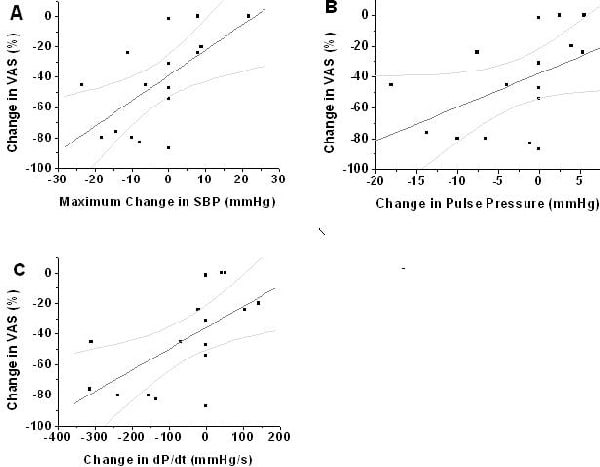
Figure 1. Comparison of visual analogue scores with cardiovascular variables. A Average changes in VAS (%) significantly correlated to systolic blood pressure (A r2=0.62. p=0.01 n=16) and dP/dt changes (C r2=0.62. p=0.01 n=16) but weakly associated with pulse pressure changes with stimulation (B r2= 0.48 p=0.06 n=16). Black lines linear regression; outer grey lines upper and lower 95% confidence intervals. VAS visual analogue score; SBP systolic blood pressure.
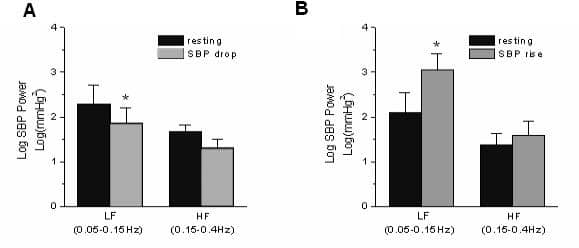
Figure 2. Power spectral analysis of systolic blood pressure A) in those patients with a significant reduction in systolic blood pressure with stimulation there was a significant decrease (p<0.001) in the low frequency component (0.05 to 0.15Hz) of systolic blood pressure variability. B) Similar results for patients with increases in systolic blood pressure (p<0.001). Error bars indicate one standard deviation of the mean. n=7 for drop and n=4 for rise group. *Statistically significant.
Where applicable, experiments conform with Society ethical requirements.