
Central 5-HT-containing pathways are involved in behavioural responses to uncontrollable stress (Maier & Watkins, 2005) and in cardiovascular regulation (Ramage, 2001). Activation of peripheral chemoreceptors evokes a cardiovascular and behavioural response reminiscent of an acute stress response; indeed, chemoreceptor activation causes 5-HT release in the locus coeruleus similar to that evoked by stress (Singewald et al. 2000), and a sympathoexcitation and bradycardia mediated in part by brainstem 5-HT7 receptors (Kellett et al. 2005). In the present experiments, the effect of the selective 5-HT7 receptor antagonist SB-269970 was tested on baseline mean arterial pressure (MAP) before and after chemoreceptor activation with KCN. Male Wistar rats (300–320g) were implanted with intracisternal (i.c.), femoral arterial and venous cannulae under tribromoethanol anaesthesia (250 mg kg-1 i.p.) for i.c. injection and MAP/heart rate (HR) recording. Peripheral chemoreceptors were activated by KCN (40 μg i.v.) before and after i.c. saline or SB-269970 (100 μg kg-1). Male Sprague-Dawley rats (300–400g) were submitted to the same protocol under α-chloralose anaesthesia (80 mg kg-1 i.v.), neuromuscular blockade (α-bungarotoxin 75 μg i.v.; Kellett et al. 2005) and atenolol pretreatment (1 mg kg-1 i.v.). Depth of anaesthesia was assessed by the stability of BP and HR following a noxious stimulus. In awake animals after KCN stimuli, SB-269970 caused a significant rise in baseline MAP lasting ~20 min, but no change in baseline HR (Table 1). In a separate group of animals in which no KCN was given, SB-269970 failed to change baseline MAP. In anaesthetised rats SB-269970 also failed to affect baselines after KCN stimuli. KCN itself caused a dramatic pressor response in awake animals which was inhibited by SB-269970 (50±4 vs. 19±9 mmHg), comparable to the SB-269970-sensitive sympathoexcitation seen in anaesthetised animals (Kellett et al. 2005). Hence SB-269970 prevents the KCN-evoked pressor response from returning to basal level only in awake animals, suggesting a behavioural mechanism caused by the experience of KCN. The data indicate that a 5-HT-containing pathway to the medulla provides a normalising input in putative stressful situations, and this is mediated by 5-HT7 receptors.
University of Bristol (2007) Proc Physiol Soc 5, PC10
Poster Communications: Brainstem 5-HT7 receptors prevent maintained chemoreceptor-induced hypertension in awake rats: implications for stress-evoked hypertension
Daniel Otto Kellett1, Enio L Damaso3, Benedito Honorio Machado3, David Jordan2, Andrew Gordon Ramage1
1. Pharmacology, University College London, London, United Kingdom. 2. Physiology, University College London, London, United Kingdom. 3. Physiology, University of São Paulo, Ribeirão Preto, Brazil.
View other abstracts by:
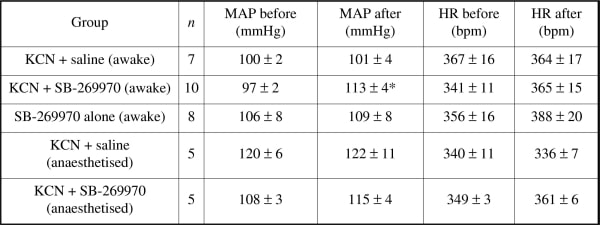
Mean (± s.e.m.) baseline MAP and HR (5 min before and 5 min after i.c. saline or SB-266970). *P<0.05 (1-way ANOVA).
Where applicable, experiments conform with Society ethical requirements.