Running performance is influenced by multiple physiological determinants, including rate of oxygen uptake (V̇O₂), blood lactate concentration and running economy. Physiological testing of team sport athletes has mainly been conducted using field-based assessments, with few laboratory-based studies. This study aims to compare the physiological characteristics of a trained runner (TR) and a team sport athlete (TS) during laboratory-based testing.
Testing was performed in standard (non-plated) running shoes. Following ethical approval and informed consent, two healthy male participants (TR: 39 years, 64.9 kg, 174.9 cm; TS:19 years, 80.7 kg, 168.2 cm) completed a submaximal graded exercise test (GXT) consisting of 4-minute treadmill running stages beginning ~5 km/h below 10 km race pace and increasing 1 km/h per stage. Following ~5 minutes of recovery during which participants remained ambulatory, a maximal incremental test was performed, initiated with 2 minutes below lactate threshold (LT) 2 (LT2) followed by 1 km/h increases every 30-seconds, until volitional exhaustion. Gas exchange data and heart rate were collected continuously, and RPE (Borg 6-20 scale) was collected in the final 30 seconds of each stage during the GXT. Blood lactate was collected (earlobe) at the end of each 4-minute stage and 2 minutes and 5 minutes post-maximal test. LT1 and LT2 were determined using recognised methods for identifying lactate thresholds during incremental exercise (1, 2). Running economy was calculated as oxygen cost per kilometre at LT1 and LT2.
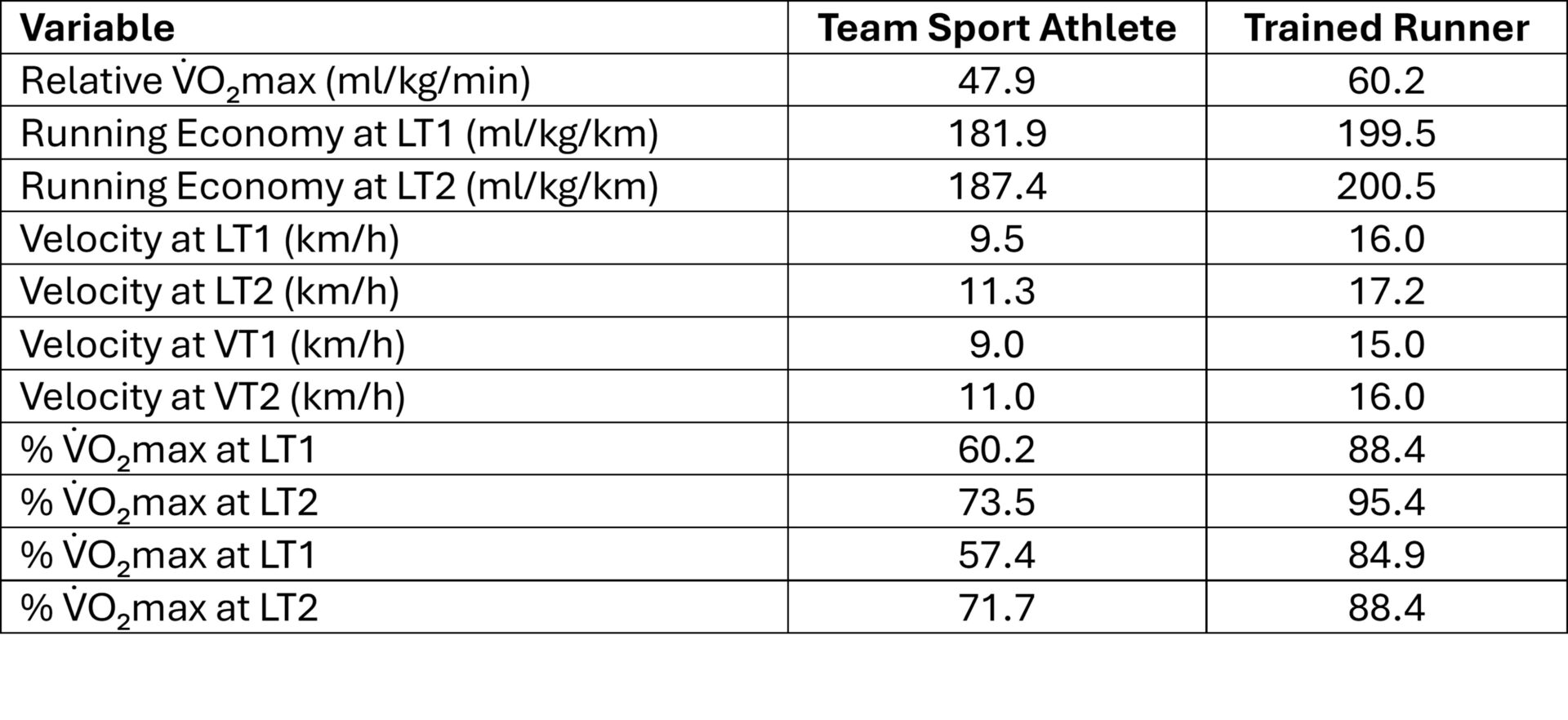
Physiological profiles for both participants are shown in Table 1. The TR demonstrated a 25.7% higher relative V̇O₂max and a higher vV̇O₂max than TS. In contrast, the TS exhibited a lower oxygen cost of running at both LT1 and LT2. Lactate and ventilatory thresholds occurred at higher running speeds in the TR. Similarly, lactate and ventilatory thresholds occurred at a greater percentage of V̇O₂max in the TR, indicating an ability to sustain a higher fraction of their maximum aerobic capacity. Ventilatory thresholds generally corresponded with the lactate thresholds, although a greater discrepancy between LT2 and VT2 was observed in the TR. Both participants demonstrated a plateau in V̇O₂ during the final stage of the maximal test, achieved a heart rate within 5% of their age-predicted maximum, reported an RPE ≥18, and achieved an RER >1.1.
The TR had higher V̇O₂max, vV̇O₂max and lactate and ventilatory thresholds occurred at higher relative intensities. However, the TS demonstrated superior running economy, maintaining a lower relative O2 cost across LT1 and LT2. This novel finding may reflect the physiological adaptations associated with team sports and highlights that superior aerobic capacity does not necessarily coincide with superior running economy. This study provides laboratory-based physiological profiling of a TS athlete, contributing to an area where such research is relatively limited. Multiple physiological determinants rather than a single metric should be evaluated to provide a more comprehensive assessment of an athlete’s aerobic performance abilities.