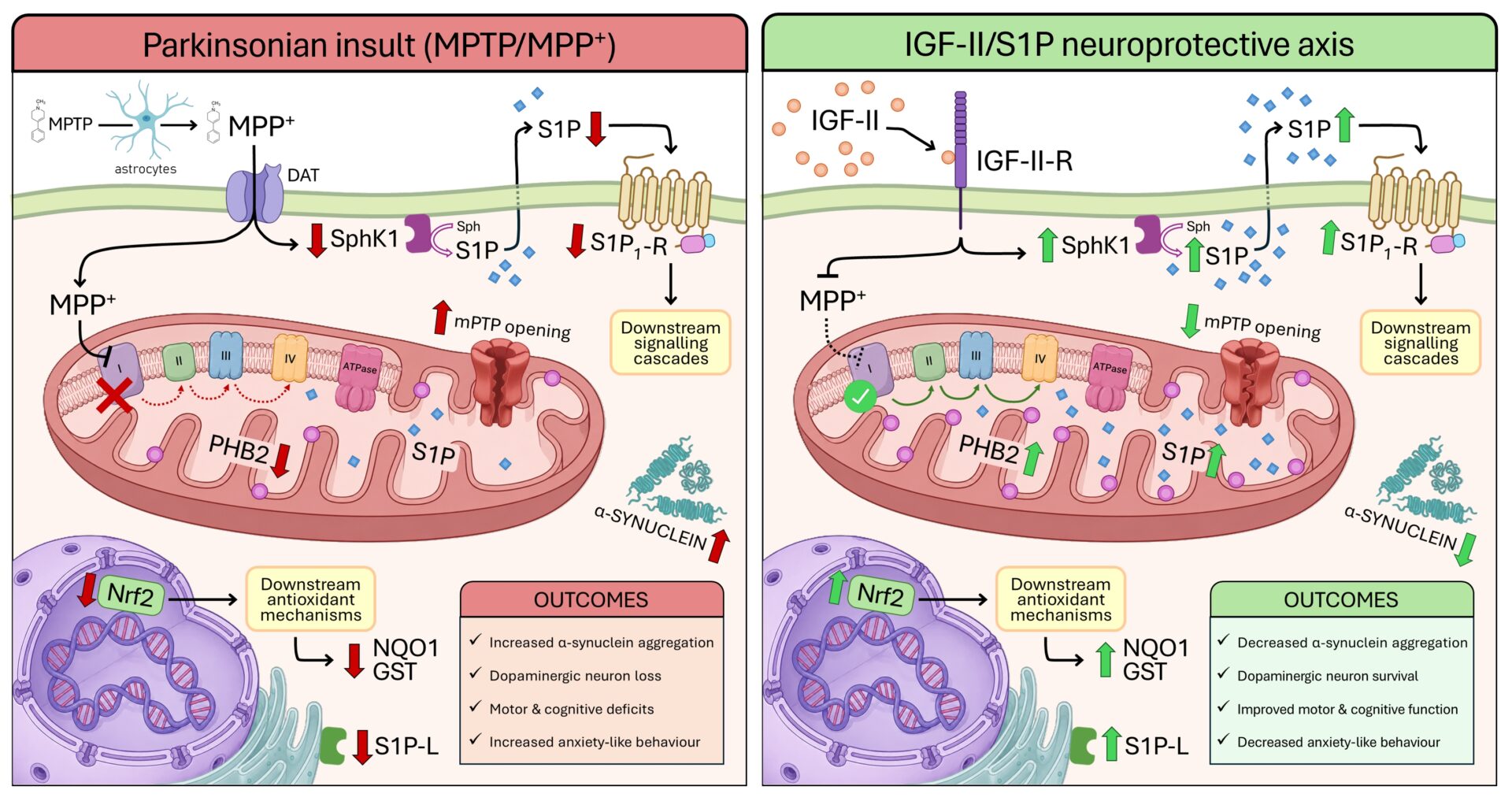
Background: Parkinson’s disease is characterised by progressive dopaminergic neurodegeneration associated with mitochondrial dysfunction, oxidative stress, and α-synuclein accumulation. Insulin-like growth factor II (IGF-II) exerts neuroprotective effects in experimental models of neurodegeneration, although the underlying molecular mechanisms remain poorly understood.
Aims: This study aimed to determine whether the neuroprotective actions of IGF-II against dopaminergic neurotoxicity depend on the “inside-out” transactivation of the sphingosine kinase 1 (SphK1)/sphingosine-1-phosphate (S1P)/S1P1 receptor signaling axis. Specifically, we sought to elucidate how this pathway links organelle stability, prohibitin-2 (PHB2) preservation, and the Nrf2-mediated antioxidant response both in vitro and in vivo.
Methods: Neuroprotective mechanisms were evaluated in SN4741 neurons (mouse embryonic dopaminergic cell line, RRID: CVCL_S466, which expresses phenotypic markers of substantia nigra dopaminergic neurons) exposed to 1-methyl-4-phenylpyridinium (MPP+) and in a chronic 1-methyl-4-phenyl-1,2,3,6-tetrahydropyridine/probenecid (MPTP/p) mouse model (ten-week-old male C57BL/6J mice). Mitochondrial permeability transition pore (mPTP) opening, cell viability (lactate dehydrogenase [LDH] release), sphingolipid metabolism (global SphK and S1P lyase [S1PL] activities, and S1P ELISA), antioxidant enzyme activities, protein expression (western blot), and immunofluorescence analyses (for Nrf2 translocation, PHB2, and receptor trafficking) were performed to characterise intracellular signalling pathways. Tyrosine kinase receptors were blocked using BMS-536924 to isolate specific IGF-II-R actions. Behavioural assessments included rotarod, Y-maze spontaneous alternation, self-grooming, and elevated plus maze (EPM) tests. In vivo western blots utilized a standardized protein pool (STD) from control substantia nigra for inter-gel normalization. Data were combined from at least 4 independent experiments, expressed as mean ± SEM, and analysed using ordinary one-way ANOVA followed by Tukey’s post-hoc test.
Results: MPP+ exposure induced mitochondrial dysfunction, oxidative stress, prohibitin-2 depletion, and neuronal death, whereas IGF-II restored mitochondrial integrity and cell survival. Specifically, MPP+ triggered a 2.9-fold increase in mPTP opening and a 56% reduction in the inner membrane scaffold PHB2, which were fully reversed by IGF-II. IGF-II increased sphingosine kinase activity, restored intracellular and extracellular S1P levels, preserved S1P1 receptor expression, and selectively upregulated SphK1 upstream of receptor activation. Furthermore, MPP+-induced impairment of S1PL turnover was partially rescued by IGF-II, maintaining functional lipid signalling flux. Pharmacological inhibition of either SphK1 (MP-A08) or S1P1 receptor (W123) abolished the protective effects of IGF-II, confirming the requirement of this signalling pathway, whereas SphK2 inhibition had negligible effects. In addition, IGF-II promoted nuclear translocation of Nrf2 (completely blocked by W123 or iSphK1) and restored the activity of antioxidant enzymes, including NAD(P)H quinone oxidoreductase 1 and glutathione S-transferase. In vivo, IGF-II prevented MPTP-induced cognitive impairment (Y-maze spatial memory) and anxiety-like behaviour (EPM open-arm exploration), reduced nigral α-synuclein accumulation, and preserved SphK1 expression in the substantia nigra of MPTP-treated mice.
Conclusions: These findings identify the IGF-II/IGF-II-R/SphK1/S1P/S1P1 receptor axis as a key neuroprotective mechanism linking mitochondrial preservation via S1P/PHB2 platforms, antioxidant defence, and proteostatic regulation in experimental Parkinson’s disease models. Modulation of this sphingolipid-dependent pathway may represent a promising disease-modifying therapeutic strategy capable of addressing both motor and non-motor symptoms in Parkinson’s disease.