
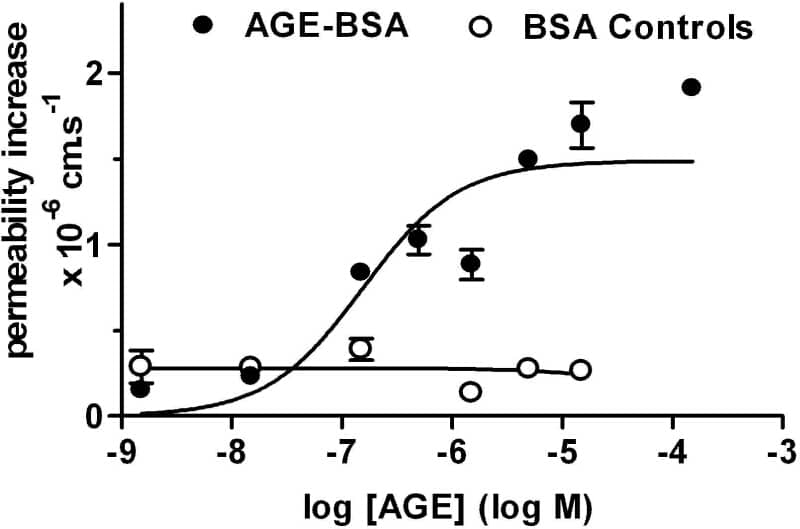
Increased retinal vascular permeability occurs as a consequence of diabetes and is associated with macular oedema and vision loss (Stitt, 2003). The severity is closely correlated with the degree of hyperglycaemia, and the increased formation of advanced glycation end products (AGEs, Hammes et al. 1999). We have developed a technique using the isolated perfused retina to test whether AGEs mediate acute increases in retinal vascular permeability and to explore the pathways by which this occurs. Wistar rats were killed by a Schedule 1 method and decapitated. A carotid artery was cannulated and perfused with 300 U.ml-1 heparin in 9.0 g.l-1 NaCl, followed by a balanced buffered salt solution containing 10 mM Mg2+, 10 μM isoprenaline and 5.0 g.l-1 Evans Blue-albumin. The retina was dissected from the eye, pinned out and superfused with artificial cerebrospinal fluid, pH 7.4, heated to 37oC. A surface arteriole was cannulated with a glass micropipette (tip diameter ~ 2 μ m) containing 1 mM sulforhodamine dye to perfuse the microcirculation. Microvascular permeability was determined from the rate of decrease in fluorescence gradient across a selected microvessel 1 minute after perfusion from the micropipette ceased. The initial venular capillary permeability was low (< 1.0 x 10⁻⁶cm.s-1), consistent with a tight blood-retinal barrier. Acute application of glycated albumin (AGE-BSA) produced a dose-dependent increase in permeability with a maximum permeability increase of 1.5 ± 0.1 at 5 μM (mean ± SEM) and log median effective dose (log EC50) of -6.1 ± 0.2 (n = 6), whilst application of non-glycated BSA control had no effect (see Fig 1.) The permeability increase depended on free radical production as co-application with 100 U.ml-1 each superoxide dismutase and catalase reduced the response to 5 μM AGE to 0.3 ± 0.1 (n = 4, P < 0.001, paired 't' test). The metabolism of arachidonic acid was not the source of free radicals as the PLA2 inhibitor palmitoyl trifluoromethyl ketone had no effect on the AGE-BSA permeability response. Pre-treatment with either diphenylene iodonium chloride (DPI, 100 μM), or apocynin (100 μM; NADPH oxidase inhibitors) reduced the response to AGE-BSA to 0.3 ± 0.1 (n = 5, P < 0.05) and 0.4 ± 0.1 (n = 7, P < 0.05) respectively. The permeability response to AGE-BSA also required Ca2+ entry as co-application with the divalent cation channel blocker SKF-96365 (10 μM) reduced the response to 0.2 ± 0.04 (n = 7, P < 0.01).
King's College London (2005) J Physiol 565P, C133
Communications: Advanced glycation end products acutely increase vascular permeability via activation of NADPH oxidase in the isolated perfused rat retina
Warboys, Christina M; Fraser, Paul ;
1. Cardiovascular Division, King's College London, London, United Kingdom.
View other abstracts by:
Where applicable, experiments conform with Society ethical requirements.