Celebrating Physiology in Ireland (Trinity College Dublin, Ireland) (2026) Proc Physiol Soc 77,
C04
Oral Communications: Differential remodelling of intracellular Ca²⁺ homeostasis by clinically relevant triple-negative breast cancer (TNBC)-associated TP53 variants: implications for mutation-directed therapy
Tara King1, Paul Buchanan1, Alex Eustace1, Mehdi Nikkhah2, Jay Park2
1Dublin City University Ireland, 2Arizona State University USA
View other abstracts by:
Introduction: Triple-negative breast cancer (TNBC) accounts for 10–15% of breast cancers and lacks established hormone- or HER2-directed therapies, contributing to poor clinical outcomes. Up to 80% of TNBCs harbour TP53 mutations. Beyond its canonical transcriptional functions, p53 regulates apoptosis through transcription-independent control of endoplasmic reticulum (ER)-to-mitochondrial Ca²⁺ signalling. Our previous multidimensional profiling of an isogenic MCF10A TP53-variant panel identified mutation-specific heterogeneity in apoptosis resistance, migration, invasion and anoikis. Whether this functional heterogeneity is accompanied by distinct Ca²⁺-signalling phenotypes that influence mitochondrial function and apoptotic sensitivity remains unclear.
Aim: To determine how TP53 mutation status alters ER Ca²⁺ release, store-operated Ca²⁺ entry (SOCE) and mitochondrial bioenergetics using an isogenic panel of p53-altered MCF10A mammary epithelial cells.
Methods: Isogenic MCF10A cells expressing endogenous wild-type p53 (WT), p53 knockdown (KD), wild-type p53 overexpression (p53-OE), or clinically relevant TP53 missense variants (R175H, Y163C, G245S and R273H) were studied. Intracellular Ca²⁺ was measured using Fura-2-AM during thapsigargin-induced ER Ca²⁺ depletion, followed by extracellular CaCl₂ addition to quantify SOCE. Calcium experiments comprised four independent biological replicates (n=4/group) and were analysed using Kruskal–Wallis tests with Dunn’s post hoc correction. Mitochondrial bioenergetics were assessed using the Agilent Seahorse XFp Mito Stress Test (preliminary; n=1). No human participants, human tissue or animals were involved.
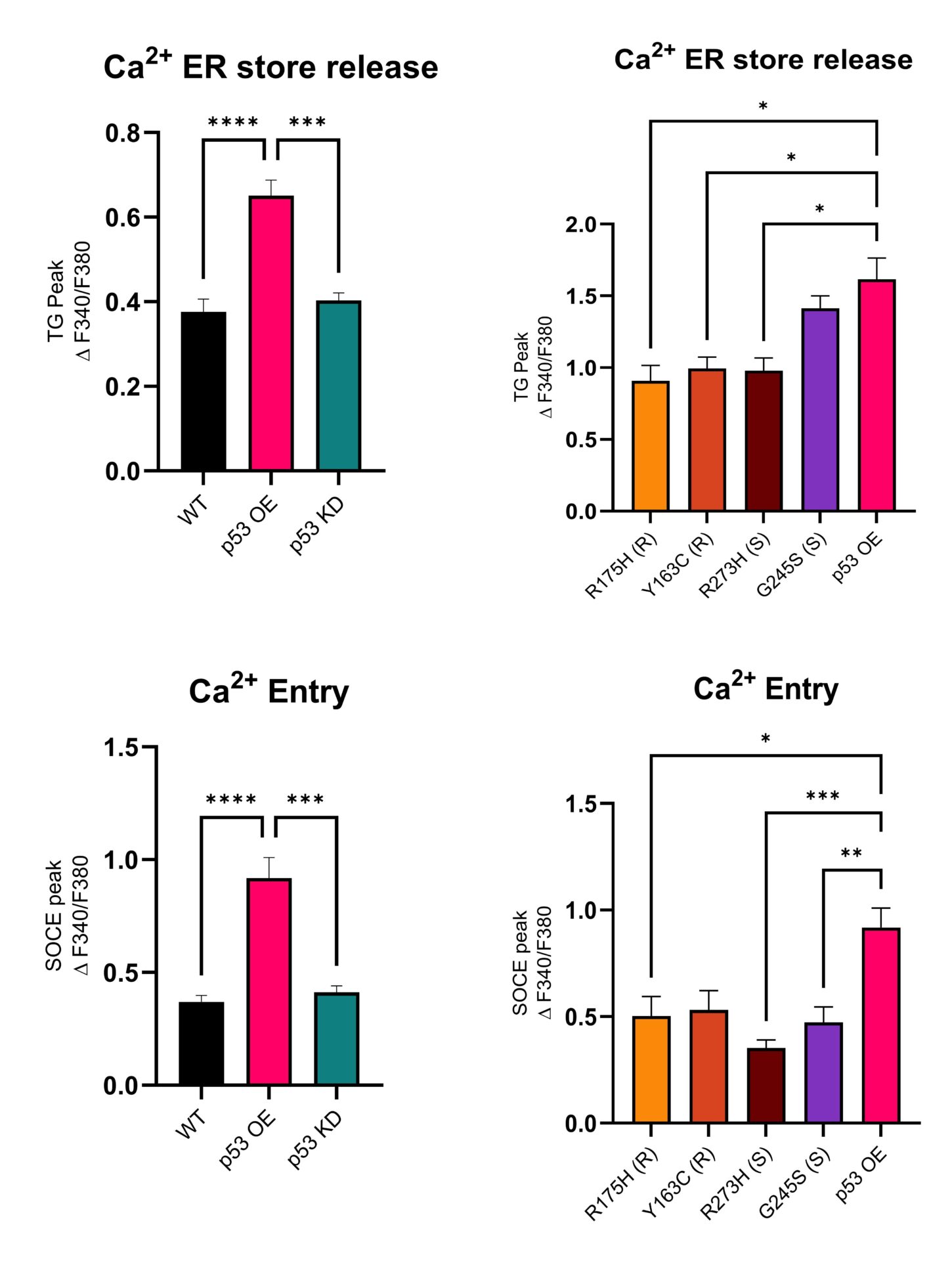
Results: p53-OE significantly increased ER Ca²⁺ release compared with WT and KD (p<0.0001 and p=0.0003, respectively) and increased SOCE compared with WT and KD (p<0.0001 and p=0.0006). WT and KD responses were indistinguishable (p>0.9999), consistent with the low basal abundance of p53 in MCF10A cells. Consequently, p53-OE enabled resolution of a p53-dependent Ca²⁺ phenotype against which TP53 variants could be compared. Relative to p53-OE, ER Ca²⁺ release was reduced in R175H (p<0.01), R273H (p<0.05) and Y163C (p<0.05), whereas G245S was unchanged. SOCE was reduced in R175H (p=0.0312), R273H (p=0.0001) and G245S (p=0.0062), whereas Y163C was unchanged. Alongside our previous phenotypic profiling (Pal et al, 2023, NPJ Breast Cancer), G245S and Y163C retained different components of the p53-OE Ca²⁺ phenotype and displayed contrasting apoptotic and migratory behaviours: G245S retained ER Ca²⁺ release and had shown greater sensitivity to doxorubicin-induced apoptosis with lower migratory activity, whereas Y163C retained SOCE and displayed relative apoptosis resistance with higher migratory activity. Preliminary Seahorse analysis demonstrated reduced basal respiration and spare respiratory capacity in p53-OE, suggesting that enhanced ER Ca²⁺ mobilisation may be accompanied by reduced mitochondrial oxidative metabolism and bioenergetic reserve. These findings require confirmation in additional biological replicates.
Conclusion: Wild-type p53 overexpression revealed a calcium-regulatory phenotype characterised by enhanced ER Ca²⁺ mobilisation and SOCE. Clinically relevant TP53 mutations remodelled this phenotype in a mutation-specific manner, generating distinct Ca²⁺-signalling profiles alongside heterogeneous tumour-associated behaviours. These findings establish TP53 mutation status as an important determinant of intracellular Ca²⁺ homeostasis and provide a physiological framework for studies of ER-to-mitochondrial Ca²⁺ transfer, mitochondrial metabolism and apoptotic sensitivity, with the aim of informing mutation-directed therapeutic strategies in TNBC.
Where applicable, experiments conform with Society ethical requirements.