
Movement of the arm in response to pointing task involves complex cortical control and patterns of muscle activation. However, several factors can modify the stereotypical response including adaptation to novel sensory feedback and central and peripheral neural damage. The purpose of this study was to map activation patterns of several agonist and antagonist muscles in response to direction-specific and load-dependent arm movements. Seven right-handed subjects (18-45 yrs) sat in front of an interactive robot device (InMotion2, IMT, USA) with the right lower arm supported against gravity. They grasped a hand-held joystick with which they moved an onscreen cursor to a series of visual targets. The movement was completed within 1.6 sec and subjects then held position for a further 1.6 sec before returning the cursor to the centre location. Movement directions were approximately 10 cm from the central start position to 8 equally spaced targets (25 mm diameter) arranged around the circumference of a circle. Blocks of 25 trials were performed towards each target in a randomised order for each subject. The movements were made against a damping force (25 N). Surface EMG were measured from biceps (BB), triceps (TR), anterior (AD) and posterior deltoid (PD) muscles using pre-amplified electrodes (Biometrics, Gwent, UK). EMG signals were sampled at 1Kz and processed (20 Hz high-pass filter and full wave rectified) using a CED 1401 unit and Spike 2 software (CED, Cambridge, UK). The preferred direction for EMG peak amplitude in the first 1 s of movement was determined for each subject. Values are mean ± SEM and significance level was set at p < 0.05. BB and TR muscles showed significant direction specific activation patterns (see Fig. 1). The most preferred direction for peak amplitude EMG for BB was 3.6 ± 0.3 rads (206 ± 17 deg) and for TR was 0.7 ± 0.3 rads (39 ± 15 deg) from a straight ahead movement of the joystick (0 deg in Fig. 1). The spatiotemporal pattern of activation of each muscle also changed with direction such that phasic only, tonic only and phasic-then-tonic EMG signals were observed depending on the direction of arm movement. This study demonstrates complex spatiotemporal patterns of upper arm muscle activation are present in relatively simple movements. The coordination of activations across several muscles is hypothesized to show discrete alterations in a number of motor learning paradigms and across patient groups with different neural dysfunction.
University College London 2006 (2006) Proc Physiol Soc 3, C10
Oral Communications: Directional tuning of arm muscle activation to reaching tasks in a robot-induced force field
Timothy Hunter1, Paul Sacco1, Duncan L Turner1
1. School of Health and Bioscience, University of East London, London, United Kingdom.
View other abstracts by:
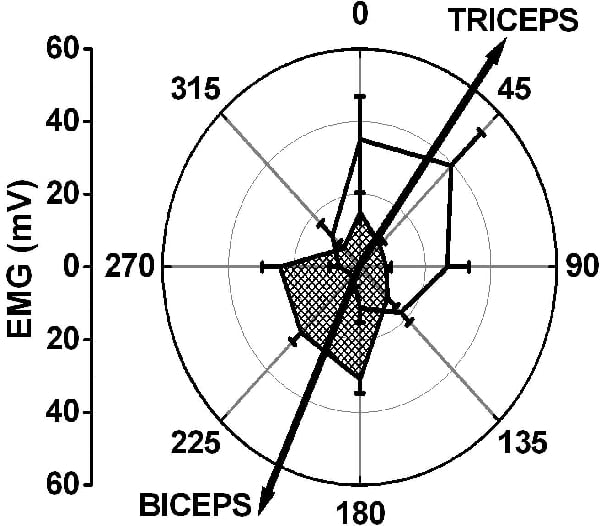
Figure 1. Mean ± SEM (n = 7) EMG for biceps (hatched area) and triceps (clear area) muscles as a function of 8 directions of movement in a reaching task against a damping load (25N). Arrows indicate preferred average direction for peak amplitude.
Where applicable, experiments conform with Society ethical requirements.