
We have shown previously that the cutaneous hyperaemic response is attenuated in smokers (Noble et al. 2003). The aim of this study was to investigate the vascular response to mild thermal warming and to explore changes in microvascular vasomotion in the skin of long-term smokers. Skin blood flux was measured using laser Doppler fluximetry (LDF, Moor Instruments Ltd, UK) in 10 long-term smokers (range 12.5 – 42 pack years) and their age, sex and BMI matched non-smoking controls. A pin-head LDF probe was mounted in a 3 cm heating block attached to the skin of the non dominant forearm and blood flux measured continuously before, during and for up to 30 min after local warming of the skin to 43oC for 10 min. The LDF trace was analysed in the time domain to obtain mean blood flux (in arbitrary flux units, AU) during baseline and sustained response using the manufacturers software (Table 1). The trace was also analysed in the frequency domain using a fast Fourier transform (Matlab, The MathsWorks Inc, Cambridge UK) and the total spectral amplitude together with the contribution of the frequency intervals shown in Table 1 calculated. A total of 11946 data points were analysed in the baseline phase and 2311 data points in the plateau phase for each volunteer. Previous analysis has revealed five characteristic frequencies: cardiac and respiratory rhythms (1 and 0.3 Hz) and three others around 0.1, 0.04 and 0.01Hz. These are thought to reflect myogenic, neurogenic and endothelium-mediated activity of the peripheral vasculature respectively (Kvernmo et al. 1998). The data shown in Table 1 show that the attenuation of the sustained response to thermal warming in long-term smokers is associated with a reduction in vasomotion and that this is in part the result of a reduced endothelial and smooth muscle cell activity. The mechanisms underlying this have yet to be fully elucidated but may be the result of a direct action of the products of smoking at the vessel wall.
King's College London (2005) J Physiol 565P, PC153A
Communications: Evidence for endothelial dysfunction in the skin microvasculature of long-term smokers
Avery, Miriam R; Voegeli, David ; Clough, Geraldine F;
1. School of Medicine, University of Southampton, Southampton, United Kingdom. 2. School of Nursing & Midwifery, University of Southampton, Southampton, United Kingdom.
View other abstracts by:
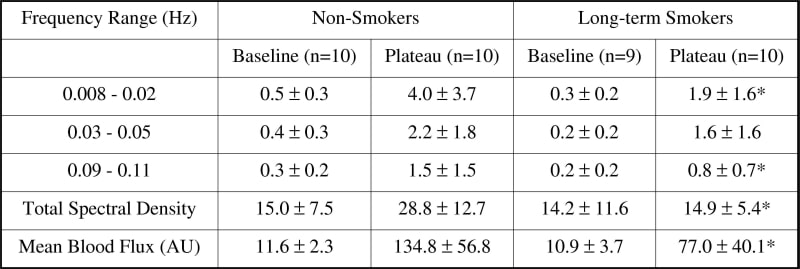
Table 1. Spectral density of laser Doppler flux signal and mean blood flux measured in the skin of long-term smokers and non-smoking healthy controlsData are means ± SD. *P<0.05 plateau response smokers vs non-smokers (Mann-Whitney U test).
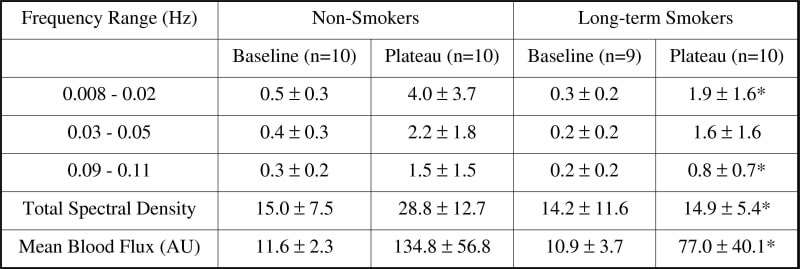
Table 1. Spectral density of laser Doppler flux signal and mean blood flux measured in the skin of long-term smokers and non-smoking healthy controlsData are means ± SD. *P<0.05 plateau response smokers vs non-smokers (Mann-Whitney U test).
Where applicable, experiments conform with Society ethical requirements.