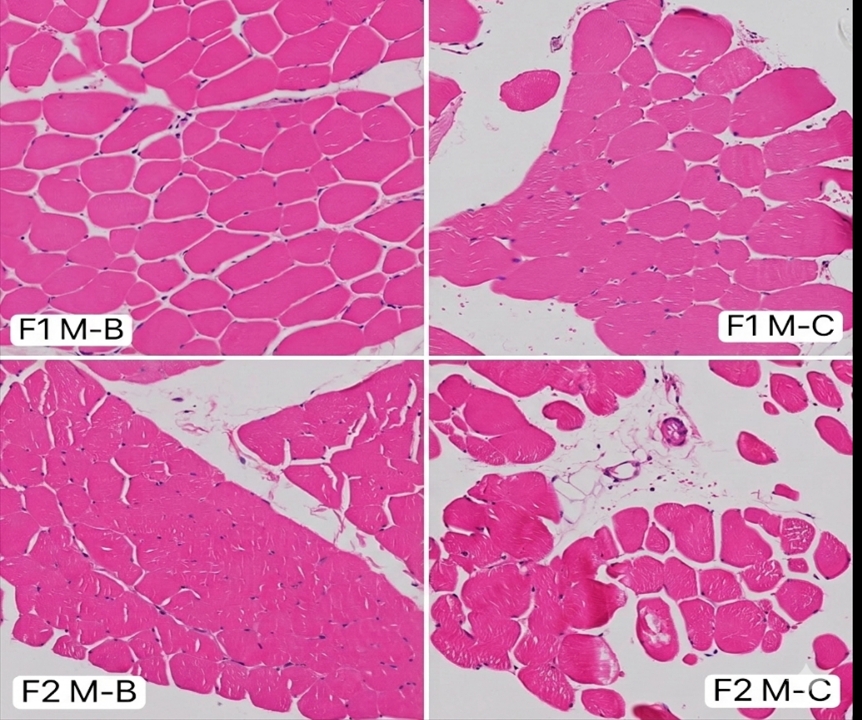
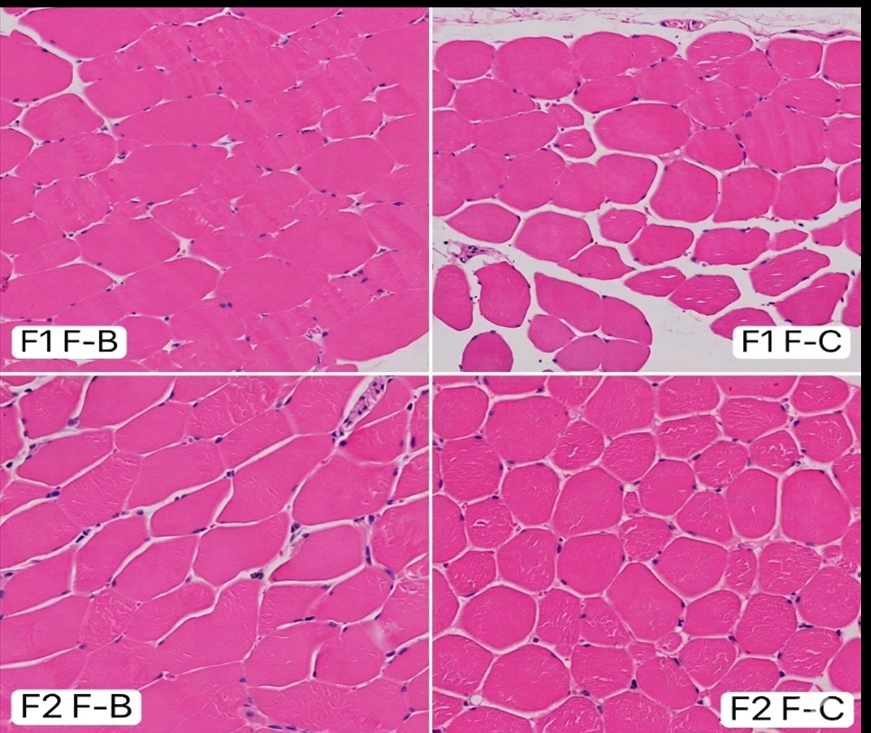
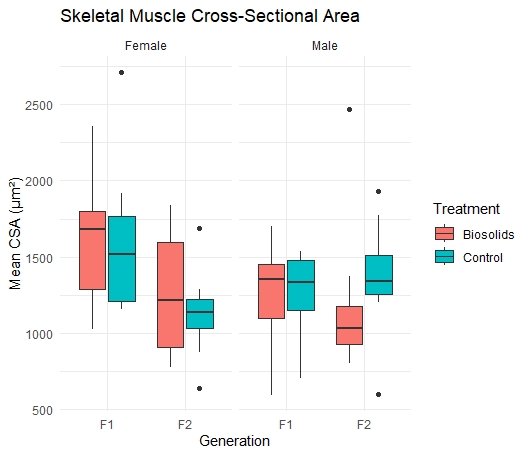
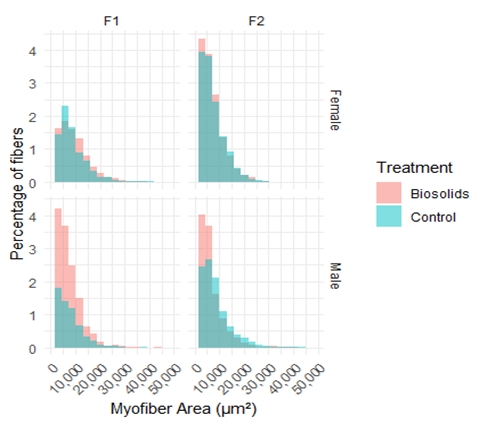
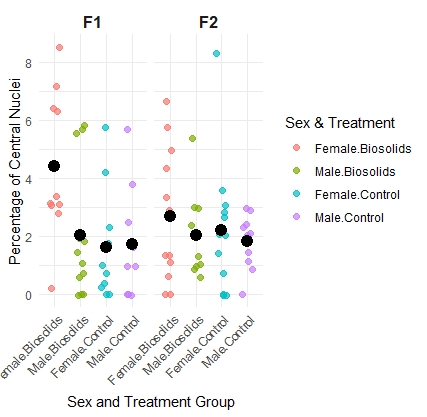
Humans are continuously exposed to complex mixtures of environmental chemicals (ECs), many of which are implicated as risk factors for metabolic disease. Biosolids-treated pastures (BTP) contain environmentally relevant mixtures of anthropogenic chemicals and provide a powerful “real-world” exposure model to understand EC mixture effects on metabolic health across generations. This study investigated sex-specific and multigenerational effects of maternal real-world EC mixture exposure on skeletal muscle, a key regulator of whole-body metabolic health, in adult F1 offspring, and their F2 descendants. Ewes (F0) were grazed on either control (conventionally fertilised) or BTP from one month prior to mating until parturition. All F1 and F2 offspring were maintained on control pastures throughout life. The Longissimus dorsi muscle was analyzed for myofibre cross-sectional area (CSA), fibre size distribution, and muscle regeneration to investigate whether gestational biosolids-treated pasture (BTP) exposure altered skeletal muscle morphology and regenerative characteristics across generations and between sexes. It was hypothesised that biosolids exposure during the sheep gestational stage would affect skeletal muscle metabolic health in offspring, resulting in increased central nuclei percentage and reduced muscle fibre size distribution and cross-sectional area, with effects differing between sexes and persisting across generations. Sample sizes were: F1 females (Control n = 10, BTP n = 10), F1 males (Control n = 9, BTP n = 12), F2 females (Control n = 12, BTP n = 12), and F2 males (Control n = 10, BTP n = 9). Mean myofibre CSA was significantly (p = 0.015) lower in F2 compared with F1 animals, with a significant (p = 0.012) sex-by-generation interaction. However, there was no effect of real-world EC mixture exposure on mean CSA (p = 0.83). Fibre size distribution differed significantly between control and BTP groups, characterised by a shift toward smaller fibres in F1 females (p = 0.0047) and in both sexes in the F2 generation, with the strongest effect (p < 0.001) observed in F2 males. These findings suggest that gestational BTP exposure altered skeletal muscle architecture and fibre remodelling across generations. In addition, BTP-exposed animals showed a trend (p = 0.071) toward increased centrally nucleated fibres, suggestive of muscle regeneration and/or tissue remodelling (independent of sex or generation). These
findings demonstrate that developmental exposure to real-world EC mixtures can reprogram skeletal muscle organisation across sexes and generations, supportive of a heritable biologic memory on muscle structure and metabolic health. All animal procedures were conducted under the UK Animals (Scientific Procedures) Act 1986 and approved by Cochno Farm and Research Centre, University of Glasgow. This work was supported by the National Institutes of Health R01 ES030374.