Introduction: Maternal obesity increases the risk of obesity and metabolic disease in the offspring, however, the cellular mechanisms that program adipose tissue development remain poorly understood. Mesenchymal stem cells (MSCs), the precursors of adipocytes, may represent an early target of metabolic programming during fetal development. Previous studies have shown that MSCs isolated from neonates of mothers with obesity exhibit enhanced adipogenic differentiation potential (Iaffaldano et al. 2013; Chen et al. 2016).
Objective: This study investigated whether maternal obesity alters stemness, redox homeostasis and adipogenic commitment in neonatal MSCs from mothers with obesity compared to those from mothers with normal weight. We hypothesized that maternal obesity induces redox adaptations that could modulate Forkhead Box O1 (FOXO1) adipogenic pathway (Jing et al., 2007).
Methods: MSCs were isolated from Wharton’s jelly of umbilical cords from neonates born to mothers with normal weight (NW‐MSCs, n = 15) or obesity (OB‐ MSCs, n = 15). Basal MSCs were characterized for stemness properties and redox parameters. Cells were exposed to 250 μM hydrogen peroxide (H₂O₂) to assess antioxidant enzyme responses, and to measure intracellular levels of reactive oxygen species (ROS) and O2•‐ production in response to oxidative stress. Further, MSCs were subjected to adipogenic differentiation to evaluate FOXO1 expression and ROS responses. FOXO1 involvement was confirmed through acetyl‐FOXO1 localization, while adipogenesis was confirmed by Peroxisome Proliferator-Activated Receptor gamma (PPARγ) expression. All procedures were conducted according to the Helsinki Declaration and complied with all relevant institutional and national ethical regulations.
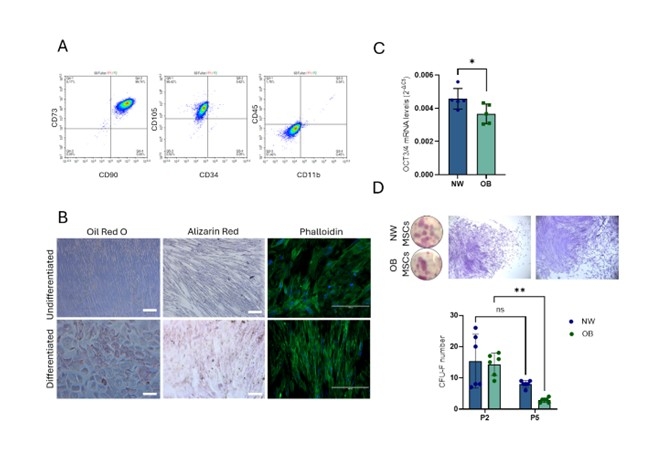
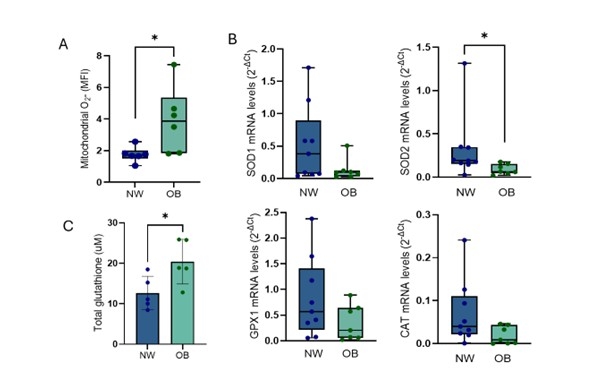
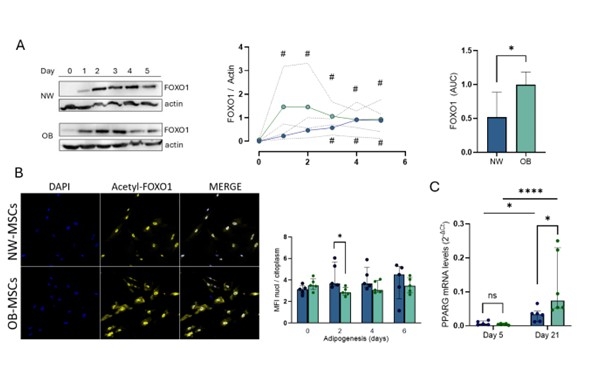
Results: Cells from both groups were positive for MSC markers CD73 and CD90, and CD105; and negative for CD11b, CD34, and CD45. Both NW‐MSCs and OB‐MSCs showed trilineage differentiation potential. OB‐MSCs exhibited reduced stemness characteristics, including lower octamer binding protein 3/4 (OCT3/4) expression and decreased clonogenic capacity (Figure 1, *p < 0.05 Mann−Whitney U test; **p < 0.01 Tukey’s range post hoc test, n = 6 NW‐MSCs and 6 OB‐MSCs). These cells also displayed increased mitochondrial superoxide levels and reduced superoxide dismutase 2 (SOD2) expression, indicating mitochondrial oxidative stress. In addition, OB‐MSCs showed increased GSH levels, compared to NW‐MSCs, suggesting an adaptive redox response (Figure 2, *p < 0.05, Mann−Whitney U test, median ± range, n = 9 NW‐MSCs and 7 OB‐MSCs). During early adipogenic commitment, OB‐MSCs exhibited higher FOXO1 expression levels, and predominant cytoplasmatic localization during early adipogenesis, consistent with reduced repression of the adipogenic regulator PPARγ. Furthermore, adipocytes derived from OB‐MSC displayed increased PPARγ expression at later stages of differentiation (Figure 3, #p < 0.05 Paired Wilcoxon signed‐rank test compared to Day 0; *p < 0.05 and ***p < 0.0001Tukey’s range post hoc test, n = 6 NW‐MSCs and 6 OB‐MSCs).
Conclusions: Maternal obesity impacts stemness, redox balance, and FOXO1 dynamics in neonatal MSCs, leading to dysregulated FOXO1 compared to NW‐MSCs. These findings support a model in which maternal obesity induces mitochondrial oxidative stress in neonatal MSCs, disrupting FOXO1 regulation, thereby shifting early adipogenic signaling toward enhanced adipocyte commitment. This mechanism may expand the adipocyte precursor pool, potentially predisposing the progeny to metabolic disorders later in life (Bellalta et al. 2026).