Introduction: Carbohydrate (CHO) availability is a key determinant of physical work capacity (PWC), particularly during prolonged activity in hot environments where thermal strain, cardiovascular load, and fatigue are elevated. As such, identifying nutritional strategies that support both metabolic stability and heat tolerance has growing relevance for occupational, military, and sporting settings, against the backdrop of increased global warming.
The glycaemic index (GI) of carbohydrate (CHO) sources reflects the rate at which glucose enters circulation, thereby shaping substrate utilisation and fatigue resistance, with downstream implications for metabolic heat production, thermoregulatory strain and ultimately ohysical work capacity. Indeed, rapidly absorbed, high-GI carbohydrates can provoke sharp fluctuations in blood glucose and insulin, which may impair metabolic stability and gastrointestinal comfort. In contrast, low-GI carbohydrates provide a slower, more sustained glucose release that may better preserve endogenous glycogen stores and support prolonged work under thermal stress.
While low-GI CHO ingestion has been shown to enhance endurance performance in temperate environments, evidence under heat stress remains limited. Recent work suggests that heat exposure reduces the oxidation of rapidly absorbed carbohydrates due to impaired exogenous glucose utilisation under thermal strain, increasing reliance on muscle glycogen and highlighting the potential advantage of slower-release CHO sources. However, the interaction between CHO glycaemic index, heat strain, and physiological tolerance during prolonged submaximal work remains poorly understood.
Aim: To examine the impact of high- versus low-GI CHO ingestion on physical work capacity and heat tolerance during prolonged activity in the heat. Furthermore, this study aims to characterise the underlying physiological mechanisms during carbohydrate (CHO) ingestion in the heat, including metabolic, thermoregulatory, cardiovascular, and gastrointestinal responses.
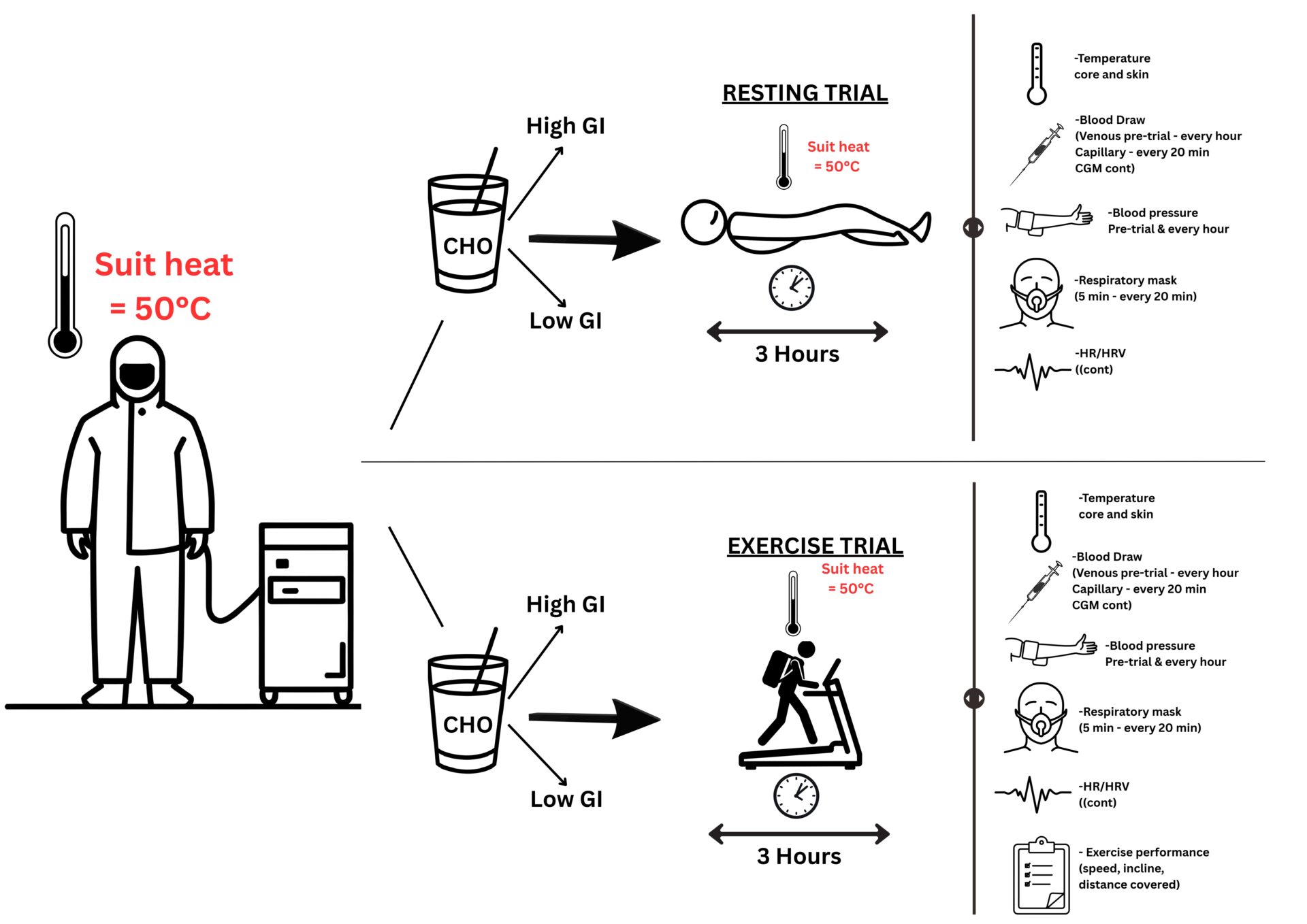
Method: This study employs a repeated-measures, double-blind, randomised crossover design. Healthy adults (n = 27-30) will complete four experimental conditions under simulated heat stress: (1) rest with high-GI CHO, (2) rest with low-GI CHO, (3) exercise with high-GI CHO, and (4) exercise with low-GI CHO. Each condition will follow a 12-hour fast after which, participants will ingest 1 g·kg⁻¹ body mass of either a fast-release or slow-release CHO drink.
Resting trials will involve three hours of supine rest, while exercise trials consist of three hours of treadmill walking while carrying a 7 kg rucksack to simulate occupational or military load carriage. Exercise intensity will be clamped at 130 beats·min⁻¹ (governed by adaptive treadmill speed/inclined), reflecting World Health Organisation (WHO) safe upper limits for prolonged manual work.
Environmental heat stress will be induced using a water-perfused suit to replicate temperatures typically experienced during heat-wave conditions. Core and skin temperatures will be continuously monitored to assess mechanistic heat strain and ensure participant safety. Continuous glucose monitoring, capillary and venous blood sampling, indirect calorimetry, and cardiovascular measures will assess glucose regulation, substrate utilisation, energy expenditure and gut permeability.
Applications: This study will provide novel insight into how CHO glycaemic index modulates physiological tolerance and work capacity under heat stress, with implications for nutritional strategies aimed at sustaining human performance, productivity and function in increasingly hot environments. This study is undergoing ethical approval before participant recruitment.