Introduction: Muscle mass and strength are crucial for healthy aging, but their maintenance depends on muscle recovery capacity that often declines with age. Omega-3 polyunsaturated fatty acids (n-3 PUFA) possibly improve muscle recovery due to their anti-inflammatory effects.
Aims and objectives: Recognizing potential sex-specific differences in inflammation and muscle physiology, we examined whether n-3 PUFA supplementation affects muscle recovery following exercise-induced muscle damage (EIMD) and collagen turnover markers differently in older women and men.
Methods: Forty-three healthy older adults (65-85 years) participated in an eight-week, double-blind, randomized, placebo-controlled trial (German Study Registry number DRKS00032985). Participants ingested either 5 mL n-3 PUFA algae oil (609 mg eicosapentaenoic acid, 1158 mg docosahexaenoic acid; n=21, women: n=13) daily or a placebo oil (sunflower oil; n=22, women: n=13). Plasma n-3 PUFA% index was measured. Following the intervention, participants performed a bout of resistance exercise consisting of 10×10 eccentric-emphasized leg extensions. Maximal voluntary contraction of the quadriceps, countermovement jump height, and perceived muscle soreness were assessed as functional indicators of EIMD. Creatine kinase (CK) and hydroxyproline (HYP) were measured as markers of muscle damage and collagen turnover; high-sensitivity C-reactive protein and interleukin-6 as inflammatory markers using ELISAs over 72-hours post-exercise. Trajectories were analyzed using repeated-measures ANOVA, adjusted for sex, pre-exercise concentrations and plasma n-3 PUFA% index. Data are presented as mean and 95%CI.
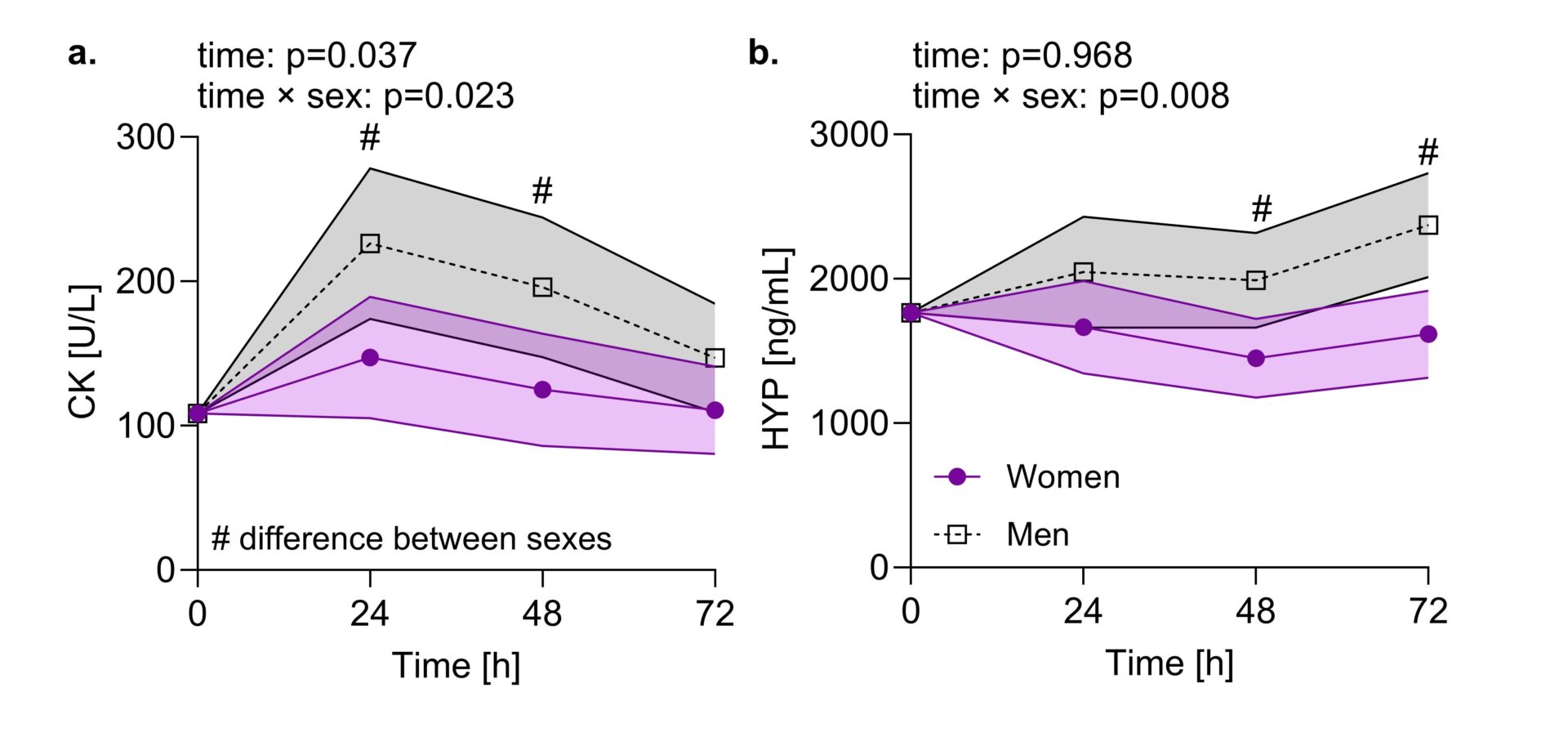
Results: Overall, functional recovery and post-exercise molecular markers did not differ between n-3 PUFA supplementation and placebo. Regarding sex differences, functional and inflammatory parameters were similar post-exercise (all p>0.05). To maintain a larger group size, we continued with sex-specific analyses adjusted for n-3 PUFA% index instead of group assignment. Men exhibited higher post-exercise CK concentrations than women at 24-hours (+78.9 U/L, 95%CI: 9.61;148, p=0.027) and 48-hours post-exercise (+71.0 U/L, 95%CI: 6.82;135, p=0.031). This results from women exhibiting only a small CK increase post-exercise (+38.7 U/L, 95%CI: -3.30;80.7, p=0.070), which returned to baseline by 48-hours. In men, CK peaked at 24-hours post-exercise (+118U/L, 95%CI: 65.4;170, p<0.001) and remained elevated above baseline at 72-hours (Figure 1a). HYP concentrations also differed significantly between the sexes (Figure 1b), with men having higher post-exercise HYP concentrations. In women, HYP declined from baseline to 48-hours post-exercise (-315 ng/mL, 95%CI: 42.9;588, p = 0.025), returning to baseline by 72-hours. In contrast, men had the highest HYP concentrations 72-hours after exercise (+607 ng/mL, 95%CI: 246;968, p=0.002). For HYP there was also a significant interaction with n-3 PUFA% index (p=0.035). Post-hoc analysis revealed that only in men, higher n-3 PUFA% index was associated with HYP response.
Figure 1. Trajectories of a. CK and b. HYP 24, 48, 72-hours post-exercise. 0h indicating baseline/pre-exercise. Repeated measures ANOVA adjusted for baseline concentrations of CK/HYP and plasma omega-3 PUFA index. Data shown as mean and 95%CI, #indicates difference between sexes.
Conclusion: We found significant sex-specific differences in muscle damage response and collagen turnover post-exercise. Plasma n-3 PUFA levels affecting HYP trajectories in men suggests sex-specific PUFA supplementation effects, that at least in men result in enhanced extra-cellular matrix remodeling.