
Calcitonin gene related peptide (CGRP) and substance P (SP) are released from stimulated sensory neurones, in tissues that include the mouse ear. Recently, this group (Grant et al, 2002) established that vasodilatation induced by capsaicin, the pungent ingredient of hot peppers, is only abolished when the vasodilator mechanisms of both CGRP and SP are blocked in this model. We now realise that SP-induced vascular activity is independent of nitric oxide and vasodilator prostaglandins. Since reactive oxygen species (ROS) can mediate vasodilatation in the microcirculation the aim of this study is to determine whether SP acts via ROS in this tissue. Capsaicin (200μg) was applied topically to the ears of female CD1 mice under urethane anaesthesia (2.5mg/g i.p.). Vehicle was applied to the contralateral ears. Blood flow in the ear was then continuously assessed over a one-hour period using a laser Doppler blood flowmeter or imaged by a laser Doppler scanner. A cocktail of L-NAME (nitric oxide synthase inhibitor, 15mg/kg), indomethacin (COX inhibitor, 20mg/kg) and the CGRP antagonist BIBN4096BS (0.3mg/kg) or vehicle controls were administered i.v. 10 min prior to capsaicin application. Catalase (CAT) and superoxide dismutase (SOD) or their vehicles were administered i.p. (25000 units/kg) prior to capsaicin application. Results were expressed as the area under the recorded flux vs. time curve or shown as colour images. Statistical analysis was carried out using one-way ANOVA followed by Bonferroni’s multiple comparison test. Capsaicin induced significant increases in ear blood flow compared to vehicle, as previously shown. The cocktail of drugs did not reduce blood flow on its own, however when given in combination with catalase blood flow was significantly reduced (P<0.05, Table 1). Catalase also reduced vasodilatation when given alone but combined administration of CAT and SOD abolished increased blood flow (P<0.05). These data provide evidence that mechanisms of neurogenic inflammation, especially SP-induced vascular activity are dependent on ROS in the mouse ear.
King's College London (2005) J Physiol 565P, C141
Communications: Role for reactive oxygen species in substance P-induced vasodilatation in the mouse ear.
Starr, A ; Brain, S D;
1. Cardiovascular Biology and Medicine, Kings College London, London, United Kingdom.
View other abstracts by:
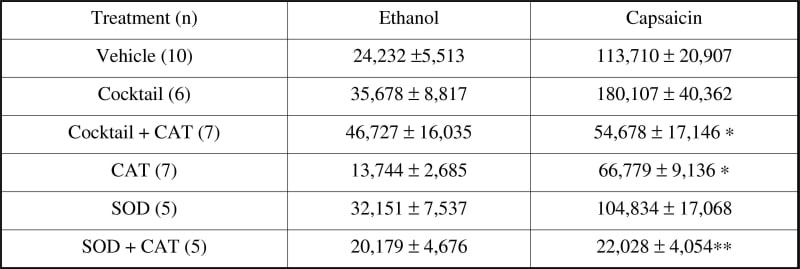
Effects of vasdoactive modulators on increased blood flow in the ear induced by topical capsaicin. Data expressed as area under the flux vs. time curve (mean ± s.e.m)∗P<0.05. ∗∗p<0.001 compared to vehicle treated mice
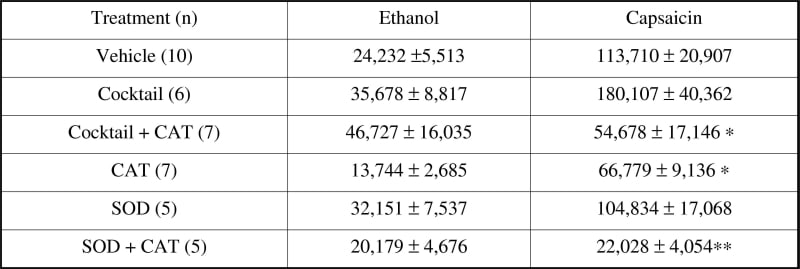
Effects of vasdoactive modulators on increased blood flow in the ear induced by topical capsaicin. Data expressed as area under the flux vs. time curve (mean ± s.e.m)∗P<0.05. ∗∗p<0.001 compared to vehicle treated mice
Where applicable, experiments conform with Society ethical requirements.