Dietary Manipulations for Health and in the Prevention and Management of Disease 2026 (Manchester Metropolitan University, UK) (2026) Proc Physiol Soc 68,
C54
Poster Communications: The effect of a 4-week ketogenic diet and ketone ester supplementation on substrate utilisation and metabolic flexibility – An interim analysis of the KETO-GENETIC diet.
Harry Yuen 1, Sophie L. Russell1, Benedita Deslandes2, Francisca Fuentes2, Gayathiri Rajakumar22, Bruno Spellanzon1, Stephanie Smith1, Laura Bell1, Serena Macpher
1Centre for Nutrition, Exercise and Metabolism (CNEM), Department of Health, University of Bath, Bath, UK United Kingdom, 2Translational Health Sciences, Bristol Medical School, University of Bristol, UK United Kingdom, 3Cancer Evolution, Early Cancer Institute, University of Cambridge, UK United Kingdom, 4Department of Epidemiology and Biostatistics, School of Public Health, Imperial College London, London, UK. United Kingdom, 5Centre for Nutrition, Exercise and Metabolism (CNEM), Department of Health, University of Bath, Bath, UK United Kingdom, 6Translational Health Sciences, Bristol Medical School, University of Bristol, UK United Kingdom, 7Cancer Evolution, Early Cancer Institute, University of Cambridge, UK United Kingdom, 8Department of Epidemiology and Biostatistics, School of Public Health, Imperial College London, London, UK. United Kingdom, 9Centre for Nutrition, Exercise and Metabolism (CNEM), Department of Health, University of Bath, Bath, UK United Kingdom, 10Translational Health Sciences, Bristol Medical School, University of Bristol, UK United Kingdom, 11Cancer Evolution, Early Cancer Institute, University of Cambridge, UK United Kingdom, 12Department of Epidemiology and Biostatistics, School of Public Health, Imperial College London, London, UK. United Kingdom, 13Centre for Nutrition, Exercise and Metabolism (CNEM), Department of Health, University of Bath, Bath, UK United Kingdom, 14Translational Health Sciences, Bristol Medical School, University of Bristol, UK United Kingdom, 15Cancer Evolution, Early Cancer Institute, University of Cambridge, UK United Kingdom, 16Department of Epidemiology and Biostatistics, School of Public Health, Imperial College London, London, UK. United Kingdom, 17Centre for Nutrition, Exercise and Metabolism (CNEM), Department of Health, University of Bath, Bath, UK United Kingdom, 18Translational Health Sciences, Bristol Medical School, University of Bristol, UK United Kingdom, 19Cancer Evolution, Early Cancer Institute, University of Cambridge, UK United Kingdom, 20Department of Epidemiology and Biostatistics, School of Public Health, Imperial College London, London, UK. United Kingdom, 21Centre for Nutrition, Exercise and Metabolism (CNEM), Department of Health, University of Bath, Bath, UK United Kingdom, 22Translational Health Sciences, Bristol Medical School, University of Bristol, UK United Kingdom, 23Cancer Evolution, Early Cancer Institute, University of Cambridge, UK United Kingdom, 24Department of Epidemiology and Biostatistics, School of Public Health, Imperial College London, London, UK. United Kingdom, 25Centre for Nutrition, Exercise and Metabolism (CNEM), Department of Health, University of Bath, Bath, UK United Kingdom, 26Translational Health Sciences, Bristol Medical School, University of Bristol, UK United Kingdom, 27Cancer Evolution, Early Cancer Institute, University of Cambridge, UK United Kingdom, 28Department of Epidemiology and Biostatistics, School of Public Health, Imperial College London, London, UK. United Kingdom, 29Centre for Nutrition, Exercise and Metabolism (CNEM), Department of Health, University of Bath, Bath, UK United Kingdom, 30Translational Health Sciences, Bristol Medical School, University of Bristol, UK United Kingdom, 31Cancer Evolution, Early Cancer Institute, University of Cambridge, UK United Kingdom, 32Department of Epidemiology and Biostatistics, School of Public Health, Imperial College London, London, UK. United Kingdom
View other abstracts by:
- Deslandes, B
- Spellanzon, B
- Hazelwood, E
- Vincent, E
- Fuentes, F
- Koumanov, F
- Rajakumar2, G
- Yuen, H
- Betts, J
- Gonzalez, J
- Maher, J
- Yarmolinsky, J
- Bell, L
- Macpherson, S
- Smith, S
- Russell, SL
- Hardman, T
Introduction: The respiratory exchange ratio (RER) reflects the balance between carbohydrate and lipid oxidation, with values from 0.7 to 1.0 indicating predominant fat or carbohydrate oxidation, respectively. The food quotient (FQ), derived from dietary intake, estimates the expected RER under energy balance, and the alignment between fasting RER and FQ serves as an indicator of metabolic flexibility. A greater mismatch between FQ and RER is commonly observed in individuals with excess weight. Although ketogenic diets, a common weight loss strategy, lower RER by promoting fat oxidation, their impact on substrate oxidation relative to the diet’s reduced FQ has not been well characterised in overweight or obese adults. Ketone ester supplementation increases circulating ketone bodies without carbohydrate restriction or altering FQ, but its effects on fasting substrate utilisation and metabolic flexibility also remain unclear.
Aims and objectives: This interim analysis examined 1) fasting substrate oxidation and 2) metabolic flexibility, measured as FQ – RER, after a 4-week controlled weight-maintaining ketogenic diet (WMKD), ketone ester supplementation (SUPP), or habitual control diet (CON) in overweight and obese adults.
Methods: In this ongoing three-arm, four-week intervention, 32 adults (44.9 ± 11.7 years; BMI 30 ± 3.6; 21 females) were randomised to WMKD (n = 11), SUPP (n = 11), or CON (n = 10). Fasted, rested RER was measured via indirect calorimetry (Servoflex miniMP52000, Servomex Group Ltd.) at baseline and week four. Baseline FQ was calculated from three days of dietary records collected during a one-week monitoring period. During the intervention, FQ was assumed stable for SUPP and CON. WMKD participants received all foods with an estimated daily FQ of 0.75, assumed constant despite variation in additional foods required to meet individual energy needs. Dietary data were analysed using Nutritics (Version 6.15).
Statistical analysis: All 32 participants were included (26 completed the intervention; 6 provided baseline only). Follow-up RER and FQ – RER were analysed using baseline-adjusted ANCOVA with Tukey’s Honestly Significant Difference test for pairwise comparisons. Significance was set at p < 0.05. Analyses were conducted in RStudio (version 4.4.0).
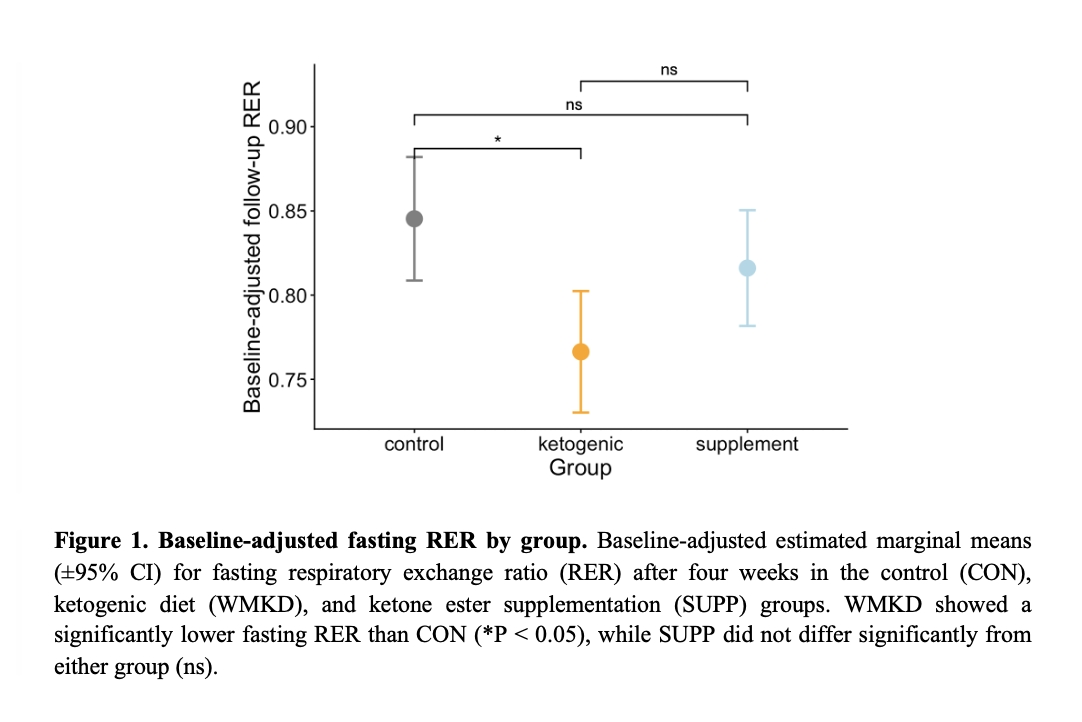
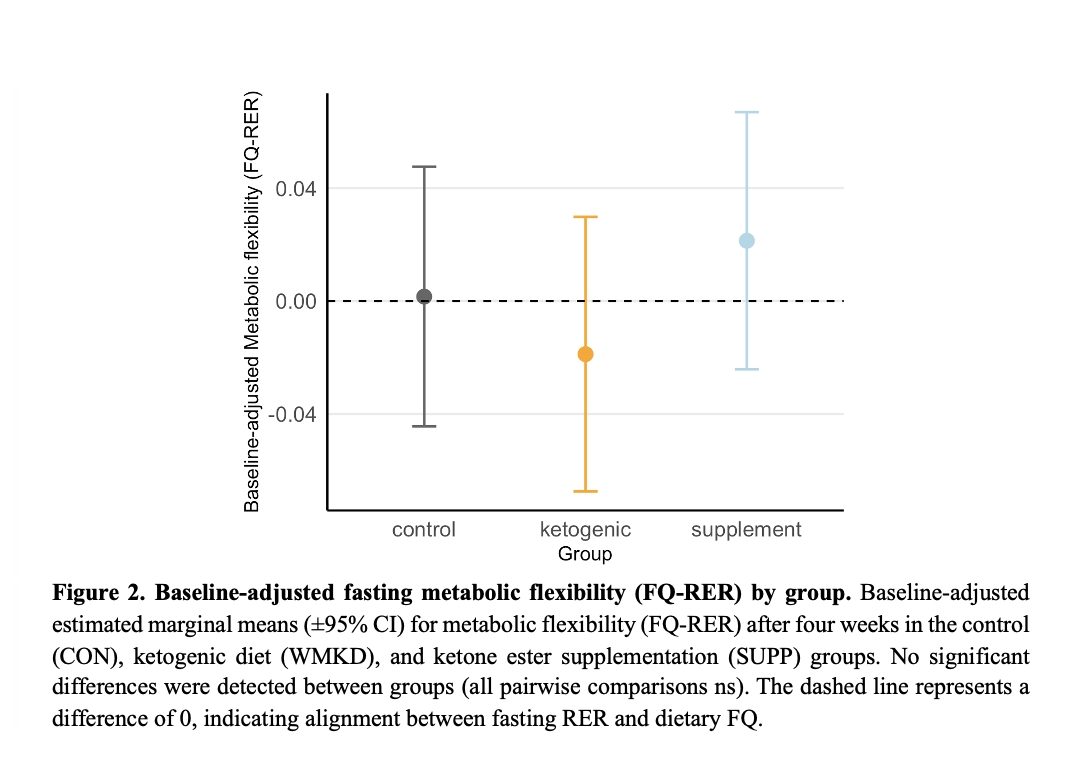
Results: After four weeks, WMKD showed a significantly lower fasting RER than CON (estimate = −0.08 ± 0.03, p = 0.01). SUPP did not differ from CON (estimate = −0.02 ± 0.02, p = 0.49), and no significant difference was found between WMKD and SUPP (estimate = −0.05 ± 0.03, p = 0.10). Baseline-adjusted estimated marginal means (EMMs) for FQ − RER at follow-up were 0.002 (95% CI: −0.04 to 0.04) in CON, −0.02 (−0.067 to 0.03) in WMKD, and 0.02 (−0.02 to 0.07) in SUPP. No significant group differences were detected (F = 1.70, p = 0.199). Tukey-adjusted contrasts for CON vs WMKD, CON vs SUPP, and WMKD vs SUPP were not significant (p = 0.80, p = 0.80, p = 0.43, respectively).
Conclusion:
Four weeks of a weight-maintaining ketogenic diet, but not ketone ester supplementation, reduced fasting substrate utilisation. No differences in baseline-adjusted FQ – RER were observed between groups. Incorporating postprandial RER measurements in future work may help identify more dynamic changes in metabolic flexibility.