A noticing trend is the rise of predatory journals; individuals and organisations that exploit and abuse pay-to-publish models while not providing legitimate editorial or peer review processes. Currently, most research on predatory journals related to academics has involved surveys on awareness and knowledge of this practice. There is also substantial work published on students, primarily related to their understanding and use of predatory journals. This study aims to illustrate the disruption predatory publishers cause to researchers, institutions and academics through recording the frequency predatory emails are sent to academics over a two-month period and how they perceive this.
Data was collected from 13 participants (9 males and 4 females) using a questionnaire. The questionnaire included demographic questions (age, gender etc.) and professional background information (area of expertise, publication history), alongside open-ended questions designed to gather deeper insights into participants’ awareness of predatory publishing and their experiences with email solicitations. This study was approved by the University of Plymouth Science and Engineering Research Ethics & Integrity Committee. All participants were asked to give their consent as a preliminary question. All data was anonymised. Inclusion criteria were that participants had to have published at least one academic journal article and consented to send all predatory emails to a designated email address over a two-month period for analysis. Given the small number of participants and the nature of the data, analyses were primarily descriptive and exploratory. Means (SD), medians, interquartile ranges, frequency distributions, qualitative analysis, linear regressions were used for analysis. P values of <0.05 were considered statistically significant.
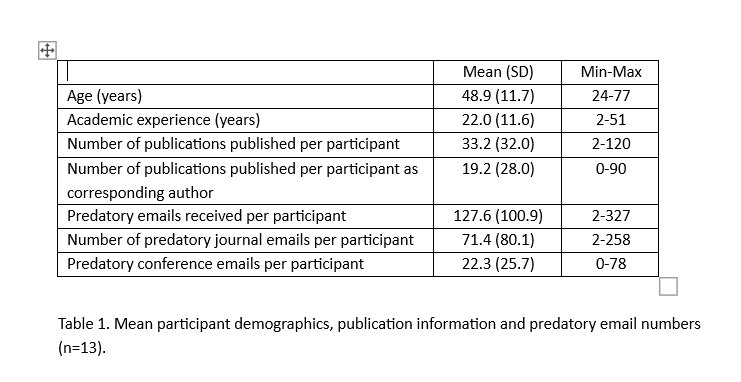
A total of 1,248 predatory emails were analysed. 55.8% were from journals, while 17.5% were for conferences. The remainder included predatory emails for journal editorial board invitations, books, and vanity press. Table 1 shows mean demographical, publishing and predatory email data.
[Table 1]
Linear regression of participants’ papers published as corresponding author showed a positive non-significant relationship with the number of predatory emails received (p=0.34). This did indicate there was a trend for corresponding authors to get more predatory emails.
Study participants consisted of a wide range of bioscience areas and career experiences. There was a trend for more senior academics to receive more predatory emails. All participants received on average about two emails per day; this varied widely but was comparable to previous studies. 62% of participants were bothered by receiving predatory emails. This study showed receiving predatory journal and conference emails is a nuisance for academics and there is a potential for this affecting not only early-career researchers but also senior academics.