Filler words and sounds (e.g. “um”, “er”, “so”, and “okay”) are commonly used in everyday speech and are often present in university teaching. Whilst filler words are a natural feature of spoken communication, little is known about how students perceive their use in higher education settings. This study aimed to investigate student and staff attitudes towards the use of filler words in teaching and explore whether perceptions differ according to year of study and academic faculty.
Survey data was collected from 126 students across multiple year groups (Foundation Year, Year 1, Year 2, Year 3 and MSc) within the School of Biomedical Science (SoBS) and Plymouth Business School (PBS). 14 staff from these schools also participated. Ethical approval was given by the University of Plymouth Faculty of Science and Engineering Research Ethics and Integrity Committee. Participants completed an anonymous online questionnaire using the JISC online survey platform which was shared via a link or QR code. Both questionnaires gathered demographic information including age, gender, ethnicity, and whether English was the participant’s first language. Students were also asked their home postcode, programme of study, year of study, and to rate their agreement with statements relating to the frequency, acceptability and impact of filler word use during teaching, using Likert-scale responses. Staff were also asked their area of expertise, highest educational qualification, years of university teaching experience and if they have a teaching qualification. A Likert scale was used to also obtain data on staff’s estimated usage of fillers in teaching, whether fillers are wasteful and if they had heard of fillers previously. Open-text comments were also collected to provide qualitative insights. Mean (SD) and median (IQR) were used for analysis. Further statistical testing will be presented.
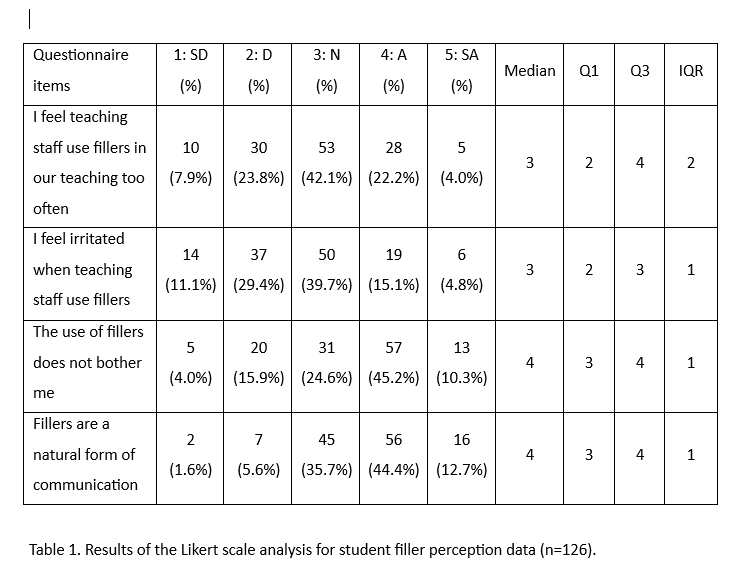
Mean (SD) age for student participants was 23.8 (7.5) years while for staff it was 46.4 (8.5). 81 (64.3%) student participants were female, 44 (34.9%) were male and 1 (0.8%) was non-binary. For staff, 3 (21.4%) were female and 11 (79.6%) were male. 92 (73.0%) students were from SoBS and 34 (27.0%) were from PBS. 6 (42.9%) staff were from SoBS while 8 (57.1%) were PBS. Median results showed most students felt fillers are not used too often and were not irritated by their use (Table 1). Most students agreed that fillers did not bother them (55.5%) and they felt it was a natural form of communication (57.1%). 11 (78.6%) staff participants agreed they regularly use fillers. However, staff were neutral in their view that fillers are wasteful. 13 (92.9%) staff had previously heard of fillers before.
[Table 1]
Our main finding was that this cohort of students found the use of fillers acceptable in teaching. Although this is an area with limited published data, we felt it is an important aspect in teaching and learning and staff should be aware of it. These findings will contribute to a greater understanding of communication practices in higher education and may help inform teaching approaches that better support student engagement and learning.