Introduction. For more than a century, cable theory has provided the mathematical language for understanding voltage spread in neurons. By the 1950s, the responses to subthreshold stimuli were largely established, permitting the expression of passive cable properties in terms of intuitive and experimentally-measurable length and time constants. In Cambridge, Hodgkin and Huxley then provided a quantitative description1 of the non-linear ionic currents that generate and propagate the action potential (AP). Their active cable equation powerfully relates conduction velocity to cable properties and waveform shape, but has resisted reduction to measurable descriptors analogous to the passive length and time constants.
Aim.
We sought to extend the quantitative framework of Hodgkin, Huxley, Rushton and others2 by defining length and time constants of AP propagation and establishing their relationships with conduction velocity and cable properties.
Method
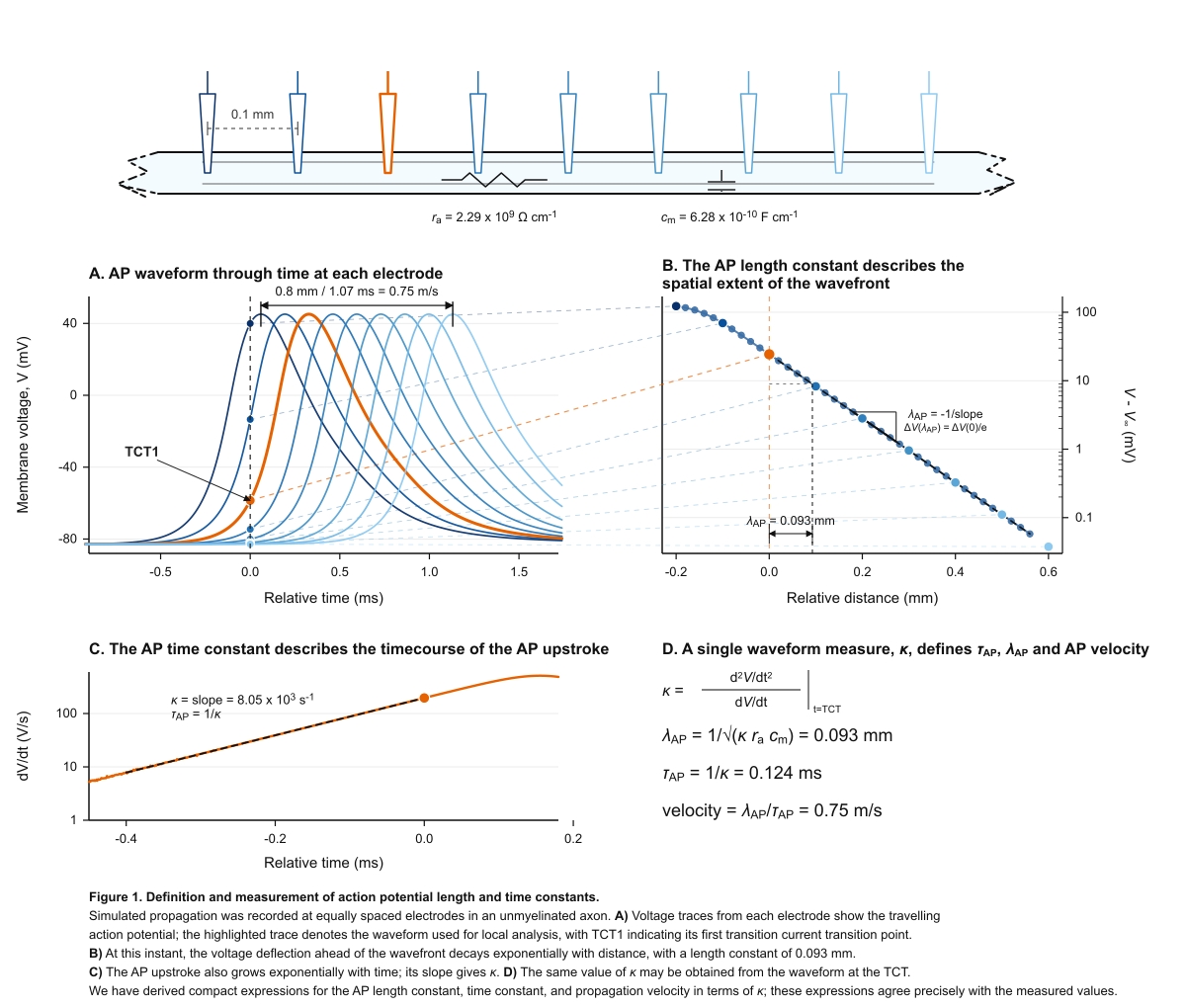
We analysed propagating APs in a computational cable model3,4 of an unmyelinated axon with Hodgkin-Huxley ion channel kinetics. We identified specific instants during AP propagation at which net transmembrane ionic current is transiently zero, while axial and capacitive currents remain non-zero. At these Transmembrane Current Transition (TCT) points, the active cable equation simplifies, allowing us to relate propagation velocity only to the curvature of the action potential upstroke, axial resistance and membrane capacitance.
Results
At the TCTs, we defined a waveform curvature parameter, kappa, as the ratio of the acceleration to the rate of change of membrane potential. From this, we defined and derived length and time constants for the propagating AP. Measured values of AP propagation velocity (Fig 1A), AP wavefront length constant (1B) and AP upstroke time constant (Fig 1C) were shown to be equal to those calculated from kappa (Fig 1D). Our simulations show that kappa is determined by ion channel properties and membrane capacitance but not axial resistance, explaining why fibre diameter scales velocity without altering action potential shape. We suggest single-electrode methods for the experimental measurement of kappa: from the exponential rise of the upstroke with time (Fig 1C), and from the initial slope of an action-potential phase plot (not shown). Thus, kappa provides a single-value descriptor of AP shape that provides the missing bridge between the measurable waveform and physiological measures of propagation. We further show that kappa is the local real Laplace exponent of the AP upstroke, and thereby provides a framework to extend this approach into other physiologically realistic geometries, including myelinated, tapering and terminated cables.
Conclusions
By exploiting TCT points at which the active cable equation simplifies, we extend the elegant analytical framework of cable constants from passive to active membranes. We show that exact, measurable AP length and time constants are derivable from waveform recordings and establish a natural foundation for extension to myelinated axons and complex geometries.
1. Hodgkin AL & Huxley, AF J Physiol (1952) 117, 500–44.
2. Jack J, et al (OUP: 1975).
3. Fraser JA & Huang CL (2007) Prog Biophys Mol Biol 94, 336–72.
4. Fraser JA & Huang CL (2004) J Physiol 559, 459–478.