

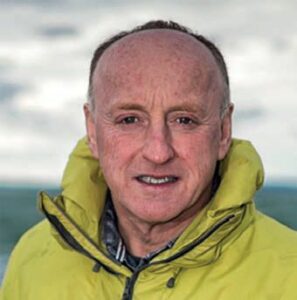
Professor Mike Tipton (MBE, FTPS), President of the Physiological Society
Professor Mike Tipton, our Society’s President, published his first paper in the Society’s The Journal of Physiology in 1986, before becoming a member of the Society in 1997. During his membership, he has served as Editor in Chief of Experimental Physiology (2016-2022), followed by Trustee and Chair of the Policy Committee (2021 – 2026).
For our 150th anniversary celebrations, Mike shares his thoughts on the Society’s community and the vital role of physiology and physiologists, now and in the future, in addressing global issues from health to climate change.
Professor Mike Tipton is a physiologist specialising in human and applied physiology, based at the Extreme Environments Laboratory (EEL), University of Portsmouth. Educated at the Universities of Keele and King’s London, he joined the University of Surrey in 1986. After 12 years at the Robens Institute and European Institute of Health and Medical Science, he moved to the University of Portsmouth in 1998. In addition to his University positions, Mike was based at the Institute of Naval Medicine (INM) from 1983 to 2004 and was Consultant Head of the Environmental Medicine Division of the INM from 1996.
How did you first get involved with the Society?
I have been a member of the Society for close to a third of a century. Membership was something you aspired to, in part because it demonstrated that you had achieved a level of competence; you had to present to the Society and publish before becoming a member. My first two papers from my PhD were published in The Journal of Physiology in whole body integrative physiology, the fashion then moved away from this area of physiology (or perhaps my papers got worse!). Professor Romaine Hervey from Leeds University encouraged me to get involved with the Society when we worked together with Frank Golden on post-immersion rescue collapse. I eventually became secretary to the Climatic Physiology Group of the Society which, I am pleased to say is being resurrected this September after twenty years in hibernation.
How would you describe the Society’s community?
Diverse, informed and supportive. Unfortunately, over the years we have moved away from using this amazing resource and the power of peer review and networking to evaluate new ideas and potential experiments before studies are commenced, I hope we can get back to this. Experimental Physiology has moved towards this with Registered Reports. I hope we can have some meetings that achieve the same objective, I think the Climatic Physiology Group meeting I mentioned earlier, will be a step in this direction.
What role do you think physiologists play in addressing big global challenges, like climate change?
Given that physiology is the “science of life” physiologists should play a fundamental and central role as an essential part of a multidisciplinary team addressing questions related to health, safety and functionality. The Society is having increasing success with getting this message across to organisations such as Wellcome and government agencies in the UK, primarily by demonstrating the unique insights and interventions physiology brings to such challenges.
All major global challenges require transdisciplinary collaboration to address them; physiology must be one of those disciplines if humans are to remain central to considerations and actions. Regarding the major challenge of climate change, readers should visit the Society’s policy pages to get a feel of the work of physiologists in this area.
Speaking of extreme environments, as I write Artemis II, twin sister of Apollo, has just undertaken a translunar injection burn and left Earth’s orbit to head for the moon. Everyone recognises the incredible technical achievements of such missions, perhaps fewer realise they are also founded on the detailed combined understanding of human physiology and technology needed to sustain life.
Where do you hope to see the Society 50 years from now?
On its 200th birthday I hope the Society will be thriving, resilient and continuing to enhance the careers of physiologists around the globe working on life-changing and preserving projects. I hope physiology will be recognised for what it is, a critical independent discipline that has a crucial input to contribute to a wide range of challenges. Physiology and its application will be (and already should be) regarded as critical for understanding and integrating work in areas of technology, fields of biology, translational medicine, health science, and data analyses where the aim is to enhance and preserve humanity.
I think the charitable objectives of the Society will still apply as much in 50 years as they did 150 years ago, although the context will be very different.
How do you see physiology improving people’s lives over the next few decades?
If we continue to be successful in demonstrating the impactful contribution physiology can make to a wide range of critical societal issues, physiologists should be recognised for the crucial contribution they can make to life changing issues, such as and in no particular order: ageing societies; health care and personalised medicine; wearable healthcare technology; animal and plant physiology and ecosystem preservation; preventative health & fitness; disease mechanisms, diagnosis and treatment; occupational health and selection; climate change; nutrition & metabolism (food and water needs and supply); extreme weather – comfort, adaptation & survival; colonisation of space – lunar habitation; AI interpretation; design of future urban and home spaces; sports performance; psychophysiology; brain-computer interface …… and many more! Watch this space (and that space).