Peer Review Capacity: Volume, Speed, and Quality
Lucinda Periac-Arnold, Associate Director of Publishing, The Physiological Society
In September 2023, I had the opportunity to celebrate the quiet but integral work of the Physiological Society’s in-house peer review team, recognising that their tireless efforts “ensure the continued reputation of excellence and integrity” (Periac-Arnold, 2023) for which our journals are recognised.
As we enter Peer Review Week 2026, this year’s theme, “Peer Review Capacity: Volume, Speed, and Quality,” gives me an opportunity to revisit the work our team does every day to support the Editors, Authors and Referees who together make up our journal communities.
Across the discipline, the volume of published journal articles related to physiology has increased by 34% since 2021 (Dimensions).
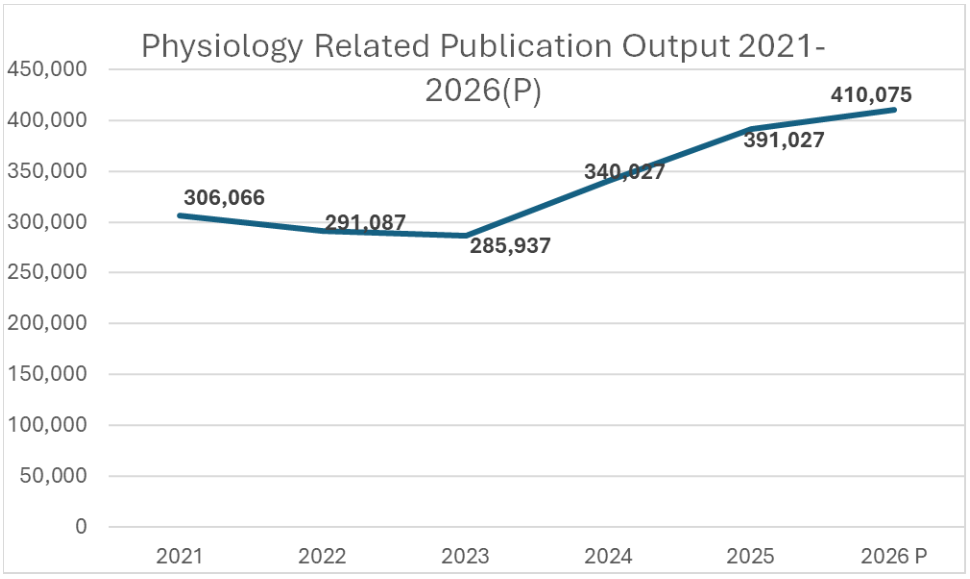
This figure captures only those articles that ultimately meet the threshold for publication; there is currently no single source that enables us to quantify the additional submissions that do not go on to be published. Nevertheless, the trajectory is clear. We are asking more of the peer review ecosystem than ever before.
This is equally true across the Physiological Society’s journals. We are experiencing record submission volumes while, at the same time, expanding our family of journals through the launch of two new titles. Alongside The Journal of Physiology (JP) and Experimental Physiology (EP), our team now administers peer review for The Journal of Precision Medicine: Health & Disease and The Journal of Nutritional Physiology.
We take great pride in providing dedicated support to our communities throughout the publication process. But as we recognise the value of growing our family of journals and providing more opportunities for physiologists to share their research, we must also recognise the challenge this creates: how do we maintain quality and integrity while keeping the peer review process efficient and sustainable?
Technology has an increasingly important role to play. The Society has recently adopted tools to help screen manuscripts for potential research integrity concerns, supporting our Editors in maintaining the quality of the research we publish, helping to ensure that Referees are not unnecessarily burdened with submissions that should not reach peer review, and giving Authors the opportunity to address potential issues earlier in the publication process.
But technology is only one part of the solution. The peer review system remains under considerable strain. The continued growth in research and publication output is likely to persist in the coming years, alongside rapid advances in Artificial Intelligence. AI brings enormous opportunities for researchers and publishers when used honestly and transparently, but it can also be exploited by bad actors seeking to manipulate the publication ecosystem for financial gain, including through the proliferation of paper mills.
Against this backdrop, the capacity of our peer review communities has never been more important. We need sufficient expertise to handle increasing volumes of research; we need processes that enable timely and efficient decisions; and, above all, we need to protect the quality, credibility and integrity of the research record.
The Physiological Society remains committed to providing a family of journals that offers recognised, reputable and high-quality venues for physiologists looking for a home for their research.
At the heart of that commitment is our peer review team. Their work may often happen behind the scenes, but it is fundamental to everything we do. They coordinate the complex journey between submission, Editor and Referee; support our communities through challenges in the process; identify opportunities to improve efficiency; and help ensure that the right research reaches the right experts at the right time.
Their contribution to volume, speed and quality is substantial — and often invisible.
So, this Peer Review Week, I would like to put that work firmly in the spotlight and celebrate our indefatigable peer review team, whose expertise, commitment and care sit at the heart of the Society’s journals and the communities they serve.
Thank you, Diana, Marie and Paroma, for everything you do.

References
Periac-Arnold, L. (2023, September 28). Physiological Society. https://www.physoc.org/blog/celebrating-peer-review-week-the-future-of-publishing/
AI use declaration
AI tools were used in the preparation of this blog to support editing and refinement of the text. The author reviewed and revised the content and takes full responsibility for the accuracy, integrity and final version of the article.