
By Dr Lindsay Robinson
Dr Lindsay Robinson is a Senior Research Fellow at the University of Nottingham, investigating the physiological effects and potential metabolic health benefits of cold exposure, with a focus on human brown adipose tissue (BAT).
Her interest in physiology began when she was a medical student, during her intercalated BMedSci under the supervision of Professor John Coote at the University of Birmingham, who encouraged her curiosity and instilled a commitment to high-quality research and scientific rigour.
After completing her medical training in Birmingham, she sought further research experience as a Clinical Research Fellow and later as a Clinical Lecturer in the Department of Academic Child Health at the University of Nottingham. She completed her PhD on the early-life influences on BAT in 2019 and, after maternity and carer’s leave, returned to Nottingham in her first post-doctoral role within the Department of Lifespan and Population Health, as lead for the Nottingham arm of the CoolBAT study.
Lindsay was awarded an Unlocking Futures Fund grant from the Physiological Society in 2025. We caught up with her to discuss the results of her project as well as any advice she had for future applicants.
Please tell us about your project:
I am currently helping to set up the UK arm of the CoolBAT study, an international collaboration with researchers in the Netherlands exploring the effects of regular mild cold exposure on metabolic health in individuals living with overweight and obesity. In Nottingham, we are particularly interested in the effects on brown adipose tissue in the free-living environment, using a combination of thermal and magnetic resonance imaging.
Early in the study, I could see that using contemporary, commercially available thermal imaging software would not only help us optimise our thermal imaging acquisition and analysis, but also, importantly, extend our measurements beyond simple regional skin-temperature changes, opening up novel, previously unexplored approaches to quantifying human BAT activity. Our initial pilot studies also highlighted two important potential confounders of BAT activity that the original study design did not account for: the behavioural thermoregulatory response to cold, and the impact on non-exercise activity thermogenesis (NEAT).
How did receiving the Unlocking Futures Fund support you in this work?
Through the Physiological Society’s Unlocking Futures Fund, I was able to purchase a one-year software licence and a starter pack of actigraphs with temperature and light sensors (enabling simultaneous assessment of the behavioural thermoregulatory response to our cold stimulus and of NEAT). Crucially, this equipment fell outside the scope of the original project grant, and no institutional funds were available to cover it.
What were the outcomes/impact of your research?
The CoolBAT studies are ongoing. The software is currently being used to acquire high-resolution time-series data, which we will draw on to explore novel approaches to quantifying BAT activity once data collection is complete. Early trials with the actigraphs have been positive and have provided sufficient data to support integrating these measurements into the main study protocol. Ultimately, this should make our study outcomes more robust.
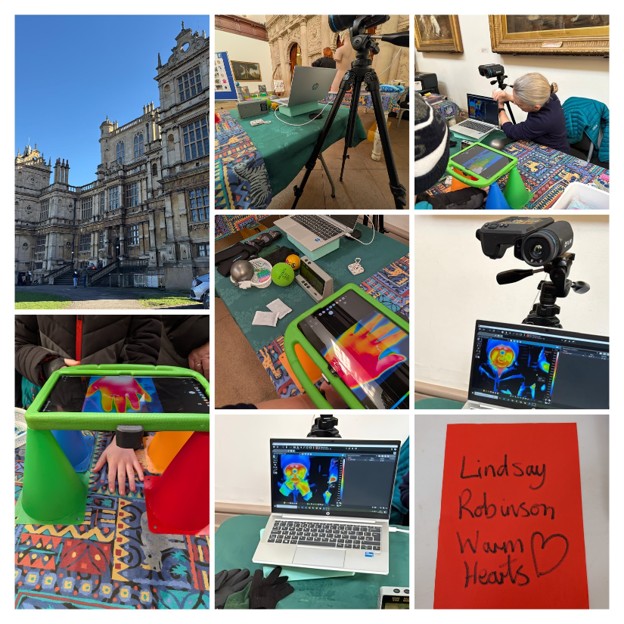
We also used the software at The Secret Science Show, part of the Nottingham Festival of Science and Curiosity 2026. This family-focused public event drew over 1,000 attendees. The software let us demonstrate live, interactive thermal imaging. The children loved exploring their own thermal physiology with simple warming and cooling activities, and parents gave valuable feedback about our cooling methods and study design. As my first experience leading public engagement single-handedly, this was hugely rewarding, and an experience I will carry forward as a researcher.
Do you have any plans to continue this work? If so, how?
Now that we have high-resolution, time-series data from radiometric thermal video, we have a wealth of information to explore. I have already enlisted the help of two enthusiastic summer students through the University of Nottingham’s INSPIRE programme, who are helping to explore this new dataset and develop our approaches to quantifying brown adipose tissue activity alongside paired MRI. I am excited to see what their fresh perspective brings to the work, and to support them in their first steps into research.
In parallel, the actigraph measurements will now be embedded in the main CoolBAT protocol, and hopefully beyond, so the behavioural thermoregulatory response to cold and NEAT will continue to be captured as the study progresses.
Do you have any advice or recommendations for potential future applicants?
Always be curious and strive to do the best with the resources you have. If you see ways to improve your work, never be afraid to ask for help and support to achieve them. For the Unlocking Futures Fund application, make it feasible, with a clear, tangible outcome.
“Believe in yourself and go for it. You have to put yourself forward to move forward!”