
Dr Cameron Malcolm
Physiology Lecturer
University of Aberdeen
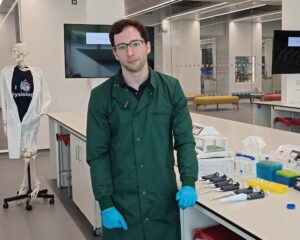
Dr Cameron Malcolm is a Lecturer in Physiology at the University of Aberdeen. In 2014 Cameron came to Aberdeen to study BSc (Hons) Pharmacology at the University of Aberdeen for which he was awarded a 1st class honours degree. During his undergraduate studies Cameron was awarded a Teaching Development Bursary (2017) and carried out his honours project at Robert Gordon University under the tutelage of Professor Cherry Wainwright and Dr Sarah Walsh. Upon graduating Cameron stayed at the University of Aberdeen and began his PhD research on the orphan receptor GPR75 in the lab of Dr Fiona Murray as part of the EastBio Doctoral Training programme. On completion of his PhD research Cameron joined the therapeutic biologics company Elasmogen Ltd. and worked in the Auto-immune Inflammation Team and then in the widening access field as part of AspireNorth before returning to the University of Aberdeen to take up his current position of Lecturer in Physiology.
Read the first instalment of Cameron’s Early Educator Series here.
First term teaching challenges – Learning and adapting
Early challenges
The theme for this second instalment of my blog series, is the challenges I faced during my first term teaching. This was a fortunate subject choice as after I finished the first week of the teaching term I thought to myself ‘Well at least I’ll have plenty of challenges to write about in my Society blog’! Possibly a slight exaggeration for dramatic effect; I am already looking forward to teaching the same topics next year with a year of learning what worked well and what didn’t under my belt. I will focus on two challenges that were common across the different levels of university study I was teaching and thus are likely to be most relatable for other early career educators. These are the focus of students on assessment and the challenge of keeping students engaged during lectures.
Prioritising concept understanding over assessment material
The challenge of students focusing on assessment material rather than concept understanding was an issue I had on my radar after reading the Physiological Society article “An Early Career Lecturer’s insight into teaching physiology” by Dr Colleen Deane on the same issue. Dr Deane highlighted that students were more focused on learning the content they needed to know for assessment rather than learning principles and understanding concepts. My initial teaching experience mirrored that of Dr Deane’s. Focus on ‘what do we need to know for assessment’ was common across all years but was particularly stark in my 1st year cohort.
Rather than aiming to assess the students, the aim of that particular course was to get students excited and enthused about medical sciences and the various opportunities in the field, of course whilst also introducing some aspects of good science. My lecture series in that course was titled ‘Big Challenges for Today’s Medical Scientist’ but was actually focused on how these ‘challenges’ were opportunities for tomorrow’s medical scientists (the current students). These lectures covered topics such as misinformation, the role of medical science in combatting climate change, AI/machine learning in medical science, etc. Diverse and broad topics that I by no means was expecting students to have an extensive knowledge of after 1 lecture on each topic; the takeaway from each lecture I was trying to convey was an appreciation of the scope of each challenge and an awareness of the range of opportunities each presents.
This was possibly more conceptual than the typical fact-based learning students were used to with most students coming direct from secondary school. After being asked various different variations of “what kind of questions are going to come up?” I began to include interactive class poll-based questions with examples of questions similar to those they would be posed in their assessment on this topic. This proved effective in reassuring students about their ability to answer the questions and gave me an opportunity to highlight the key aspects of the topics whilst the students were particularly engaged, in this case using that assessment focus as an advantage.
Tackling student engagement
This brings me onto another challenge I faced: student engagement, or more specifically a lack of it. Not only is a lack of student engagement in a lecture far from ideal in terms of teaching content but I also found it challenging to remain fully enthusiastic, charismatic and ultimately engaged myself when I could sense that students were checked out. The solution was to commit to interacting more with the student audience and driving that engagement from my end, as opposed to having an expectation that students will hang on my every word. As mentioned, one of the techniques I began using in my lectures was incorporating poll questions. These were used across level 1 but also in teaching content in later years of study that a more comprehensive understanding of the topic was expected of students. These mid-lecture class poll questions had the dual benefit of increasing student engagement and reassured me as to the effectiveness of my lectures. Although I had initially felt I had not engaged the cohort, most of the questions were being answered correctly, implying that the information was, in fact, being successfully conveyed.
Student participation proved particularly effective in engaging the whole class. In one late Monday afternoon lecture on the challenge of the ageing population I was able to convince one brave student to volunteer to come down to the front of the lecture theatre and carry out the Timed-up-and-go test (start sitting on a chair, walk to and around another chair 3 meters away, back to original chair and sit down), a test used to assess fall risk in the elderly, whilst another class mate timed the test and the rest of the class provided enthusiastic encouragement. This roused the entire class and proved an effective teaching technique as one of my class poll questions the next week was asking students to describe the test and, despite deliberately including tricky plausible options as the incorrect choices for the multiple-choice question, 99.25% of students answered the question correctly.
Adapting my teaching style
Breaking down the barrier between myself, as the lecturer, and the students also proved effective. When teaching cell physiology to level 2 students I had initially presented the students with a table of intracellular and extracellular ion concentrations and stressed the importance of learning the concentration gradients. Reflecting on this on my walk to my office the following morning I concluded that this was a poor way of teaching an important point and came up with a creative analogy to make the content more memorable.
I hastily updated my slides with some rudimentary illustrations and presented this during my next lecture on the topic later that day. I began by addressing that simply presenting figures and expecting students to go away and memorise these was a poor way of teaching on my part, I then presented my analogy where the cell is a tropical island, the extracellular environment is the sea. In my analogy the tropical island has banana trees representing the high intracellular potassium concentration, the sea is salt water representing the high sodium and chloride concentrations relative to the intracellular environment and explained that as I had come up with this on my way to work that morning I was yet to decide on a good example to represent a high extracellular calcium concentration. I opened this up for students to make any suggestions and, despite this lecture taking place in the campus’s largest lecture theatre, students were shouting out suggestions such as fish bones or coral in the sea to represent calcium.
When discussing this approach with a student representative later in term, they pointed out that they had made one of the suggestions and that it was the first time they had ever spoken up in front of the entire lecture. They added that this approach of a two-way interaction, where the students felt part of the process, had helped him feel comfortable enough to express his ideas. I felt that by being transparent with the students about my initial attempt of teaching that content had been poor, helped to humanise ‘the lecturer’ and break down the barrier between lecturer and student. This helped students to overcome their apprehension of speaking out in front of the class due to the often stated “fear of saying something stupid”.
The challenges of students having such a strong focus on assessments and earning student engagement are issues that myself, and all educators, will continue facing, not just in their first terms of teaching but throughout each and every academic term. I have found, however, that incorporating the simple approaches I have discussed here helped during my first term and are tools I will continue to utilise going forward. Particularly encouraging is that during a recent teaching review, students highlighted the importance of engagement and cited my lectures as an example of engagement done well with reference to the strategies I have discussed as part of this blog.
Cameron’s Early Educator blog series will conclude at the end of this academic year, covering his thoughts following the completion of his second term teaching as well as reviewing his first full academic year as an early career educator.
Help shape the future of Early Career Educators
Are you interested in helping shape the experiences of future Early Career Educators and/or share your own experiences? If so, please spare 20 minutes of your time to help improve the experiences of current and future Early Career Educators. The Physiological Society have agreed to help disseminate and publicise this work. You can read the participant information sheet and then get involved in the research project by either following this link (https://tinyurl.com/ECESurvey25) or by scanning the QR code below.