

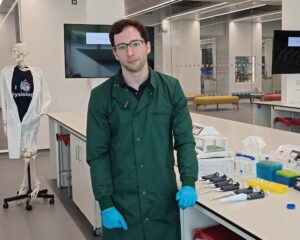
Dr Cameron Malcolm
Physiology Lecturer
University of Aberdeen
Dr Cameron Malcolm is a Lecturer in Physiology at the University of Aberdeen. In 2014 Cameron came to Aberdeen to study BSc (Hons) Pharmacology at the University of Aberdeen for which he was awarded a 1st class honours degree. During his undergraduate studies Cameron was awarded a Teaching Development Bursary (2017) and carried out his honours project at Robert Gordon University under the tutelage of Professor Cherry Wainwright and Dr Sarah Walsh. Upon graduating Cameron stayed at the University of Aberdeen and began his PhD research on the orphan receptor GPR75 in the lab of Dr Fiona Murray as part of the EastBio Doctoral Training programme. On completion of his PhD research Cameron joined the therapeutic biologics company Elasmogen Ltd. and worked in the Auto-immune Inflammation Team and then in the widening access field as part of AspireNorth before returning to the University of Aberdeen to take up his current position of Lecturer in Physiology.
Read the first and second instalment of Cameron’s Early Educator Series.
Third term teaching – lessons and hopes for the future
Scholarship projects
In the first two instalments of this early career educator blog series, I reflected on what I learned during my first and second terms of teaching. In this third and final post, I want to focus on the scholarship aspect of my role. More specifically, I want to reflect on how I began to fit scholarship into a first year that was largely dominated by preparing lectures, creating teaching materials and finding my feet as a new lecturer.
Because much of my time was spent creating teaching content from scratch, there was limited space for separate scholarship activity. However, it also made it easier to build scholarship directly into the material I was teaching. For example, while creating a new lecture series on respiratory physiology, I began a collaborative project with Dr Jenny Macaskill at Robert Gordon University. We explored how breathing techniques, more commonly associated with mindfulness and anxiety reduction, could be used within lectures to illustrate aspects of respiratory physiology, such as respiratory sinus arrhythmia. This kind of collaboration proved to be an excellent route for carrying out scholarship. Having an enthusiastic, like-minded collaborator created space to discuss ideas, maintain momentum and draw on expertise beyond my own.
Collaborating with other educators
The ideal event to make these connections and get the ball rolling on collaborative scholarship projects was “Fit for the Future: Physiology Education and Teaching in the UK”, the Physiological Society’s two-day Education and Teaching meeting which was held at Newcastle University. Attending this meeting was one of the highlights of my first year as an educator and I would strongly recommend such meetings to other early career educators looking to build a network and create collaboration opportunities. At a time when financial uncertainty across the sector can make academic life feel precarious, being in a room full of people committed to improving physiology education felt genuinely energising.
The “Fit for the Future” meeting was also a chance to present some of my work and disseminate the findings. Since my undergraduate studies, I have been involved in creating and evaluating educational “how to” videos and on starting my current role this was an area I was keen to continue developing. For the 2025-26 academic year I created a “How to pipette” video in live-action to compare to an animated pipetting video available to University of Aberdeen students. The live-action video was well received by students and my oral communication at the meeting “Authentic Videos for Authentic Assessments: Live-Action Outperform Animations for Teaching Pipetting” was awarded runner-up for the Early Career Educator Flash Talk prize. As an early career educator this was a great way of raising my profile in the field and directly led to connections with other educators interested in the videos.
Students as co-creators
A key theme of the “Fit for the Future” meeting was that of students as co-creators and this summer I supervised Andrea Henry, a University of Aberdeen Learning & Teaching Enhancement Programme (LTEP) funded student intern, carrying out a project where she created additional video learning resources. The creation of video resources is an ideal situation to involve students as co-creators. Having the target audience involved in the production and design of the videos ensured that sufficient focus was put on the areas most challenging from a student’s perspective. It also results in production of videos that are genuinely contemporary (an endeavour destined to fail in the hands of even the youngest at heart academic).
My hope is that Andrea will be able to present the findings from this pedagogical project in some form at the Physiological Society’s next Education and Teaching meeting “Physiology Education in a Changing Landscape”. The meeting is set for the 1 – 2 April 2027, at the University of Sussex, with one of its themes focusing on the challenges faced by early career educators and discerning the best support to provide. Followers of this blog series will really benefit from attending the “Physiology Education in a Changing Landscape” meeting and exploring more of what it means to be an early career educator.
Final thoughts
As I reach the end of my first year, three aspects particularly excite me about a career as an educator: continuing to engage with students at the University of Aberdeen; integrating further into the talented, dedicated and enthusiastic education community within the Physiological Society; and having the chance to contribute, even in a small way, to the future direction of physiology education.