
Dr Aaron Hengist, National Institutes of Health, US
Physiological Society member and speaker at our 2026 Dietary Manipulations meeting
The low-carb, high-fat ketogenic diet has been growing in popularity in recent years following claims of the eating plan being a weight loss wonder. But how does the diet affect our metabolic health? We asked Dr Aaron Hengist from the National Institutes of Health (NIH) to take us through the physiological changes that occur in the body at the onset of eating a ketogenic diet. In this Q&A, Aaron tells us more about nutrition and metabolic physiology, as he discusses his research on the impact of the ketogenic diet. A topic he will be discussing in more detail at our meeting, Dietary Manipulations for Health and in the Prevention and Management of Disease 2026.
Firstly, what inspired your interest in researching nutrition?
I became hooked learning about exercise physiology and energy balance during my undergraduate Sport and Exercise Science degree. I then spent a year as a Research Assistant before my final year of study, supervised by Professor Dylan Thompson. That year, I was exposed to several research techniques and had the privilege to work on a range of ongoing studies. My favourite experiences were with Dr Jean-Philippe Walhin, who was investigating the physiological effects of overfeeding, and Professor Javier Gonzalez, who was investigating carbohydrate and exercise metabolism. By the end of that year, I knew that I wanted to do human physiology research. A couple of years later, a PhD position was advertised working with Professor Gonzalez to investigate the effects of free sugar restriction and ketogenic diets on energy balance. I jumped at the opportunity!
What is the ketogenic diet?
The ketogenic diet is very low in carbohydrates, typically less than 50g per day, with a moderate protein intake. The remaining energy intake comes from fat, typically up to 80% of energy intake. It is called ketogenic because the restriction of carbohydrates causes physiological conditions for the liver to produce ketone bodies as an alternative fuel to carbohydrates. The word ketone is derived from acetone, one of the three ketone bodies, along with beta-hydroxybutyrate and acetoacetate.
What happens in the body when we eat a ketogenic diet?
We completed a 12-week randomised controlled trial comparing the ketogenic diet against higher carbohydrate diets to try to capture the broad integrated physiological effects of the diet (1). Amongst the findings, two were particularly noteworthy. The first was that the ketogenic diet increased small and medium-sized low-density lipoprotein particle (LDL, otherwise known as bad cholesterol) and apolipoprotein B (apoB, the chief protein component of LDL) concentrations, reflecting a higher number of circulating atherogenic lipoprotein particles. These can lead to atherosclerosis, the buildup of cholesterol lining artery walls, which restricts blood flow. There is still debate about the extent to which this translates to long-term increased heart disease risk in the context of ketogenic diets, but I personally would not take the risk. We also found that the ketogenic diet altered gut microbiome composition, notably decreasing the abundance of Bifidobacteria, which are widely regarded as beneficial.
How does this impact our metabolism?
When people eat meals containing very little carbohydrate, the body quickly shifts towards fat metabolism (burning more fat as a fuel). You can see this even with the first ketogenic based meal by measuring the ratio of carbon dioxide production and oxygen use from breath samples using indirect calorimetry (2). After 24 hours, blood ketone concentrations often rise to a range considered ‘nutritional ketosis’ (typically >0.5 mmol/L) and this keeps rising in the first few days of the diet (2,3). Interestingly, sleeping energy expenditure increases in the first week of starting a ketogenic diet (3). Over time, the effect decreases, so at around four weeks, energy expenditure comes back down to normal levels (3). We are carrying out an inpatient feeding trial to explain the metabolic physiology behind this and should have collected all our data by the summer (4).
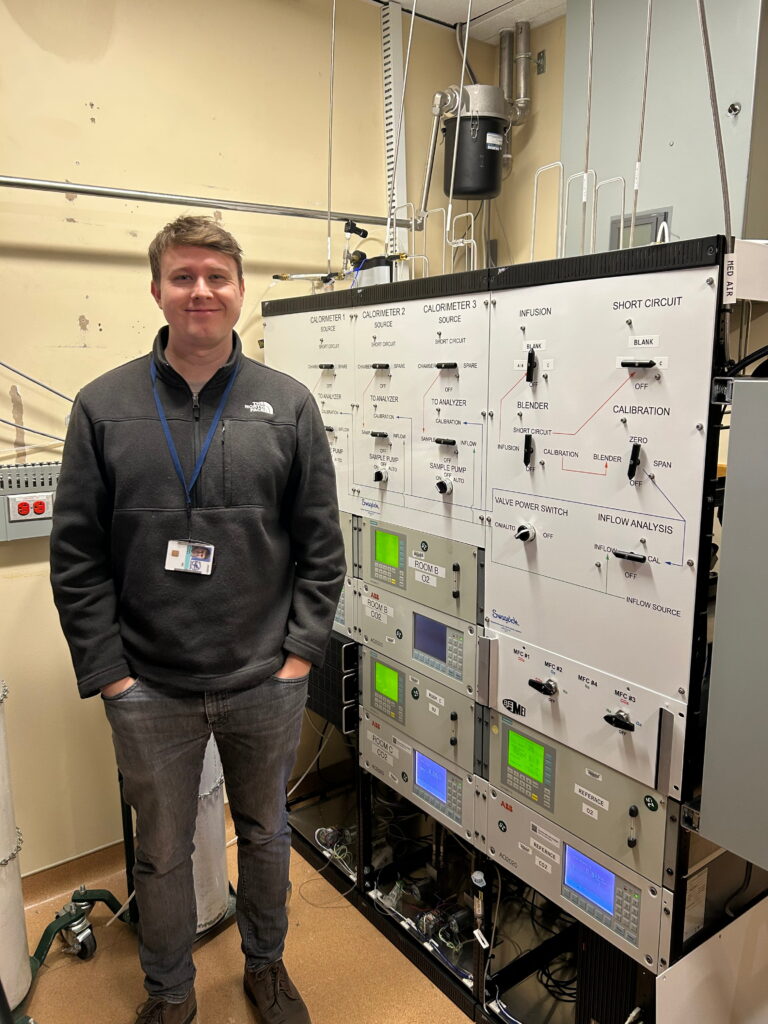
Aaron standing next to a metabolic chamber at NIH.
How do you investigate the effect of the diet on metabolism?
Indirect calorimetry allows you to measure energy expenditure and substrate oxidation well, but it needs to be carried out in the lab. With free-living studies, where people are using the diet in their usual environment, we can bring people into the lab for a day and let them leave between visits. However, we can’t control their diet and need to trust them to accurately report what they are eating outside the lab, which is prone to systematic under-reporting. To overcome potential inaccuracies with self-reporting, we can use a range of methods, such as wearables that measure physical activity or glucose levels, and body composition scans that show us changes in the body energy stores. These can help us to better understand what and how much people are actually eating.
To more accurately control and measure food intake, we can ask people to live in the laboratory, which we call inpatient feeding studies. These studies are critical to confidently assess the effects of diets on metabolic physiology, but they are expensive and the environment is less like people’s normal environment outside the lab.
A big feature of understanding how people respond to diets is to measure a range of post-meal metabolic and hormonal blood responses, which can tell us how people are metabolising the carbohydrates or fats from a meal. We can combine this with the ingestion or infusion of stable isotope tracers, these are slightly heavier atomic versions of molecules that naturally occur in the body, to give a detailed picture of ‘flux’ or turnover. This provides more mechanistic insight than concentrations alone.

A chamber at NIH for participants taking part in inpatient feeding studies.
What research is needed to improve our understanding of the diet’s long-term metabolic health impact?
We need to better understand the integrated metabolic physiology of ketogenic diets and identify populations and clinical contexts where they may be therapeutically beneficial. It is essential to determine whether ketogenic diets increase long-term cardiovascular disease risk via changes in atherogenic lipoprotein particle number and composition, and whether these effects can be mitigated through dietary reformulation or supplementation to maximise therapeutic potential.
Looking ahead, I aim to combine tightly controlled inpatient feeding studies with free-living phases in the same individuals to capture both mechanistic precision and real-world relevance. This hybrid “bedside-to-outside” approach will enable translation of metabolic physiology into practical dietary strategies, which could be extended beyond macronutrient manipulation to broader dietary patterns and interventions.
What are you looking forward to at the 2026 Dietary Manipulations meeting?
I am really excited to network with colleagues and meet new people to hear about their research. I am looking forward to the Joan Mott Prize Lecture celebrating women physiologists, as Professor Louise Burke is a giant in the field and has published excellent work on ketogenic diets and exercise performance. On the topic of women physiologists, I’m in awe of Dr Elsie Widdowson (1906 – 2000), the pioneering nutritional physiologist and dietitian, for all she did to advance the field of nutrition and public health. I am also interested to hear more about personalised nutrition as this an area of research I am actively involved in.
Dr Aaron Hengist will be presenting ‘Metabolic physiology at the onset of a ketogenic diet’ on 9 April 2026 at Manchester Metropolitan University, UK.
Join us on 8-9 April 2026 to hear more about ketogenic diets for health and performance, discuss the latest advances in nutritional physiology and explore the role of diet in health and disease. Register by 18 March to secure your place at ‘Dietary Manipulations for Health and in the Prevention and Management of Disease 2026‘.