


Dr Anna Hadjihambi (King’s College London and Foundation for Liver Research, UK)
Speaker at the meeting, Microvasculature as a Key Regulator of Health and Disease in the Brain and Beyond
“Worldwide, the chronic liver disease known as MASLD (short for metabolic dysfunction-associated steatotic liver disease) is placing a growing burden on healthcare systems and societies. This is through rising medical costs, increased social care needs, and loss of workforce productivity,” states Dr Anna Hadjihambi from King’s College London and Foundation for Liver Research, UK. “Much of this burden occurs in mid-to-late adulthood and in advanced disease stages, strengthening the case for early intervention.” Anna and her lab are researching how MASLD affects the brain and the ageing process. Their work could inform earlier diagnosis and new strategies to support healthier ageing globally. We interviewed Anna to find out more about her career and research, which involves exploring the connection between the liver, neuroscience and physiology.
“I was fascinated with how deeply interconnected our organs are,” shares Anna about her initial interest in metabolic physiology. “I was struck by the idea that diseases we often think of as ‘metabolic’ do not stay confined to one organ but often quietly reshape how the entire body functions.” Anna adds, “Seeing how metabolic imbalance can influence behaviour, and brain health, sparked my drive to understand these hidden connections and to uncover how restoring metabolic health might protect the body and mind together.”
Liver-brain axis
Anna was training as a neuroscientist when she was first introduced to the idea of the liver–brain axis. “It was a powerful lesson in physiology,” she contemplates, looking back at her PhD in hepatic encephalopathy. “When the liver fails, the brain does not escape the consequences,” she states. “Seeing how profoundly liver dysfunction could alter cognition, behaviour, and consciousness fundamentally changed how I thought about both organs.”
It was through this training that she became fascinated by the complexity of the liver–brain axis. “It is remarkable how many ways the liver can communicate with the brain, such as through neural signals, blood flow, metabolism, and inflammation,” reflects Anna.
“This early exposure sparked a broader vision: if advanced liver disease can so dramatically affect the brain, what might be happening much earlier, in common metabolic liver conditions that affect millions of people worldwide? That question continues to drive my research today,” says Anna.
Liver disease and metabolic dysfunction
“MASLD is a common chronic condition affecting around one in three adults.” Anna explains, “It is caused by excess fat accumulating in the liver, most often in people with metabolic risk factors such as obesity, type 2 diabetes, high blood pressure, or abnormal cholesterol levels”. Although lifestyle factors are usually involved, genetics also play an important role. This means MASLD can develop in people with a normal body weight. Anna adds, “While the condition can often be reversed, it could progress to cirrhosis or liver cancer”.
“MASLD is now recognised as a disease that affects more than just the liver. It has been linked to changes in mood, memory, and signs of accelerated brain ageing.” One of the main concerns is that MASLD often causes few or no symptoms. “This allows subtle brain changes to develop for many years and progressively affect quality of life,” warns Anna, adding, “Understanding how MASLD impacts brain health is therefore key to protecting long-term wellbeing”.
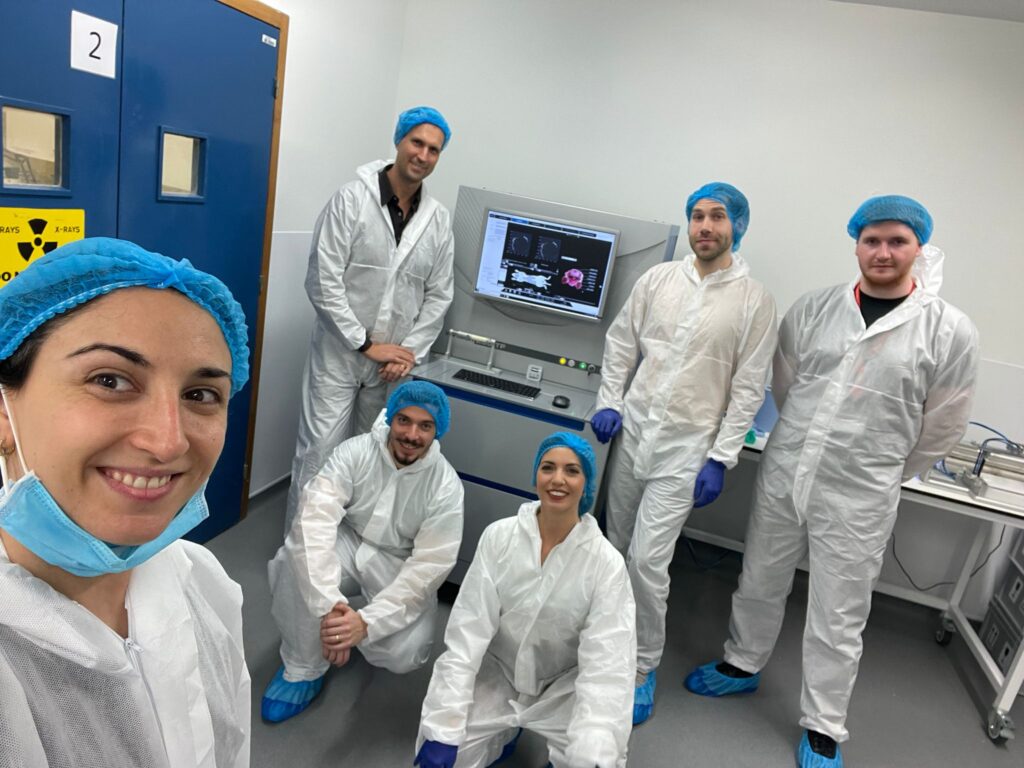
The Hadjihambi Lab
Anna is group leader of the Liver-Brain Axis group at King’s College London/Foundation for Liver Research (UK). She and her lab are researching how MASLD affects brain health, looking at the mechanisms underlying the detrimental effects of the disease.
“I study whether liver disease disrupts blood flow, oxygen delivery, and waste clearance in the brain through changes in the cerebrovascular system, contributing to cognitive decline and increased dementia risk.” I also examine how altered liver–brain communication, including signalling via the vagus nerve, may drive these effects.”
Anna and her hardworking team are investigating this by combining advanced experimental studies with the analysis of large human datasets. They use state-of-the-art imaging and molecular techniques to investigate how liver disease affects brain blood vessels, brain oxygen homeostasis, and vulnerability during ageing.
“We also examine whether these changes can be reversed when liver disease is resolved. And analyse large-scale human biomedical data to understand these effects at a population level,” says Anna.
“We only use animal models of MASLD when it is essential to uncover biological mechanisms that cannot be examined directly in people,” explains Anna. “We design our studies to minimise animal use while maximising the information gained.”
Investigating the underlying mechanisms of liver disease induced brain dysfunction
The research is ongoing, with the lab group actively analysing and interpreting the results. Anna can share a few emerging insights with us. “One particularly striking finding from our two parallel studies, using different models of MASLD and accounting for both sex and age, is that hepatic steatosis (fat accumulation in the liver) in the absence of insulin resistance is consistently associated with reduced brain tissue oxygen concentrations.”
Anna highlights, “Although most MASLD models are accompanied by obesity, we observe the same abnormal oxygen concentrations in lean rodents with steatotic liver. This is a fascinating observation because it suggests that steatotic liver disease alone may directly impair brain oxygenation. We are now working to understand the mechanisms underlying this effect.”
Chronic reductions in brain oxygenation are known to impair normal brain function and play a critical role in the onset and progression of neurodegenerative disorders. “Our findings suggest that MASLD may increase the risk of cognitive decline and dementia through such mechanisms, particularly later in life.”

The long-term impact of liver disease
To improve our understanding of how MASLD affects the brain and the ageing process, the team is working on answering whether targeting the liver–brain communication could protect the brain. They are also exploring if it is possible to reverse MASLD-related brain changes through lifestyle interventions. “All of this work is aimed at achieving our overarching goal: to inform strategies that reduce the long-term neurological impact of metabolic liver disease,” says Anna.
Although millions of people live with MASLD, the symptoms are often underestimated and misunderstood. Alongside Anna’s research, her attention is on raising public awareness of the chronic condition. “We are collaborating on a public engagement project with UCL PEARL to develop an immersive, multisensory experience to help people feel aspects of what it is like to live with liver disease.”
Anna shows us that unravelling brain dysfunction in liver disease takes perseverance and is a collaborative effort to seek the answers needed to help people age more healthily.
Anna will be discussing her research and findings on MASLD in her presentation ‘Mind over MASLD: Unravelling brain dysfunction in liver disease’ on 16 April 2026 at the meeting, ‘Microvasculature as a Key Regulator of Health and Disease in the Brain and Beyond’ at Sainsbury Wellcome Centre, London, UK. Register by 26 March.