

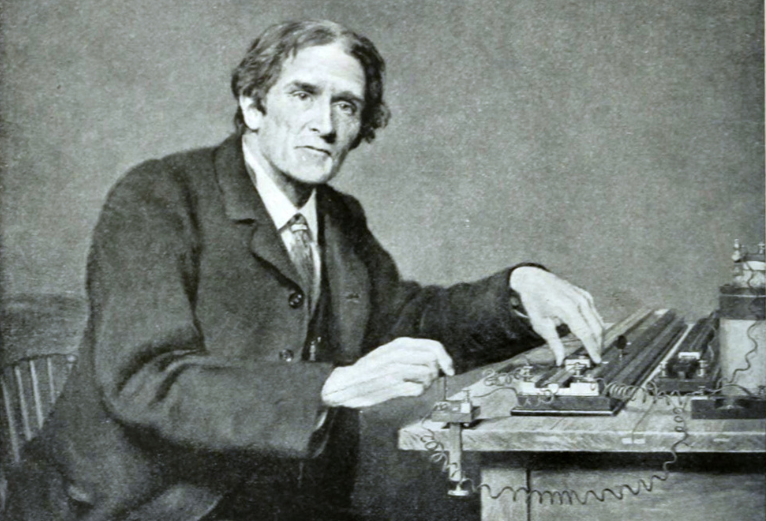
It all started in a London townhouse on 31 March 1876, at the home of Sir John Scott Burdon-Sanderson. 19 physiologists gathered with a shared vision to establish the Physiological Society for “promoting the advancement of physiology and facilitating the intercourse of physiologists”. Once the Society was formed and the rules agreed, the inaugural dinner was soon held at the Criterion Restaurant in May 1876.
150 years later, physiologists around the world are enjoying anniversary ‘Lab Lunches’ in honour of our traditions and what historically became a defining feature of the Society, scientific exchange over a shared meal.
As our birthday celebrations get underway, we reflect on the life and work of Burdon-Sanderson, a well‐renowned physiologist and pathologist. Not only was he instrumental in laying the foundations of the Society and its vibrant global community that we know today, but he also established experimental, lab‐based approaches in medicine. He is probably best known for his work in electrophysiology (the electrical activity of the heart, which now makes it possible to locate an abnormal heartbeat), muscle and nerve physiology, and infectious diseases like tuberculosis.
Solidifying physiology as an academic discipline
Burdon-Sanderson was born on 21 December 1828 near Newcastle-upon-Tyne. He studied medicine at the University of Edinburgh UK, continuing his education in Paris to study chemistry and physiology. From 1853, he was practising medicine in London, starting out as a Medical Officer of Health for Paddington. For the next eleven years, he made sanitary improvements and compiled reports on public health. He then became assistant physician, working at Brompton Hospital (1867 to 1871) and Middlesex Hospital (1863 to 1870).
In the 1870s, Burdon-Sanderson gave up his hospital appointments and his practice, to devote his time to physiology and pathology. He started a seven-year term as professor superintendent of the Brown Institution (London, UK), the first to hold this position at the research centre for comparative pathology.
In 1874, Burdon-Sanderson was the first holder of the Jodrell Chair (Chair of Physiology) at University College London. In 1882 he was appointed as the first Waynflete Professor of Physiology at the University of Oxford. In his role, he established the Department of Physiology, solidifying physiology as an academic discipline.
Penicillium and the discovery of antibiotics
During his investigations of diphtheria and cholera outbreaks in the UK, Burdon-Sanderson documented how the fungus Penicillium had a natural ability to inhibit bacterial growth. He reported his finding in 1871, almost 60 years before Alexander Fleming’s discovery of penicillin in 1928. Burdon-Sanderson’s observation lay the groundwork for others to investigate the connection between the Penicillium fungus and its antimicrobial capacity. This led to treatments for infections, and the research and development of antibiotics.
Burdon-Sanderson worked at the University of Oxford until 1904. During his time, he was appointed Regius Professor of Medicine in 1895, and mentored many future leaders in physiology. Sanderson died in Oxford on 23 November 1905.
Shaping the future of physiology
Burdon-Sanderson helped revolutionised public health and his legacy lives on in modern medicine. As we celebrate legendary figures and the past 150 years of physiological discovery, we’ve also got our eyes on the horizon looking at how our global community, journals, events and policy activities, can advance our knowledge of biological systems and the treatment of disease.
Find out more and join our anniversary celebrations on social media using #ShapeTheNext150.
References
Foundation of The Society. The Physiological Society. Available at: https://www.physoc.org/about-us/history-archives/historicalhighlights/foundation-of-the-society/ (Accessed online in March 2026)
John Burdon Sanderson. Department of Physiology, Anatomy and Genetics at the University of Oxford. Available at: https://www.dpag.ox.ac.uk/about-us/bscsc/about-us/john-burdon-sanderson (Accessed online in March 2026)
John Scott Burdon-Sanderson, a pioneer in the development of antibiotics (2024). Available at: https://www.hifasbiologics.com/john-scott-burdon-sanderson-a-pioneer-in-the-development-of-antibiotics/ (Accessed online in March 2026)
Sir John Scott Burdon Sanderson. Royal College of Physicians. Available at: https://history.rcp.ac.uk/inspiring-physicians/sir-john-scott-burdon-sanderson. (Accessed online in March 2026)