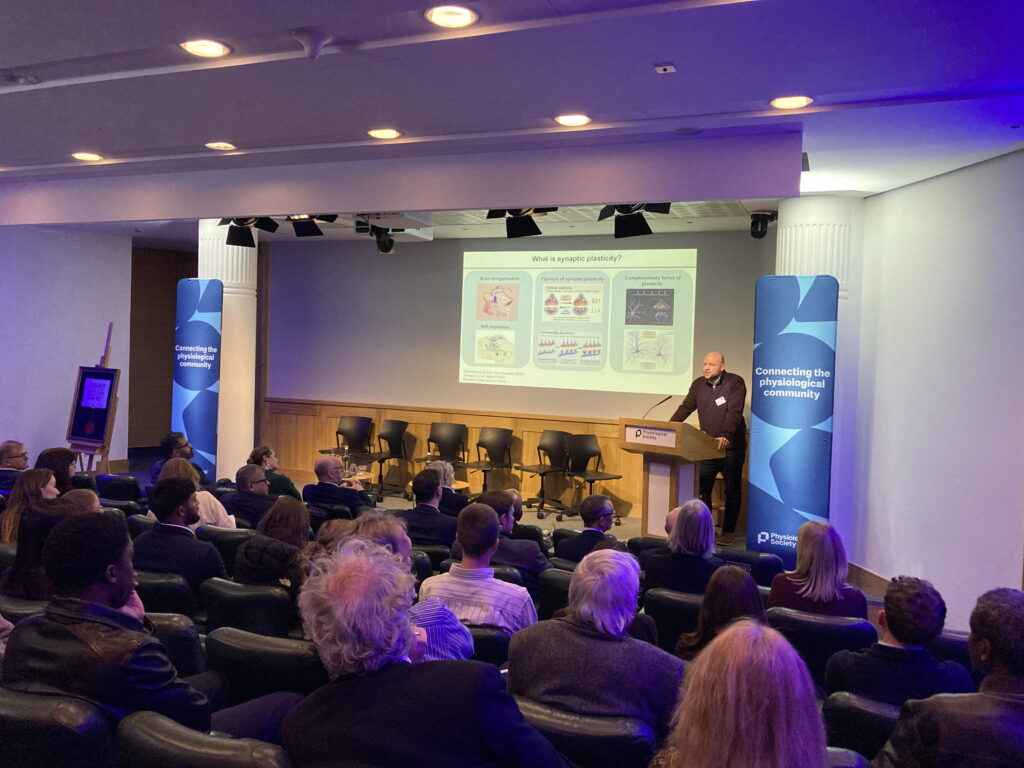
Dr Samuel Barnes, who was awarded the 2026 Bayliss-Starling Prize Lecture for Mid-Career Physiologists at Advancing Physiology Together, shared how it’s possible to harness plasticity to protect the ageing brain.
“I am honoured to be awarded this prize,” exclaims Dr Samuel Barnes, as he took to the stage to present his Bayliss-Starling Prize Lecture for Mid-Career Physiologists. He graciously thanked all those his worked with to achieve the insights he shared with us, reminding us “science is after all a team and collective effort.”
Samuel is an Associate Professor of Neural Plasticity and Deputy Director of the UK Dementia Research Institute (UK DRI) at Imperial College London, UK. At our ‘Advancing Physiology Together’, our member celebration at the Royal Society of Medicine (London, UK), Samuel explained how the brain changes as we age and the consequences of this for cognition.
“The brain is remarkable,” he stated, adding, “it has a unique quality, plasticity.” Synaptic plasticity, Samuel explained, refers to brain reorganisation and its ability to self-regulate. This quality helps the brain adapt and function, enabling it to overcome incredible challenges. As we age, our brain can become vulnerable as mechanisms are dysregulated and disrupted. ‘Neural noise’ occurs. Samuel describes this as trying to hear a friend’s voice in a crowded party. Neural noise degrades our ability to think clearly as the ageing brain struggles to pick up signals.
“Our brain is us,” Samuel points out, so we want to protect it from this degradation. “If we identify the mechanisms and apply the right pharmacological treatment, we might be able to turn back the biological clock,” he says. Studying the complex processes of the brain and deciphering how it regulates activity is painstaking work.
During his lecture, ‘Harnessing micro-circuit plasticity to target pathophysiology’, Samuel captivated us with his research tales of “taking mice to the disco” and rewarding the mice with a milkshake when they tapped their nose on a particular flashing image during the visual overstimulation experiments (Strawberry is the preferred flavour, in case you were wondering).
Investigating the mechanisms that guard against hyperactivity (hyperexcitability) in ageing brain circuits requires a range of experimental techniques. Samuel and his team have used electrophysiology and calcium imaging to measure neuronal plasticity in the intact brain. They have combined these approaches with molecular measures, such as spatial proteomics and transcriptomics, to probe the underlying mechanisms supporting plasticity and how they are impacted by ageing and neurodegeneration. They have carried out behavioural testing, in vivo pharmacology and non-invasive brain-stimulation, to measure the consequences of dysfunctional plasticity for brain function.
They are also looking into how homeostatic plasticity mechanisms operate at the synapse and how they regulate neural firing levels to prevent prolonged periods of hyper- or hypo-activity. The information and findings from exploring how dysregulated plasticity contributes to changes in cognitive function, could be used to develop interventions to improve brain health and cognition.
So, can we reverse functional brain ageing? Samuel concludes, “Yes, by hacking of endogenous plasticity.”
Advancing Physiology Together is our special two-day event marking the culmination of our 150th anniversary celebrations. View the programme to find out more.