

Dr Srikanth Ramaswamay delivered his R Jean Banister Prize Lecture for Early-Career Physiologists, ‘Neuromodulatory circuits as computational primitives for brains and machines’ at ‘Celebrating Physiology in Ireland’. A special celebration marking the Physiological Society’s 150th anniversary at Trinity College Dublin, Ireland.
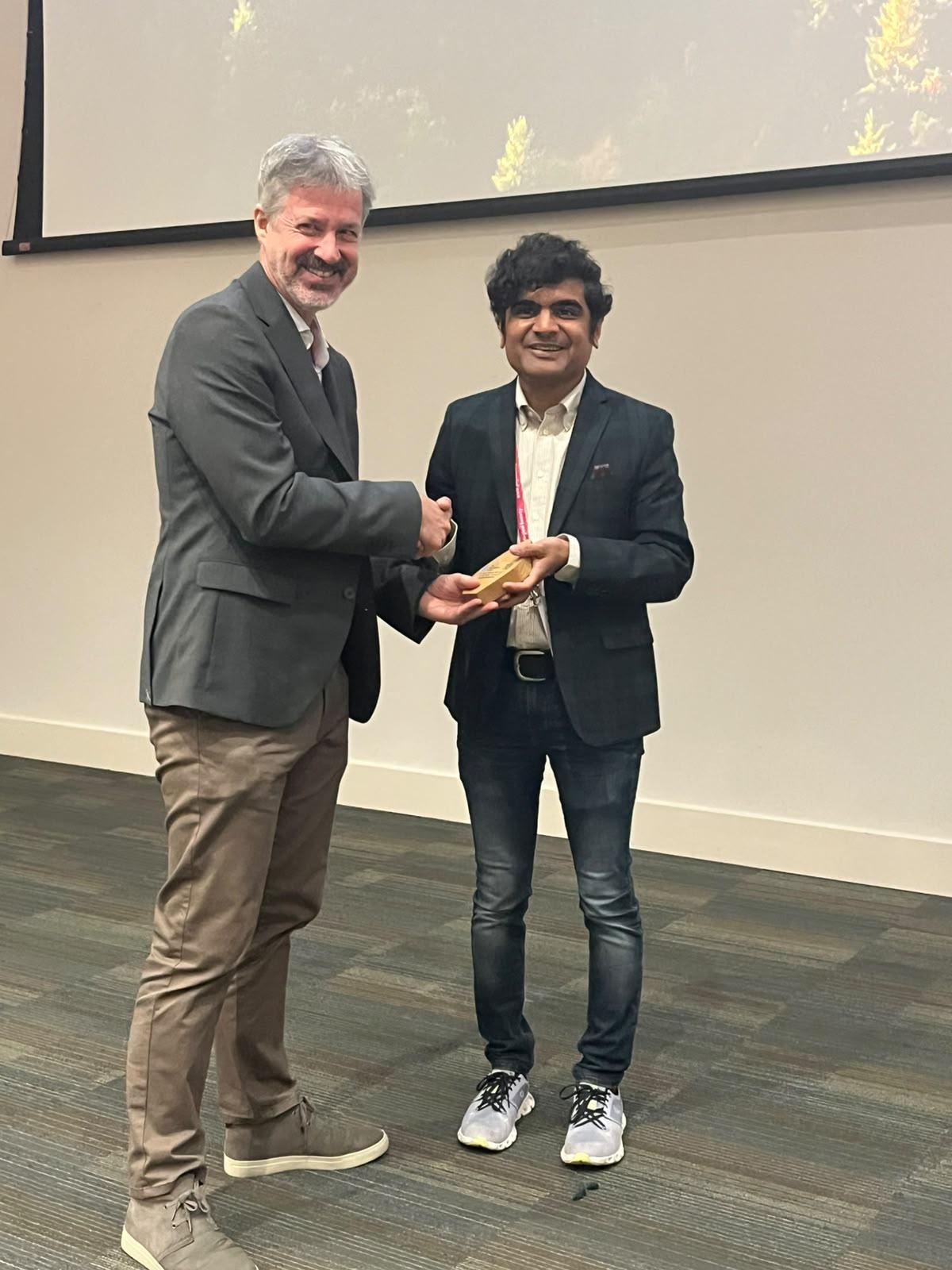
Srikanth is an Assistant Professor in computational neuroscience at Newcastle University (UK), where he directs the Neural Circuits Laboratory. His research focuses on the role of neuromodulators in shaping cognition within biological neural networks and developing biologically informed neural network models for energy-efficient AI.
“Neuromodulators are signalling chemicals in the brain, which control the emergence of adaptive learning, behaviour and physiology,” explains Srikanth. Neuromodulators include dopamine, acetylcholine, serotonin and noradrenaline. “They operate on a spectrum of spatio-temporal scales in tandem and in opposition to reconfigure functions of biological neural networks and to regulate global cognition and state transition,” says Srikanth.
In his lecture, Srikanth explained the role of neuromodulators in adaptive cognition and highlighted how neuromodulators can compete and cooperate with each other. “Although neuromodulators are important in shaping cognition, their phenomenology is yet to be fully realised in artificial neural networks,” says Srikanth, as he discussed ongoing research on bio-inspired mechanisms of neuromodulatory function in artificial neural networks. He proposed that a computational framework could incorporate the diverse functional settings of neuromodulators to inspire new architectures of “neuromodulation-aware” artificial neural networks.
Srikanth’s prize lecture was part of Celebrating Physiology in Ireland, a special celebration marking the Physiological Society’s 150th anniversary, highlighting the vital role of physiology and physiologists; past, present, and future. Browse the programme to find out more about the topics discussed.