Features
Why I chose a career researching and aiding individual's respiratory responses
Dr Pascale Kippelen (Liverpool John Moores University, UK)
Society member Dr Pascale Kippelen (Liverpool John Moores University (LJMU), UK) reflects on her career as an exercise and respiratory physiologist. She shares her career advice, the joy she has for her field of research, and tells us more about making a difference to people’s respiratory health and lives.

Pascale Kippelen
What inspired your interest in exercise and respiratory physiology?
I have always been into sport and exercise (practicing, competing, coaching and/or watching activities like gymnastics, running, cycling, hiking) and, being French, every summer from a young age I have been following The Tour de France. I have always been amazed by the gruelling effort that cyclists must put in to complete The Tour and gripped by all the sagas that surround this mythical event.
When did you know that you wanted to pursue a career in exercise and respiratory physiology?
My first research experience was during my undergraduate Sport & Exercise Science honours year. I was investigating muscle recruitment strategy, using surface electromyography, in competitive cyclists, and I absolutely loved it! From then on, I knew I wanted to do more research. So, I picked up the phone (in those days Internet was only in its infancy) to find a lab where I could complete an MSc and PhD in Exercise Physiology, and Professor Christian Préfaut (then Head of the Chest Clinic at Arnaud de Villeneuve Hospital in Montpellier, France) offered me what sounded like the most interesting project. Even though I had never heard of exercise-induced arterial hypoxemia before speaking to Professor Préfaut, when he mentioned it commonly occurred in cyclists, I was in!
Toward the end of my PhD, the Sydney Olympic Games were on TV, and I was absolutely mesmerised by it all. By then, the focus of my PhD had moved from gas exchange impairment (as signified by exercise-induced arterial hypoxemia) to lower airway dysfunctions, as emerging evidence pointed toward an increased risk for elite endurance-trained athletes, including cyclists, to develop asthma-like problems (a staggering 20% of these athletes suffer from asthma and/or exercise-induced bronchoconstriction).
When writing up my PhD thesis, I kept referring to research done by Dr SD Anderson (then Principal Scientist at the Department of Respiratory Medicine, Royal Prince Alfred Hospital in Sydney) on exercise-induced bronchoconstriction. I therefore contacted her (by email this time!) to know whether she would take me as postdoc in her lab, and before I knew it, packed my bags for Sydney, Australia. I never looked back and fully embraced further developing as a respiratory physiologist.
What fascinates you most about your field of research?
The human body is an ‘amazing machine’. Now, because of its inherent complexity, understanding how it manages to maintain homeostasis in the face of a multitude of stressors (such as exercise and / or exposure to cold / hot temperatures), can be quite challenging. For example, despite a century of research in the control of breathing, there are still so many unknown / controversies regarding the exact mechanisms that enables perfect matching between ventilation and changes in metabolic rate during exercise. It is trying to better understand intricacies of the functioning of the ‘machine’ that we inhabit that I find so fascinating.
What have been some of the highlights?
Running human-based experiments means that you can easily appreciate what difference your research can make to people’s life. As I am using diagnostic tests for asthma as part of my research, I can often advise study participants on what they could be doing to avoid the condition limiting their performance / impacting their everyday life. I remember one day testing a swimmer who narrowly failed to cross the Channel because he suffered from a bad asthma attack as he was getting close to shore. After testing him in the laboratory and getting a better sense of the severity of his condition, I helped him to get his asthma under control. The following year, he made another attempt and succeeded!
What are the challenges?
There are not very many of us in the field of Exercise and Environmental Physiology focusing on the respiratory system. In fact, the respiratory system is often (and wrongly) considered non-limiting in exercise, when we know this is not the case for many highly trained athletes and in many clinical populations. As a result of this incorrect assumption, young researchers often disregard the field, preferring to focus on cardiovascular or muscle physiology. Respiratory physiology can also sometimes feel a harsh field to strive, especially considering its chronic underfunding, e.g. in the UK, lung research receives only 2% of public research funding when lung conditions are causing 6% of the UK’s health burden (Asthma+Lung UK, 2023).
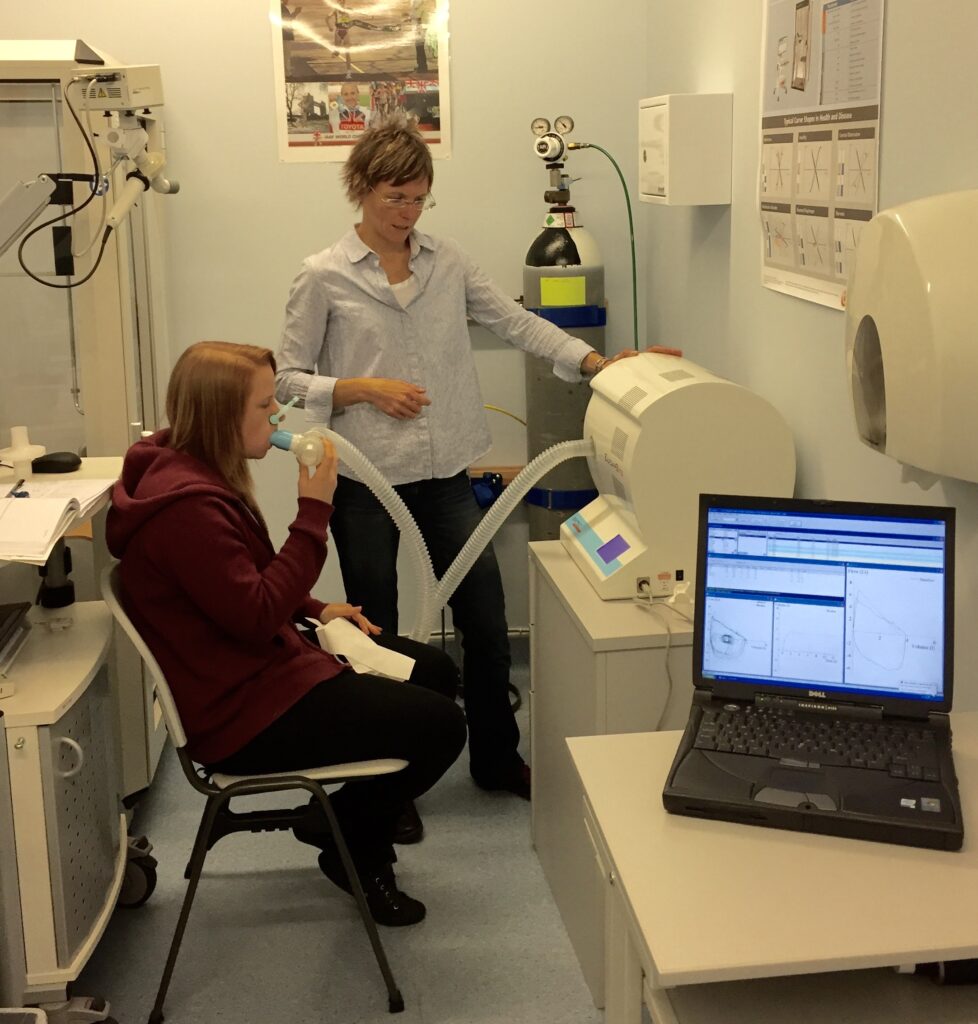
Dr Pascale Kippelen working in her previous respiratory lab at Brunel University London.
What are you currently working on?
I am currently trying to understand why we see a surge in emergency department visits, hospitalisations and deaths from respiratory illnesses every time there is a heatwave, in the UK and worldwide. Considering climate change is leading to more natural disasters like heatwaves, we need to do more fundamental research to understand how the respiratory system responds to environmental heat stress. That knowledge will then help to develop effective and evidence-based prevention and intervention strategies to protect the respiratory health and lives of the most vulnerable, i.e. children, older people, those with pre-existing medical conditions and/or on low-income.
What does a typical day involve?
Working in academia means that my work pattern / schedule follows the rhythm of a usual academic year. During teaching terms, a lot of my time is dedicated to student teaching and learning. I am lucky in that, in my current position at LJMU, I primarily teach respiratory physiology to Sport & Exercise Sciences students; so, I can really embed my research into my teaching.
Outside teaching terms, days are more research focused. As I recently changed institution, I am currently doing a lot of ‘groundwork’, i.e. refining my research ideas, developing new partnerships, and writing grant applications. I cannot wait to spend more time in the lab, especially piloting for new projects with post-graduate students. For me, pilot work is the epitome of problem-solving and such a fun part of the research process.
What advice would you give your younger self?
Do not fear but embrace unexpected findings. My post-doctoral supervisor (Dr SD Anderson) used to tell me to ‘look for the black swan’. I didn’t really understand what she meant, until the time I acted as ‘guinea pig’ for pilot work for one of my former PhD students. That day, after exercising for two hours in the heat at 35°C and becoming mildly dehydrated, I lost half a litre of lung capacity. No matter how hard I was blowing out in the spirometer, I just could not get my lung function up. This was not the result I was expecting / looking for but has been a source of inspiration ever since.
With my doctoral students, we subsequently demonstrated that whole body dehydration (induced by exercise in the heat or fluid retention) causes small airway dysfunction in young adults with and without mild asthma, and that these changes can rapidly be reversed by fluid intake. I am now trying to establish the clinical implications of these findings in individuals with a more severely compromised lung function, particularly in situations when the risk of dehydration is heightened, such as during heatwaves.
What has your career taught you?
While I primarily engage and enjoy individual sports, research is very much a team sport. To be able to generate top-level research, e.g., research that leads to significant shifts in current research and / or clinical practice paradigms, you need to surround yourself by a strong team. Akin to the human body that derives its richness and robustness from the numerous components and organ systems constantly interacting with each other’s, multiple and complex interactions between humans, although sometimes challenging, often lead to richer and more robust research.