Background: Frailty and physical disability are emerging as a third major category of complications in diabetes (Wong et al., 2013). Sarcopenia, which is the loss of muscle mass, strength, and physical function, is accelerated in T2D and central to frailty and physical disability development (Marcotte-Chénard et al., 2023). South Asian populations typically have lower fat-free mass and greater fat mass than White Europeans (Hull et al., 2011), yet less is understood regarding differences in strength and physical function. Growing evidence across the general population has shown lower cardiorespiratory fitness (Ghouri et al., 2013), hand grip strength (Ntuk et al., 2017), sit-to-stand performance (McBride et al., 2022) and greater risk of functional limitation (Heald et al., 2025; Williams et al., 2020). However, it is not clear whether such differences persist in those with T2D, or if they are independent of ethnic differences in body composition. This study examined differences in objective and subjective markers of physical function between White Europeans and South Asians, controlling for age, sex and fat-free mass.
Methods: Data were analysed from the ongoing ‘Chronotype of Patients with Type 2 Diabetes and Effect on Glycaemic Control’ (CODEC) clinical trial. Body mass, body composition and physical function were assessed in adults of South Asian (n=139) and White European (n=947) heritage, with T2D. Fat-free mass percentage was estimated using bioelectrical impedance analysis. Lower body function was evaluated using the Short Physical Performance Battery (SPPB) and Sit-to-Stand 60 (STS-60). The SPPB (scored 0-12) comprises three components: balance, 4-m gait speed and time to complete 5 sit-to-stand repetitions, while the STS-60 reflects the number of sit-stand transitions completed in 60 s. Upper body strength was assessed via maximum hand grip using a dynamometer. Subjective physical function was measured using The Duke Activity Status Index (DASI) (scored 0-58.2) based on self-reported functional capacity in daily activities. Ethnic differences in physical function measures were examined using generalized linear models, adjusted for age, sex and fat-free mass. Other population characteristics were compared between ethnicities using independent-samples t or Mann-Whitney U tests, depending on data normality, or Chi-Squared test for categorical data.
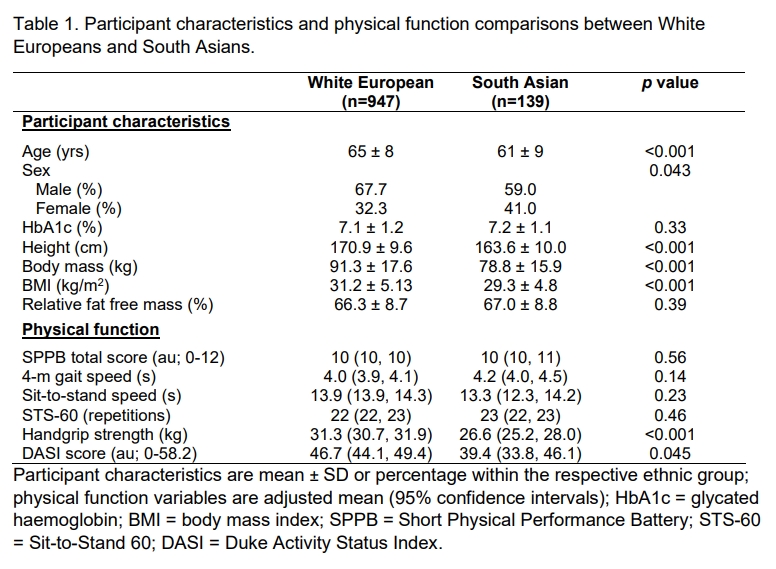
Results: Population characteristics and comparisons between ethnicities are presented in Table 1. Handgrip strength and DASI score were 4.7 (3.1, 6.2) kg and 7.3 (0.2, 14.4) au greater in White Europeans than South Asians, respectively. Neither SPPB total score, gait speed, sit-to-stand speed, or STS-60 were different between ethnicities.
Conclusions: Upper body strength and subjective physical function were significantly lower in South Asians than White Europeans with T2D, even after adjusting for fat-free mass. Importantly, the observed difference in DASI score surpassed the minimally clinically important difference (Arena et al., 2007), suggesting that these disparities may have meaningful implications for daily activities and quality of life. Combined with modest, but clinically relevant differences in handgrip strength, an established predictor of mortality and disability (Stressman et al., 2022; Rantanen et al., 1999) these findings underscore the importance of addressing both physical and perceived functional limitations in South Asian populations through tailored interventions.