Introduction. Metabolic responses to meals vary depending on time of day1. However, evidence surrounding the phase shifting effects of meal timing in humans remains limited. We have previously shown that delaying regular meals substantially delays plasma glucose rhythms even when light-dark and sleep-wake schedules are kept constant 2 3. This analysis aimed to examine further phase-shifting effects of meal-timing by comparing the circadian dynamics of intermediates of metabolism in plasma, using our well-established targeted metabolomics approach4.
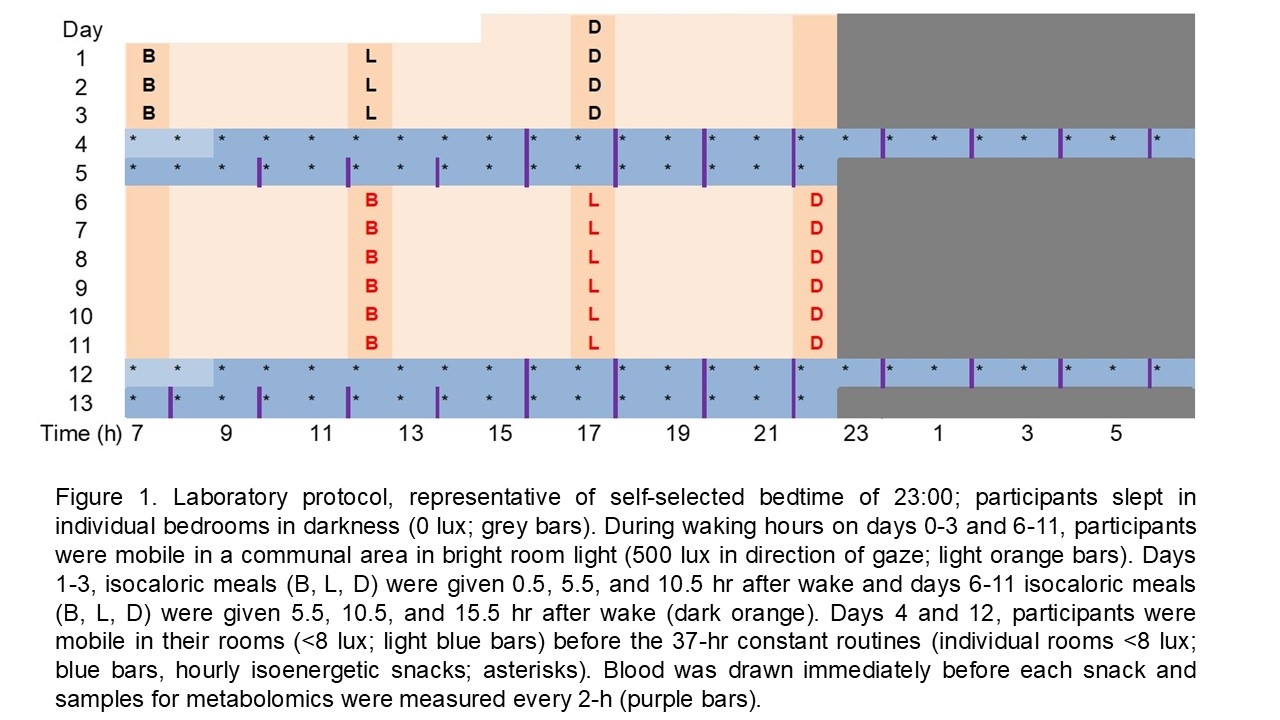
Methods. After a 10-day at-home protocol, designed to maximise synchrony of participants’ circadian rhythms, ten healthy men were enrolled into a 13-day crossover study in our clinical research facility2. The sleep and wake times during the laboratory protocol were the same as during the at-home protocol (Figure 1). A 3-day early meal schedule (3-meals; 0.5, 5.5 and 10.5-h after wake) and a 6-day late meal schedule, (same meals, delayed by 5-h) were each followed by a 37-h constant routine, which allows measurement of endogenous rhythmicity. During constant routine conditions (dim light, hourly snacks, semi-recumbent posture), 2-hourly blood sampling was performed over a 30-hour period. Plasma from these blood samples was then analysed via targeted UPLC-MS/MS metabolomics4, with 127 metabolites detected. Linear mixed effects cosine models5 identified metabolites that displayed circadian rhythms, paired t-tests assessed the impact of the delayed meal schedule on metabolite acrophase.
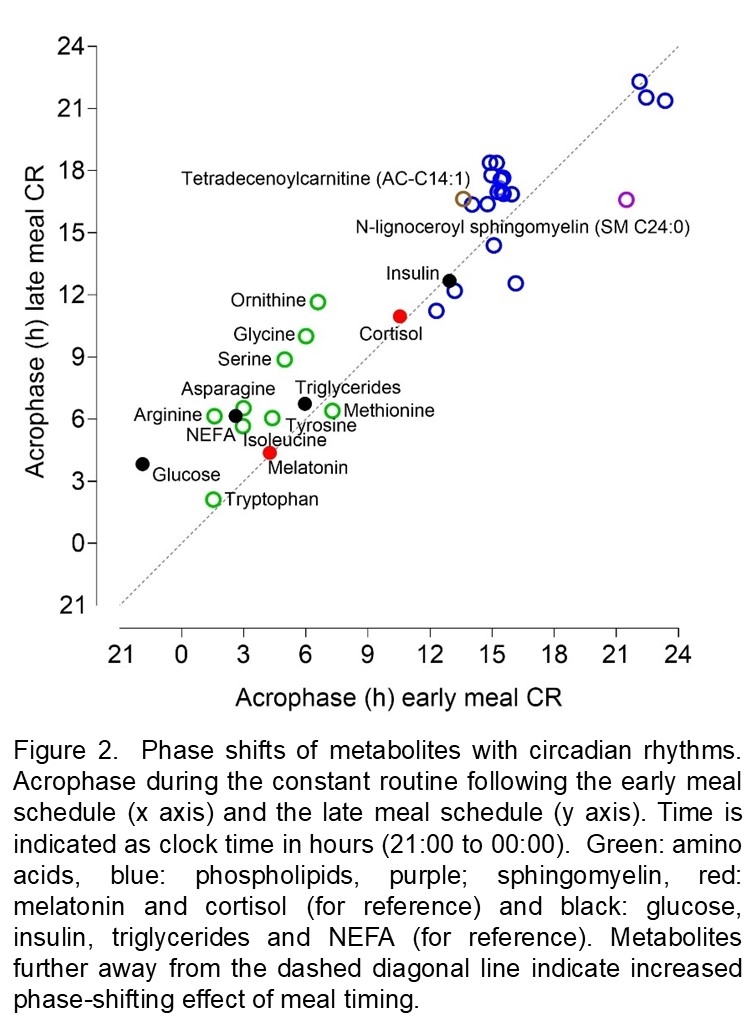
Results. Circadian rhythms were observed in 31/127 metabolites (p < 0.05). Amino acids mostly peaked at the time aligned with the previous dark period, whereas lipid-class metabolites peaked at the time aligned with the previous light period (Figure 2). Notably, there were no rhythmic biogenic amines. Of the 31 rhythmic metabolites, 17 exhibited a significant phase shift (p < 0.05). Of these, 3 lipid-class metabolites exhibited an average phase advance of 3.5h. Of the 14 metabolites exhibiting significant phase delays, amino acids (arginine, asparagine, glycine, isoleucine, ornithine and serine) delayed by 4h, whereas the lipid related metabolites (n = 8) were delayed 2.7h. This showed that 11 % of the detected metabolites (14/127) exhibited phase shifts that were intermediate to delayed meal-timing and the unchanged light-dark cycle.
Conclusion. In conclusion, delaying meal timing whilst keeping the light/dark and sleep/wake constant, resulted in smaller metabolite phase shifts than was observed in plasma glucose rhythms. This phase shifting showed a differential effect dependent on metabolite class.