
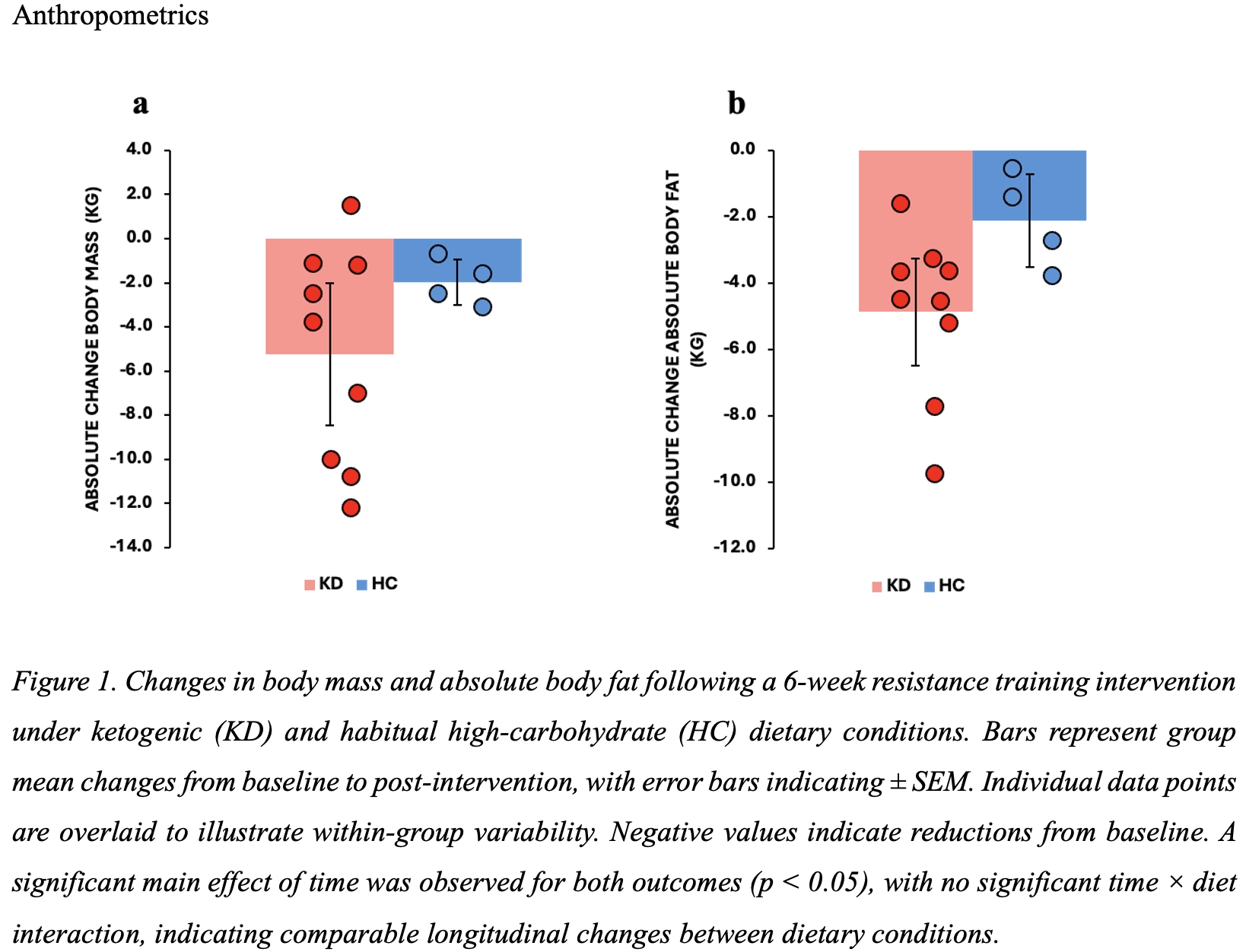
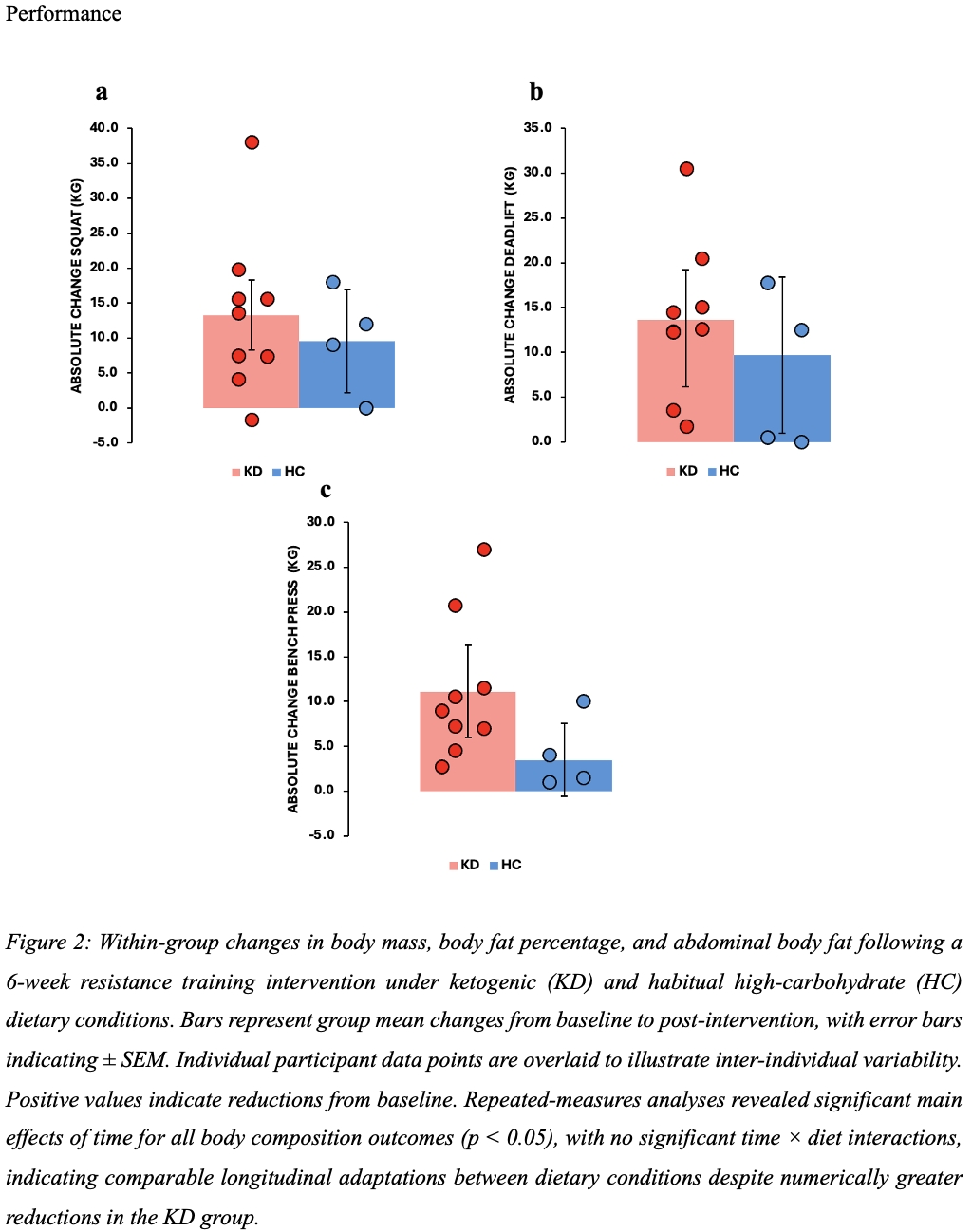
Ketogenic diets are increasingly adopted by physically active individuals, yet their physiological effects on body composition and strength outside elite sport remain unclear. KD, defined by carbohydrate intake below 50 g·day⁻¹ with increased fat intake, induces nutritional ketosis and is frequently adopted to improve body composition; however, comparative effects versus HC on resistance-training outcomes remain incompletely characterised. Thirteen participants (33 ± 9 years; 8 males, 5 females) were assigned to KD or HC and completed 14 supervised resistance-training sessions incorporating drop-set protocols targeting the squat (SQ), deadlift (DL), and bench press (BP). One-repetition maximum (1RM) performance and skinfold-derived body composition were assessed pre- and post-intervention. Capillary β-hydroxybutyrate (β-HB) and blood glucose were measured to verify metabolic response. Within-group analyses indicated significant reductions in body mass (BM) and body fat percent (BF%) in KD (BM: p = 0.007; BF%: p = 0.002), alongside significant increases in BP, DL, and SQ (all p ≤ 0.019). In HC, AbBF and SQ changed significantly (p = 0.019 and p = 0.025, respectively), whereas BM, BF%, BP, and DL did not reach statistical significance (p ≥ 0.051). Repeated-measures ANOVA identified significant main effects of time for all outcomes (p ≤ 0.017), with no evidence of time × diet interactions, indicating comparable longitudinal adaptations between diets. Post-intervention between-group comparisons showed higher DL and BP values in KD (p = 0.022 and p = 0.036), but these cross-sectional differences were not supported by diet-specific interaction effects. Capillary β-HB increased to approximately 1.1 mmol·L⁻¹ by Week 2 and stabilised near 0.8 mmol·L⁻¹ in KD, consistent with nutritional ketosis and accompanied by reductions in blood glucose. In summary, six weeks of resistance training elicited meaningful improvements in body composition and maximal strength under both KD and HC conditions. While KD showed clearer within-group reductions in BM and BF%, repeated-measures analyses provided no evidence of diet-specific superiority in training-induced adaptations over time. These findings support a context-specific role for KD in resistance training, particularly during early training phases or fat-loss interventions. KD may therefore represent a viable nutritional strategy for improving body composition without compromising strength in non-elite physically active populations.
Dietary Manipulations for Health and in the Prevention and Management of Disease 2026 (Manchester Metropolitan University, UK) (2026) Proc Physiol Soc 68, C39
Poster Communications: Impact of a ketogenic diet on body composition and strength in recreationally active adults
Richard Phillips1, Matthew Carpenter1, James Brouner1, Owen Spendiff1
1Kingston University London
View other abstracts by:
Where applicable, experiments conform with Society ethical requirements.