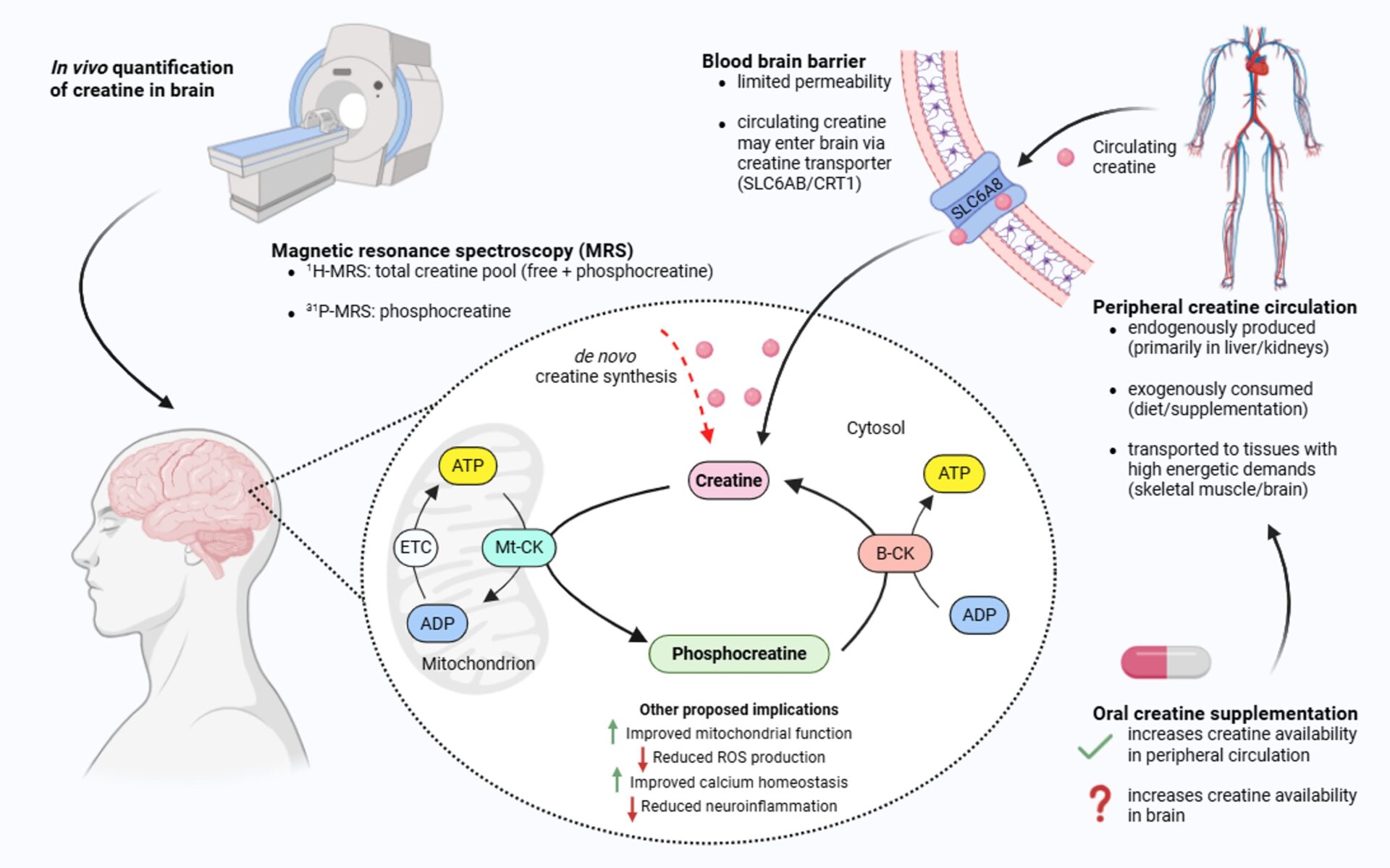
Increasing brain creatine availability through dietary supplementation has attracted significant interest as a potential strategy to support brain health and cognitive function. Magnetic resonance spectroscopy (MRS) enables non-invasive quantification of brain creatine and phosphorylcreatine in vivo, thereby providing a valuable opportunity to examine how creatine supplementation may influence brain energy metabolism via the creatine kinase system. Progress in the field has been constrained, thus far, however, by substantial methodological variability and challenges in achieving accurate and reproducible brain creatine measures. Technical and analytical factors, such as voxel relocalisation accuracy, spectral quality, and processing pipeline, combined with poorly understood levels of biological variability, can significantly affect the reliability and validity of brain creatine estimates. These challenges complicate the interpretation of existing supplementation studies, and, ultimately, lead there to be critical knowledge gaps in our understanding of how, and to what extent, brain creatine can be modulated through dietary supplementation in humans.
A small body of evidence suggests that creatine supplementation, typically between 5 to 20 g·day-1 for up to 8 weeks, may increase brain creatine levels by between 3 and 10%, with the largest effects shown in people facing elevated metabolic demands, such as those with neurological disease. The magnitude and regional specificity of the responses to supplementation vary substantially, however, and their functional significance on broader metrics of brain health and cognitive function remain unclear. Another important consideration is that large error margins have been reported for brain creatine quantification, yet most existing supplementation studies do not report reproducibility estimates, making it impossible to confidently distinguish true physiological effects from measurement error.
This presentation will a) outline the rationale for why modulating brain creatine through supplementation may be of relevance to human health, b) discuss key technical considerations when applying, or interpreting MRS-derived brain creatine measurements, including recent repeatability data from our group, and c) summarise current evidence for the efficacy of creatine supplementation to increase brain creatine concentrations.