Introduction: Excess weight can increase the risk of several non-communicable diseases, impairing both metabolic function and quality of life. Lifestyle interventions offer a promising avenue to reverse some of the negative effects of excess weight gain. Previous studies have shown that a low-carbohydrate (ketogenic) diet can lower fasting glucose concentrations, however findings are often confounded by weight loss, therefore the isolated effects of ketosis on fasting glucose remains unclear. Additionally, the nutritional composition of ketogenic diets (high-saturated fat/red meat, and low-fibre) has been linked to several negative health outcomes, such as increased LDL-cholesterol concentrations. As an alternative to dietary manipulation, ketone supplements can increase circulating ketone concentrations without needing to adhere to a potentially harmful diet.
Aims/ Objectives: The aim of this interim analysis is to a) assess the ability to maintain energy balance and thus maintain weight as part of a short-term randomised controlled trial, with either a ketogenic diet or ketone supplementation and b) assess fasting and postprandial glucose responses to the interventions.
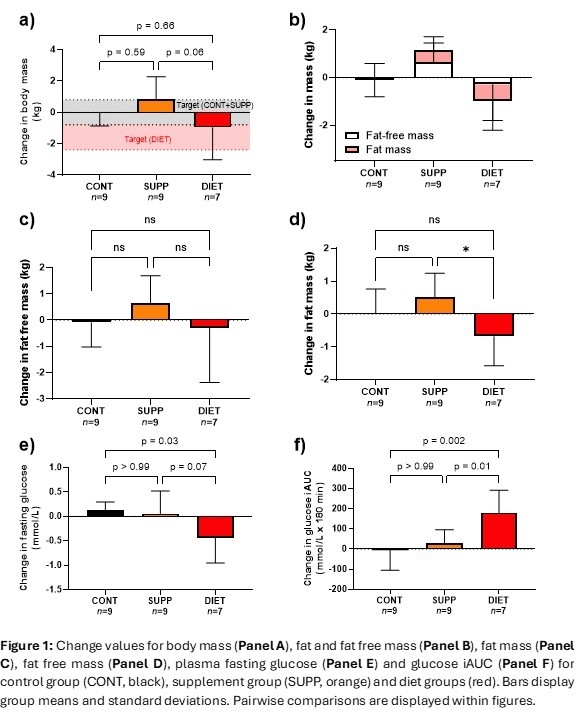
Methods: Currently, 25 individuals with overweight and/or obesity (age 44±11 years; 19 females) have been randomised to either control (n = 9, habitual diet), ketone supplementation (n=9, thrice daily alongside habitual diet) or ketogenic diet (n=7) condition (all prescribed at energy balance) for 28 days. The diet group caloric intake was determined as resting metabolic rate (RMR, determined by indirect calorimetry) plus physical activity energy expenditure (determined from Fitbit inspire 3) and diet induced thermogenesis. Body mass, body composition (via dual energy x-ray absorptiometry) and fasting glucose concentrations were assessed before and after the intervention. Postprandial plasma glucose concentrations (determined via iAUC) were also assessed over 3 hours following ingestion of a mixed-macronutrient meal (20% of resting metabolic rate). Additionally, participants wore continuous glucose monitors (CGMs) throughout a screening week and the intervention period. Change from baseline to follow-up were compared between groups with a one-way ANOVA.
Results: There was no evidence of a difference in body mass or fat-free mass between groups from baseline to follow up (Figure 1, Panels a-c). Fat mass was significantly different between groups (p=0.0196), whereby the diet group decreased, and supplement group increased (Δpost-pre = -0.69±0.89 vs 0.52±0.72 kg, p=0.0167). Plasma glucose concentrations (fasting and postprandial iAUC) were significantly different between groups (p=0.02 and p=0.002, respectively). Fasting glucose also decreased to a greater extent in the diet group compared to control (Δpost-pre = -0.44±0.51 vs 0.12±0.17 mmol/L, p=0.03), whereas glucose iAUC increased in the diet group compared to both the: supplement (Δpost-pre = 180±112 vs 27±69 mmol/L*180 min, p=0.01) and control (Δpost-pre = -66±99 mmol/L*180 min, p=0.002). There was no evidence of a difference between groups in average glucose concentrations during the intervention, as determined by CGMs (p=0.4908).
Conclusion: Early results suggest neutral energy balance can be maintained while individuals with excess weight follow a short-term ketogenic diet. Fasting glucose appears to decrease while following the ketogenic diet. Increases in the iAUC during a mixed meal may suggest reduced glucose tolerance, independent from energy balance.