
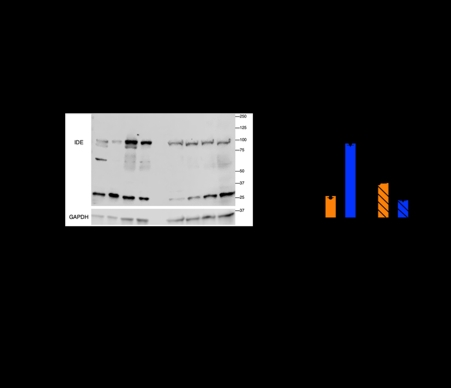
In sporadic Alzheimer’s Disease (sAD), metabolic dysfunctions such as glucose hypometabolism, hyperinsulinemia, and insulin resistance in the brain are present from an early stage. Astrocyte metabolism supports various neuronal functions in the brain, including memory encoding. Furthermore, astrocytes can produce amyloid-degrading enzymes like Insulin-degrading enzyme (IDE)—an energy-intensive process. Therefore, astrocyte metabolic dysfunction may significantly contribute to sAD pathogenesis. A recent study by Bell et al. (2025) demonstrated that hexokinase-1 (HK1), the rate-limiting enzyme of glycolysis, was deficient in astrocytes induced from sAD-patient fibroblasts, with HK1 transduction rescuing astrocytic metabolic phenotypes. Given that research has shown that IDE function and expression are decreased in sAD, this study aimed to see whether HK1-transduction affected IDE expression in sAD-astrocytes. Before the study, control and sAD fibroblasts were reprogrammed into astrocytes, with a subset undergoing HK1 adenoviral transduction using predefined protocols (Bell et al. 2018; Gatto et al. 2020). IDE expression and localisation were assessed by western blot (WB), quantitative polymerase chain reaction (qPCR) and immunocytochemistry. Contrary to existing literature, WB analysis showed that IDE immunoreactive bands were more intense in sAD samples compared to controls in most of our WBs (n=4/7, technical repeats). Fold-change analysis of these bands indicated that sAD astrocytes had higher IDE expression than controls (154% increase, SEM ± 34.2%, p = 0.0342*, Welch’s t-test; n=3, biological replicates; n=4, technical replicates). However, after HK1 transduction, this trend of IDE upregulation was eliminated: before transduction, sAD samples showed a 224% increase (SEM ± 13.3%, n=2 biological replicates) in IDE compared to controls; after transduction, though, sAD IDE levels were 18.1% lower (SEM ± 8.5%, n=2 biological replicates) than pre-transduced controls. qPCR did not corroborate WB findings, likely due to poor primer quality, while immunocytochemistry detected predominantly nuclear IDE localisation, potentially reflecting suboptimal antibody conditions or altered IDE trafficking to the cytosol in sAD. Although we were unable to proceed further, analysis of the literature enabled us to hypothesise that the low-energy state of glycolytically deficient astrocytes, due to HK1-dependent glucose hypometabolism, could result in increased AMP: ATP ratios. This may drive allosteric AMP-activated protein kinase (AMPK) signalling, a known positive regulator of IDE (Lu et al. 2020), potentially explaining our findings. Future research involving AMPK chemical inhibition could inform us on whether this is the case. Due to a small sample size and failure to orthogonally validate our findings, any implications derived from our findings would be premature. However, high IDE levels may exacerbate pre-existing insulin resistance and impede insulin-dependent memory processes. Also, hyperinsulinemic states may competitively inhibit IDE-dependent beta-amyloid degradation (given IDEs’ higher affinity for insulin), meaning increased IDE levels may not equate to increased IDE-dependent beta-amyloid proteolysis. Future degradation assays could validate this. Despite limitations, these findings provide a hypothesis-generating framework which could link metabolic impairment to IDE dysregulation in sAD in a way which is currently absent from the literature. As such, these findings should be utilised as a pilot study to inform future work on the effects of astrocytic glycolytic capacity on amyloid proteolysis in sAD.
UK Glia 2026 (University of Bristol, UK) (2026) Proc Physiol Soc 70, C44
Poster Communications: How does astrocyte metabolism affect amyloid processing pathways in Alzheimer’s Disease?
Ryan James Lewis1, Martha Oyaghire1, Simon Bell1
1Sheffield Institute for Translational Neuroscience United Kingdom
View other abstracts by:
Where applicable, experiments conform with Society ethical requirements.