The neural extracellular matrix (ECM) provides biochemical and mechanical cues that regulate cellular behaviour and function, with astrocyte-ECM interactions playing a key role in central nervous system homeostasis1. The composition and elasticity of the ECM are key factors guiding astrocyte phenotype and function2,3; however, the influence of ECM viscosity has not been investigated in this context. This study uses engineered tissue models to investigate how changes to the stress relaxation of the biomaterial can be used to guide the morphology and reactivity of human primary astrocytes.
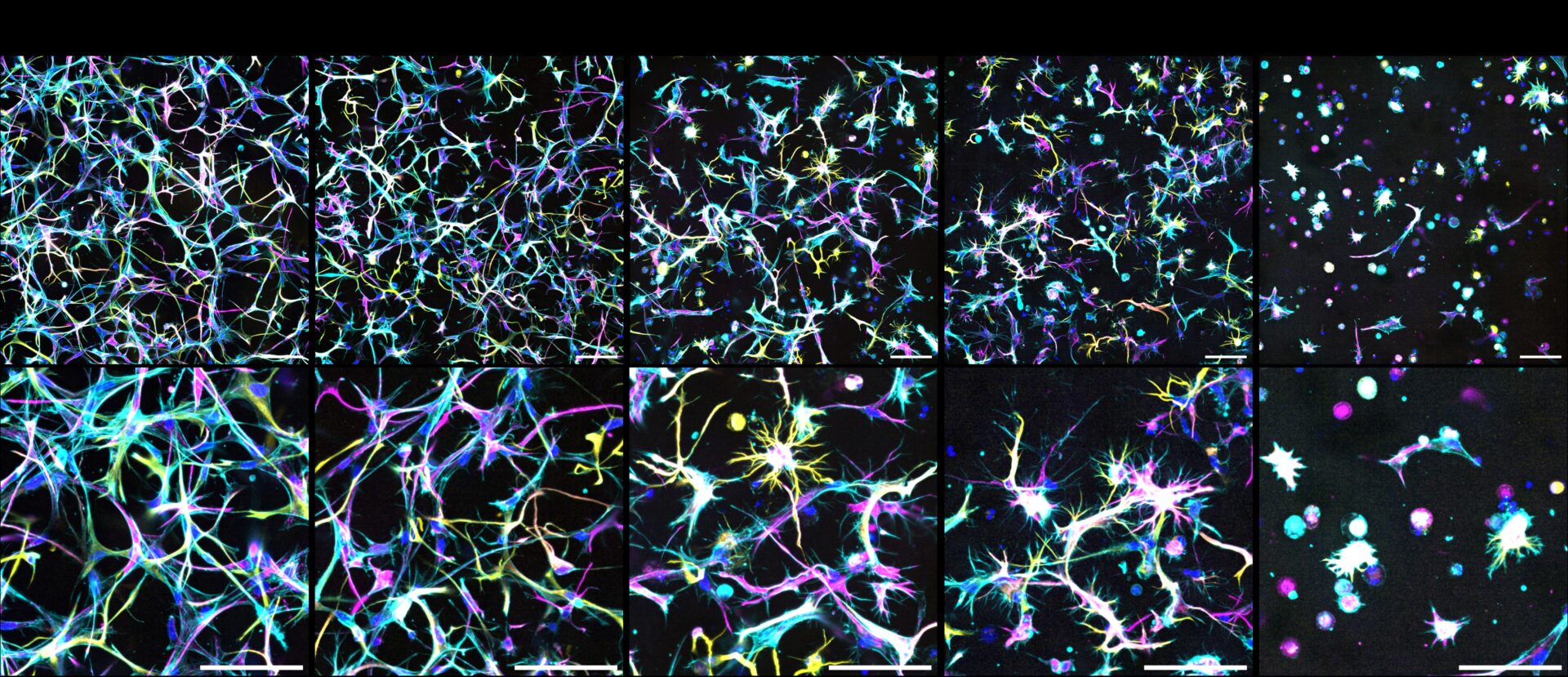
Primary human cortical astrocytes were encapsulated within double-network hydrogels with tuneable viscoelastic properties. These hydrogels were composed of a covalent network of gelatin methacryloyl and varying quantities of a reversible covalent network of gelatin-adipic acid dihydrazide and dextran aldehyde3. After 7 days of culture, the astrocyte-laden hydrogels were either (a) imaged via confocal fluorescence microscopy following fixation and staining for GFAP, S100b and F-actin or (b) processed for transcriptomic analysis through RNA extraction and RT-qPCR analysis.
By modulating the viscosity of these hydrogels, we were able to access striking astrocyte morphologies that have not previously been observed in vitro. Specifically, we observed a morphological transition along the viscosity axis, ranging from large and elongated astrocytes (low-viscosity hydrogels) to small and highly branched astrocytes (high-viscosity hydrogels). The astrocytes cultured in more viscous hydrogels exhibited a reactive-like phenotype, characterised by an increase in average process length, process number and ramification complexity. Furthermore, increasing ECM viscosity also led to significant decreases in the area, perimeter and maximum Feret diameter of nuclei within these astrocytes, correlating with nuclear morphologies previously observed in reactive astrocytes5. RT-qPCR analysis revealed that astrocytes cultured in the high viscosity hydrogels maintained their levels of GFAP, S100b, ALDH1L1 and SLC1A2, with a significantly upregulated expression of reactivity markers ICAM1, C3 and IL-6. Importantly, the absence of any inflammatory stimuli in the culture media, suggested that the pro-inflammatory state was guided by the stress relaxation of the biomaterial.
Studies are ongoing to further characterise the transcriptomic, epigenomic, and functional changes in these cultures, but our findings to date highlight the importance of matrix viscosity in modulating the morphology and phenotype of human primary astrocyte cultures. Understanding the mechanistic basis underpinning how astrocytes transduce stress relaxation cues into phenotypic changes will provide novel insights into astrocyte-ECM interactions and may pave the way for improved in vitro models (e.g., of the blood-brain barrier) and novel therapies for treating astrocyte-implicated pathologies.