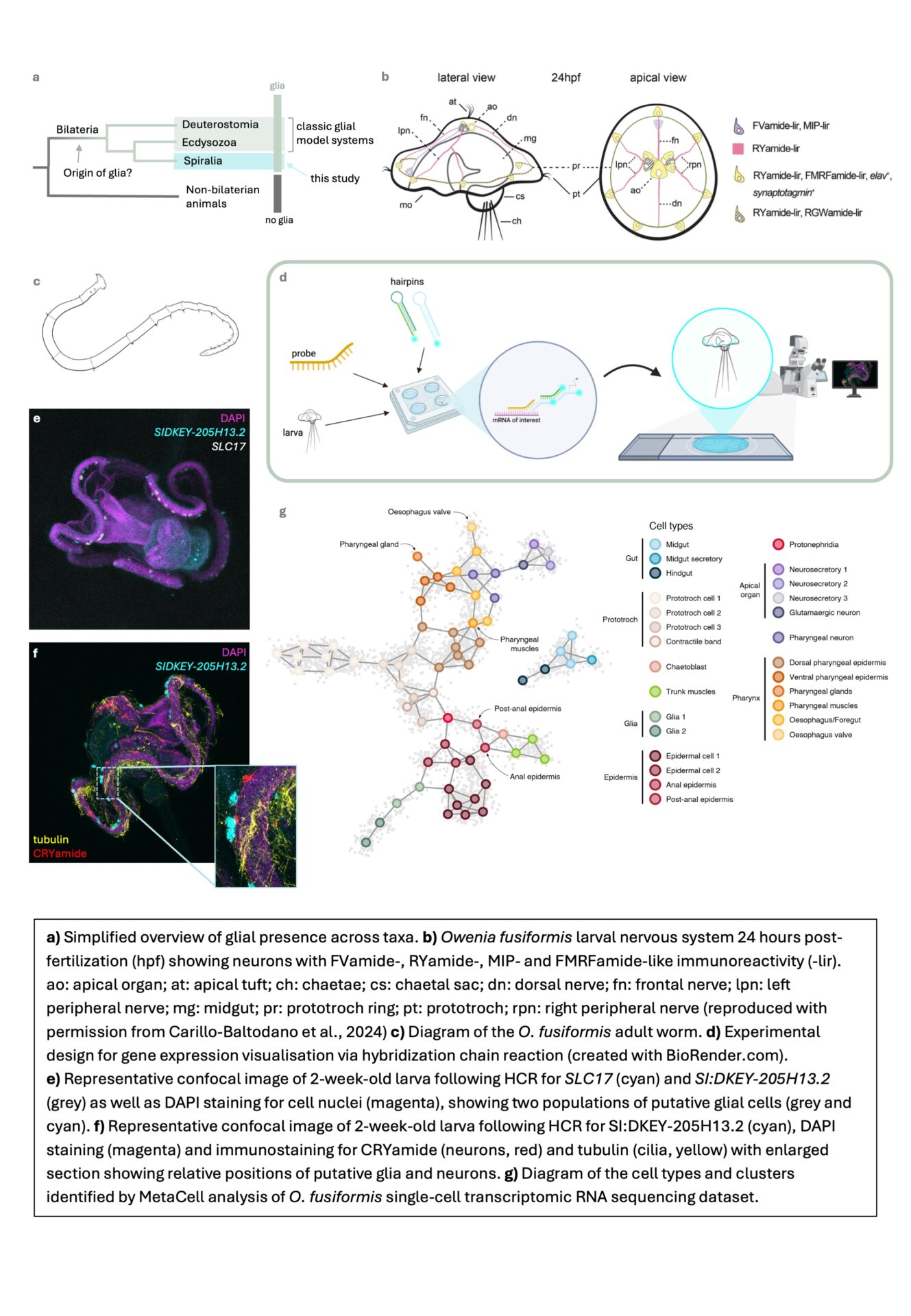
While glia studies have exploded in the last 30 years, leading to an emerging view of glia as complex and highly adaptable signalling partners to neurons, this increase in understanding has overwhelmingly focused on a very narrow range of model organisms. Across the tree of life, many animal clades and lineages remain only sketchily explored. Although glia are thought to have arisen in the bilaterian ancestor and exist across bilaterian species, the established model organisms for the study of glial physiology (including M. musculus, D. melanogaster and C. elegans) all fall within only two of the three major lineages of Bilateria. A paucity of studies has led to comparatively diminished understanding of glia in the third major lineage: Spiralia (Falcone, 2022; Piovani & Marlétaz, 2023). Addressing this imbalance by studying glia in spiralian invertebrates will provide a key piece of the puzzle for early glial evolution – a field of ongoing debate in which many questions about fundamental glial biology remain unanswered (Sheloukhova & Watanabe, 2024). In this study, we discovered and characterised a novel population of glia cells in the larvae of the annelid worm Owenia fusiformis using transcriptomics, gene expression visualisation and confocal fluorescent microscopy.
We performed single-cell RNA sequencing and subsequent computational clustering analysis using Seurat and MetaCell packages to determine the cell types present in the O. fusiformis larva (n = 400 larvae). Results of the transcriptomic analysis indicated the presence of a population of glial cells which expressed genes such as glial cells missing (gcm), the main glial cell fate determinant in Drosophila, a surprising find given the small size of the nascent larval nervous system (only 10-20 neurons at 48h post-fertilisation (when analysis was performed), Carrillo-Baltodano et al., 2024). We therefore further investigated these putative glial cells: Hybridisation chain reaction (Evanko, 2004) was used to fluorescently label expression of marker genes identified via the transcriptomic analysis, allowing for the putative glial cell population to be imaged using confocal fluorescence microscopy (n ≥ 20 larvae). We found two distinct populations of glial cells nestled along (but not overlapping with) neuronal structures in the ciliated band lining the mantle of the larva. This section of the nervous system is lost in the juvenile or adult worm and is therefore likely to perform an active physiological function in the nervous system at this larval stage rather form part of a developmental pathway. We are carrying out ongoing work to further investigate the physiology of these cells – do they arise from the same developmental precursors as neurons? What functional roles might they perform in the O. fusiformis nervous system? What differences distinguish the two subtypes of glial cells? We are currently performing lineaging as well as gene manipulation experiments to further investigate development and function of the putative glial cells, as well as comparative experiments with other annelid species. Through this work, we hope to elucidate more about spiralian glial cells and support a more balanced understanding of glial cells across the tree of life.