Background
The carotid chemoreceptors play an important role in cardiovascular regulation. In animal models of heart failure, heightened carotid chemoreflex activity is associated with increased blood pressure variability (BPV), which normalises following carotid body (CB) denervation (Del Rio, R. et al., 2013). In humans, higher beat-to-beat BPV indicates poor prognosis for cardiovascular mortality as it predicts increased risk for recurrent stroke and major cardiac events such as cardiovascular death and myocardial infarction (Webb, A.J.S. et al. 2018). Unilateral removal of CBs was shown to significantly reduce systolic blood pressure (SBP) in essential hypertensives, which was sustained in the long-term (mean ±SEM 3.1±0.6 years) follow-up investigation (Fudim, M. et al. 2015). However, whether beat-to-beat BPV is influenced by the carotid chemoreflex in humans is unclear. Therefore, the aim of this study was to retrospectively examine whether unilateral CB excision reduced BPV in people with drug resistant hypertension.
Methods
The data are from that published by Narkiewicz, K. et al. (2016), which complied with the Declaration of Helsinki and was approved by the Central Bristol research ethics committee. Fifteen people (7 males and 8 females) age 52 ±1 years with drug resistant hypertension participated in the study. Participants underwent unilateral carotid chemoreceptor excision. Beat-to-beat blood pressure was recorded during a 10-minute resting period (semi-supine) at baseline (pre-operative) and 3, 6 and 12 months post-operation. Beat-to-beat BPV was measured using average real variability (ARV) and the coefficient of variation (CoV) for both SBP and diastolic blood pressure (DBP). Only SBP ARV was normally distributed, ascertained by the Shapiro-Wilks test (alpha = 0.05), therefore all other data underwent logarithmic transformation. Data were then compared using a repeated measures one-way ANOVA with Dunnet’s correction post-hoc comparisons. Data are presented as mean ± standard deviation (SD), unless otherwise stated.
Results
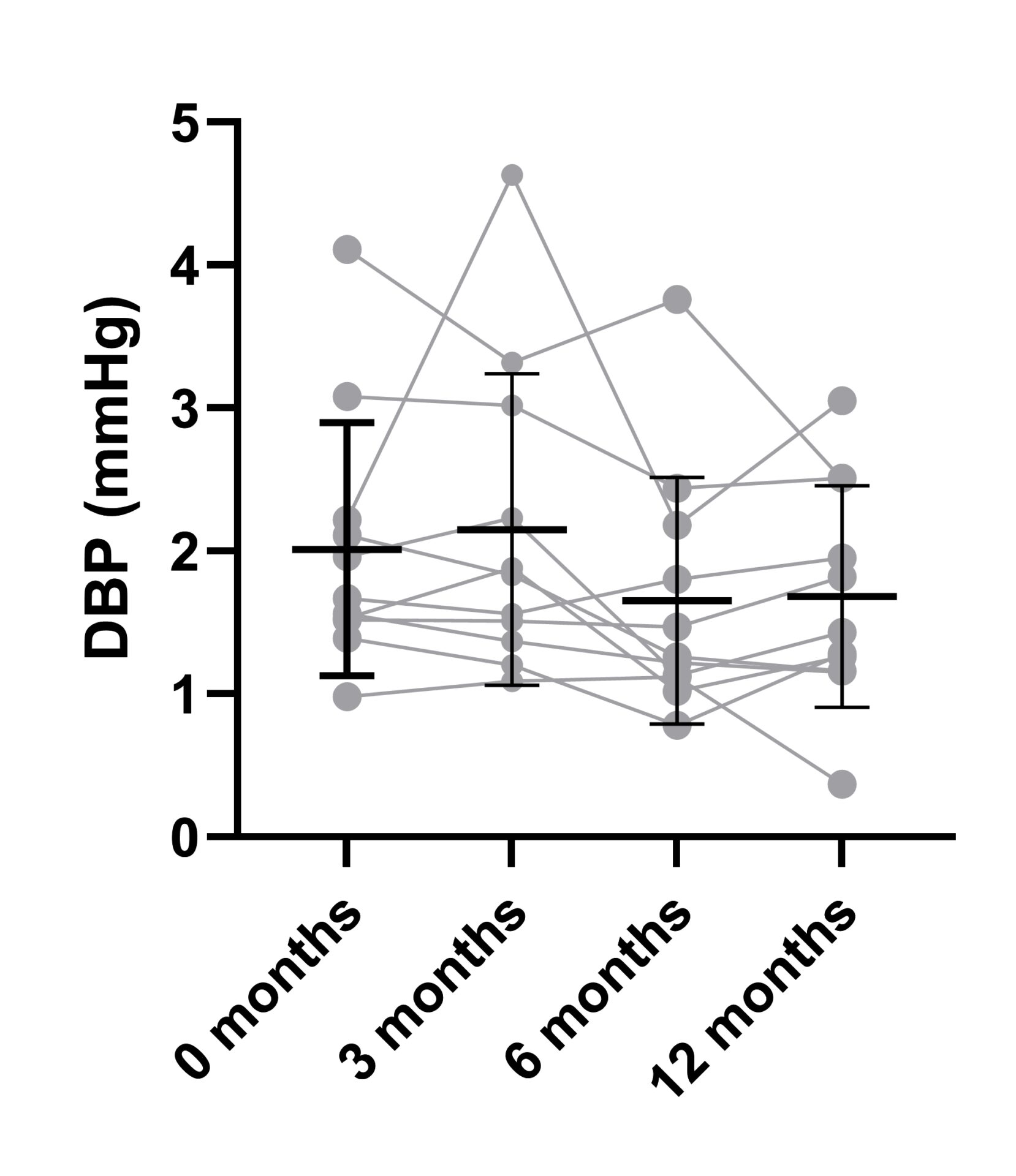
Resting SBP and DBP at baseline (pre-operative) were 165 ±38 mmHg and 81±24 mmHg. There was an effect of CB excision on the ARV for DBP (Figure 1, p = 0.411). The ARV of DBP was reduced from median 1.67 mmHg (interquartile range (IQR) 0.64) at baseline to median 1.26 mmHg (IQR 0.86 ) at 6 months post CB excision only (p = 0.0411). There were no differences in other measures of BPV from baseline to 3, 6 and 12 months post excision (p > 0.05).
Figure 1: Average real variability of DBP at baseline vs post CB excision. The ARV of DBP at baseline 0 months (2±1mmHg) is compared to 3 months (2±1mmHg); 6 months (2±1mmHg); and 12 months (2±1mmHg) post CB excision. Following logarithmic transformation, a repeated measures one-way ANOVA and post-hoc Dunnet’s correction, only baseline vs 6 months post-CB excision was significant (p = 0.041) whereas baseline vs 3 months (p > 0.05) and baseline vs 12 months (p > 0.05) were not significant.
Conclusions
There was a reduction of DBP variability in resistant hypertensives at 6 months post-CB excision, suggesting that the CBs may contribute to BPV in humans. However, this needs further evaluation in a larger cohort to determine whether targeting the carotid body will improve BPV and prognosis in resistant hypertension.